| Peace with Honor: U.S. Withdrawal |
| by John A. Scocos After years of grueling negotiations, the United States and the People's Republic of Vietnam finally signed the Paris Peace Accords marking the end of direct U.S. involvement in the war in Vietnam -- the longest war in American history. In January 1973, Secretary of State William Rogers and the North Vietnam Foreign Minister Nguyen Duy Trinh officially signed the Accords, terminating a decade of fighting. Later that year, Henry Kissinger and Le Duc Tho won the Nobel Peace Prize for their efforts to wage peace in Indochina. But behind the pomp, papers, and prize, no peace had been won. The fighting didn't stop; the war continued. In effect; the Peace Accords allowed the United States to withdraw from Vietnam, reclaim its prisoners of war, and put the onus of waging a continuing struggle on South Vietnam. It would be South Vietnam?s responsibility to prevent Communism from spreading from the north. This year marks the 30th year of the end of the Vietnam war, a conflict that altered America's perception of itself by calling into question whether we won or lost the war. It is important we remember Vietnam accurately, especially its concluding stages. The reality is that the bloody conflict raged for another two years after the Paris Peace Accords were signed and U.S. troups had departed. |
 |
 |
| President Nixon had promised an end to U.S. involvement in Vietnam. But he had struggled tremendously with how to end the war while preserving America's honor, appearing not to have been defeated militarily, and achieving the nation's foreign policy goal of containing the spread of Communism. While the idea of U.S. withdrawal seemed simple, America's conflicting goals in Paris made peace talks difficult, to say the least. The hostility between North and South Vietnam, moreover, made a peace settlement between them impossible. When the North and South Vietnamese delegations arrived in Paris to begin discussions, the two sides couldn?t even agree on the shape of the negotiating table. The North wanted a circular table to reflect that all were "equals," while the South demanded a square table to the two sides could sit on opposite ends and be represented as separate parties. Even that talk took months. When they finally agreed on a table (round with square tables on the side for staff), negotiations moved even slower. After four years, talks remained deadlocked. The North Vietnamese skirted issues while the South remained adamant on key matters, such as the withdrawal of all North Vietnamese (which the North denied existed in the South at all). The United States tried and failed to find compromise. Meantime, President Nixon slowly withdrew U.S. troops from Vietnam. Progressive U.S. troop withdrawals made the need for a peace agreement increasingly more pressing because Nixon was also anxious to move on to other foreign policy matters, such as opening trade doors with China and concluding arms agreements with the Soviet Union. Ultimately, both efforts finally spurred negotiators in Paris to action. Nixon's successful overtures to China and the Soviet Union, combined with agreements between the world's two most powerful Communist countries, convinced North Vietnam to sign for peace. North Vietnamese negotiators faced the disconcerting possibility that its two major supporters could abandon them. Rapid concessions followed. North Vietnam promised that its troops would stay in the north and agreed to the immediate return of all POWs. South Vietnam, mistrustful of the North, reluctantly agreed to the Accords. But in exchange, the United States promised military hardware -- and promised that if North Vietnam attacked, U.S. troops would return. In the end, Congress did not deliver the promised aid as the United States struggled with a financial recession in 1974 and other budget priorities. And when North Vietnamese divisions invaded the South, the United States did not return with troops. Within two years, North Vietnamese mechanized divisions rolled into Saigon. The rest is history. As U.S. involvement drew to a close, our returning soldiers took criticism -- both from those who saw our troops as the representatives of an unpopular war, and, suddenly, from supporters of the war who felt our young soldiers did an inadequate job. This will never happen in Wisconsin. Regardless of the popularity of our forei gn conflicts, we must never forget that our troops are called to serve our country and our democracy -- and must be respected for their sacrifices That's why my department has created a new program in Wisconsin called "Mission: Welcome Home." Our goal is to help returning veterans receive the support they need to readjust to civilian society with respect and dignity. We will not fail them. John A. Scocos is secretary of the Wisconsin Department of Veterans Affairs. |
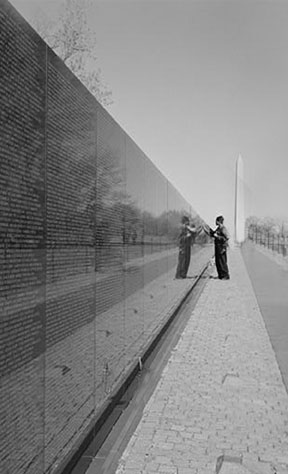
| Veterans Memorial, Washington, D.C. |
|
| to November preview |
| to homepage |