| By Laura Salinger When I was about eight, I used to ask my father what he'd been doing when Hitler rose to power, and he would reply that he'd been too busy trying to earn a living to pay attention. My mother would add that people didn't know what was going on in Germany. Now my father's generation shakes its head in dismay and wonders out loud how my generation could turn away from those values that "made America great." But they never told us that genocide was an old American habit, that U.S. soldiers scalped hundreds of Indian women and children at Sand Creek and held up their scalps at the Salt Lake City opera house; that hundreds more defenseless Indians were gunned down at Wounded Knee, that General Jake Smith ordered the massacre of 8,294 children, 2,714 women, and 420 men on the island of Samar during the American occupation of the Philippines in 1901. For me and for millions in my generation, My Lai came as the final punch in the mouth, the end of our illusions. We could no longer say we didn't know. The day we learned of My Lai changed our lives." - from "Flower of the Dragon," by Richard Boyle |
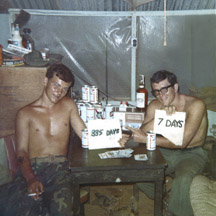
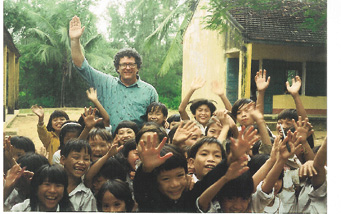
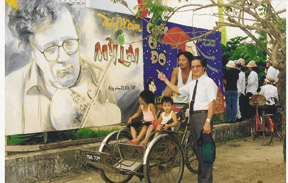
| On March 16, 1968, the men of the Charlie Company, 11th Brigade, American Division gunned down approximately 500 unarmed children, women, and older men in the Vietnamese village of My Lai. The event would become known as the most atrocious massacre of innocent villagers by American soldiers during the Vietnam War. Under the command of Lt. William Calley, American troops entered the village and were told to search and destroy. Women saddled with children and older men were forced into a ditch, where they were mowed down by relentless gunfire. Wounded children and adults were shot in the back as they tried to escape. No one, regardless of perceived threat or age, was spared on that fateful day in My Lai. For Madison-area activist Mike Boehm, My Lai has come to represent what was wrong with the war in Vietnam. "I guess I always felt that My Lai symbolized the whole war," he said. Boehm spent much of his life trying to escape from his role in the Vietnam War. In recent years, he has been trying to atone for it. Although he did not take part in the events at My Lai, he is burdened by a relentless sense of guilt over the events of that day and other atrocities that occurred during the Vietnam War. He is also burdened by anger toward a government that he says duped its children. ";I came from a small town in Wisconsin," Boehm said. "I volunteered for the war to please my father. I, like so many others, didn't really learn anything about the war while I was there. We were duped, as children, to do evil." After returning from Vietnam, Boehm began to learn more and more about the events and circumstances surrounding the Vietnam War and became more and more frustrated with his country. In the summer of 1977, he gathered his uniform and medals from the war and threw them in the garbage. He refused to continue paying his MATC (Madison Area Technical College) tuition with money from his GI bill. Boehm essentially turned away from society for a number of years, living in a shack with no plumbing or electricity and working odd jobs as a carpenter. Boehm had spent a long time wondering how to channel his anger and bitterness into something productive when he was given the opportunity to help rebuild houses and villages on the island of Vieques, Puerto Rico, in the aftermath of Hurricane Hugo. Inspired by the experience, Boehm began to wonder if he could put his carpentry skills to use in Vietnam. He joined a team of carpenters from the Veterans Vietnam Health Restoration Project to help build clinics in Vietnam. Thus began his lifelong passion to help the people of Vietnam. Boehm has been instrumental in creating two peace parks in Vietnam to honor war victims and offer hope for the future. On March 16, 1998, the 30th anniversary of the My Lai massacre, Boehm and Vietnamese officials broke ground for the My Lai Peace Park. Set on close to five acres, the peace park was inspired by Boehm?s other project, the Vietnamese-American Peace Park north of Hanoi. "This is not a monument to war," Boehm said. "It is a green, living tribute to peace." The peace park was a concept foreign to the people of Vietnam, who are used to the war memorials that dot their country. "They have war memorials up and down their country," Boehm said. "They have never considered a peace park before." The peace parks are a catalyst for healing for both Americans and Vietnamese. The Vietnamese-American Peace Park dedication in 1995 brought together American Vietnam veterans and Vietnamese veterans. They paired off, one Vietnamese and one American, to plant a tree together. Boehm quotes his friend, an American Vietnam veteran, as saying; "When I stood on that hill after planting my tree and embracing my former enemy, I felt that I could finally start to heal." It is a sign of hope, Boehm said. "To plant a tree, you have to have some hope for the future." Boehm is also responsible for establishing a number of loan-fund programs in villages throughout Vietnam. Currently supported by the Madison Quakers, the loan-fund program has helped nearly 3,000 women in 16 villages throughout Vietnam, including My Lai. The loans are often used by women to purchase cows or nets and small boats for fishing. Boehm has also been involved in coordinating the construction of three primary schools in Vietnam. A fourth such project is on the way. Through programs like these, post-war life in Vietnam is improving. But there is still a long way to go. Boehm still sees the devastating effects of Agent Orange when he visits Vietnam and witnesses the vast array of health ailments affecting both young and old. Many people are still living in poverty, and there is still a need for healing after the war. Then there are the people like Boehm. He went to Vietnam to serve his own country. He continues to go back to help heal theirs. "It is so important to me to be doing this work," he said. "It is my own personal offering." |
| After the Vietnam War: Healing of hearts Mike Boehm's tribute to peace |
 |
 |
 |
 |
 |
 |
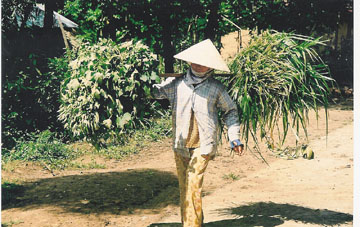 |
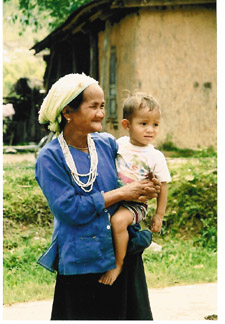
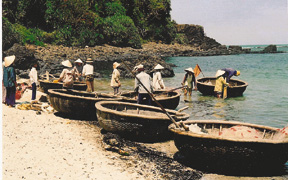
| Photos of present-day Vietnam |
 |
 |
| back to homepage |
| to Nov. 2005 preview |