| Dr. Judith Ladinsky: U.S.'s unofficial diplomat to Vietnam by Maryam Ghayyad |
| "It's become something of a joke," Ladinsky says of Peterson's quip. But the fact remains that few ambassadors can boast a career as full as hers. Ladinsky's 25 years of hands-on effort to improve social conditions in Vietnam have incorporated a panorama of disciplines -- from preventive medicine to biotechnology to education to agriculture. Although Ladinsky built much of her career abroad, the foundation of her ongoing intellectual relationship with Vietnam was established in Wisconsin. In 1968, she earned a Ph.D. in reproductive physiology from the University of Wisconsin-Madison. Seven years later, she became an associate professor of population health sciences and international health at the UW School of Medicine. During the 1970s, her research played a central role in the design of northern Wisconsin's rural health system. It wasn't long before her work in primary care networking earned her an international reputation. "In 1980, I got a call from the then chair of the U.S. Committee for Scientific Cooperation with Vietnam (USCV), and he asked me if I was willing to go to Vietnam," she recalls, her eyes widening at the memory. "That was right after the [Vietnam] war. And I thought, "How fascinating it would be to do that." Apart from her opposition to U.S. military intervention in Vietnam during the war, Ladinsky says that, initially, she knew little about the culture or social conditions of the South Asian nation that would become the focus of her career. After committee founder and chair Dr. Edward Cooperman recruited her to help Vietnam's Ministry of Health develop primary health-care services in Vietnam's villages, she combed the campus libraries for information about the country. "There was nothing there," she recalls. "Oh, some army books -- but that's about all." Then there were the political obstacles. During her first few years of cooperation with the committee, the U.S. trade embargo frustrated Ladinsky's efforts to transport medical supplies to Vietnam. "At that time it was very difficult to work with Vietnam, because anything we brought, I had to get a license from the Commerce Department to take it to Vietnam," she recalls. "So I had to fill out piles and piles of papers and send them to Washington to get permission to bring these things." Postwar tensions exploded four years after Ladinsky agreed to collaborate with the committee when Cooperman was murdered by a Vietnamese-American student -- ostensibly because of his cooperation with Vietnam's communist government. Determined to continue his work, Ladinsky assumed Cooperman's chairsmanhip. Over the years, Ladinsky has helped the U.S. Committee for Scientific Cooperation with Vietnam build a thriving clinical infrastructure and establish joint-research and primary-care programs in pediatrics, corneal surgery, nutrition, and HIV/AIDS and cancer treatment. She is currently assisting Vietnam's National Institute of Health and the World Health Association with applied research on an avian flu vaccine. When she recalls the challenges of her early work, Ladinsky is encouraged by the progress she and her colleagues have made. "Oh, my gosh, it's getting much better," she says of present-day social conditions in Vietnam. They're building a lot. They'e increasing their tourist trade. They say now that if you know what you're doing, you can find anything in Vietnam." As much as Ladinsky might want to believe that, however, she knows better. On her frequent trips to the country, she says, she retraces the same north-to-south journey she has been making for years, visiting medical centers and villages to gauge the progress of the programs she helped nurture. Requests for supplies quickly fill her notebooks. "When I go to the hospitals and research centers, I say, 'What's my homework this time?" she says. "And they tell me." Sometimes hospital staff and researchers ask for medical literature or surgical equipment, she says, and other times they have more unusual requests, such as unfertilized cow ova for animal husbandry or human organs for transplants. When she returns to the United States, Ladinsky compiles the requests as a multipage "wish list" that will serve as her inventory checklist when she returns to Vietnam. Beyond her work providing health workers with much-needed medical supplies, Ladinsky has organized medical and scientific exchange programs, through which Vietnamese physicians visit American medical schools to learn surgical techniques and treatment options. She also helps send Vietnamese patients to American hospitals to receive treatments they may not have access to in their homeland. "I was notified that there was a child that got severely burned in a nursery school in Vietnam, so I brought her to the United States to be taken care of," Ladinsky recalls. "And I've done that for a number of patients." As part of her committee's mission to promote Vietnamese students' attendance at American universities, Ladinsky's Vietnam Educational Exchange Program (VEEP) administers the TOEFL (Test of English as a Foreign Language) exam twice a year in Vietnam to more than 1,200 students. Thanks to the program, 580 Vietnamese students are attending American universities. Ladinsky's efforts have always been met with gratitude. She won recognition from Vietnamese President Tran Duc Luong in 1999 for her work in science and technology, and she received another medal in 2001 for her commitment to improving education. In 2004, Vietnam's Ministry of Health awarded Ladinsky a medal in recognition of her dedication to the health of the Vietnamese people. Later that year, Ladinsky was recognized for her support of the training of Vietnam's women scientists. Not surprisingly, Ladinsky seems to love Vietnam as much as Vietnam loves her. "The people of Vietnam are very independent," she says. "They want the transfer of technology, but they want to do it themselves. Not "I want to have foreigners come and build the hospital, equip the hospital, staff the hospital." They want the knowledge, and they will then do it themselves. And that's the kind of thing I respect very much." As she looks forward to her 96th trip to Vietnam in December, Ladinsky is eager to expand the exchange of ideas that has been her mission for more than two decades to serve Vietnamese medical researchesr' growing interest in emerging fields of science. "Right now, the Vietnamese want very much to be able to be part of the world scene," she says. "So they're interested in genomics; they're interested very much in biotechnology -- but biotechnology to improve the life of the people" Ladinsky doesn't know when her 100th trip will be, but she says she anticipates a celebration. "Everybody is waiting for my hundredth trip so that they can have a big party," she laughs. |
 |
 |
| She has been called "Madame Vietnam" and lauded as "the best-known American in Vietnam"; she's even been compared to a globe-circling dove. And Dr. Judith Ladinsky still laughs at the memory of how she earned the title "first ambassador to Vietnam" six years ago when, during a speech at a banquet in her honor, United States Ambassador to Vietnam Douglas 'Pete' Peterson told guests that Ladinsky, not he, was Vietnam's real "first ambassador." |
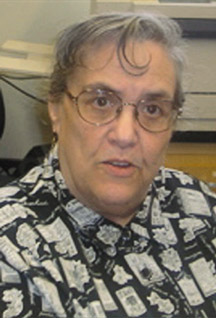
| Dr. Judith Ladinsky |
|