
by Jonathan Gramling
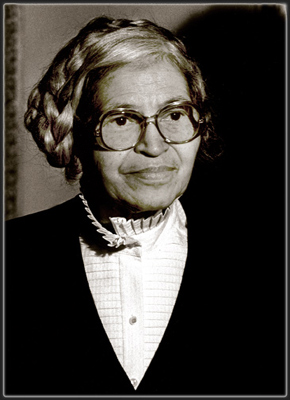
I must admit, at this point, that my perspective on Rosa Parks is heavily influenced by the words and poetry of Nikki Giovanni who spoke at the YWCA's Racial Justice Awards banquet in 2003.
Rosa Parks, according to Giovanni, was the One who sparked the Montgomery Bus Boycott in December 1955 that would eventually propel Dr. Martin Luther King Jr. to national prominence. When Parks refused to go back to the back of the bus on December 1, 1955 in compliance with Montgomery's racial segregation laws, she sparked a bus boycott that lasted the better part of a year and led to the successful desegregation of Montgomery's buses.
Nikki Giovanni said that Rosa Parks was the One because others had been ticketed before. Rosa was the first to be jailed. The igniting of Black Montgomery's collective outrage happened as much because of who Rosa was as much as the humiliation of being told to move further back into the "Coloreds Only" section at the back of the bus.
Black Montgomery perhaps wouldn't have had the same unified reaction if it had been Harry the barber down the street who also cheated on his wife or Sally the preacher's wife who talked negatively about everyone else behind their backs.
Rosa Parks' refusal to sit at the back of the bus still reminds me of Mahatma Gandhi's walk to the sea. The people of India were forced by their British occupiers to pay a tax on salt, the only condiment the poor had to season their food. In order to protest this unjust tax, Gandhi and hid supporters walked well over 100 miles to the sea where he scooped up some sea salt and proclaimed his civil disobedience to the British occupiers of India. This simple act unified Hindu India into a nonviolent course of action that led to the downfall of British occupation and Indian independence.
So too, Rosa Parks' simple, yet powerful, refusal to go to the back of the bus coalesced the 1950s Civil Rights Movement that led to the destruction of America's apartheid -- Southern segregation -- a decade later. Rosa Parks was the One.
We will miss Rosa Parks' physical presence and mourn this connection to our civil rights past. However, her spirit symbolizing the eternal human urge to be free, will live on in the history books and in our hearts forever. Rest Rosa Parks! You are free!
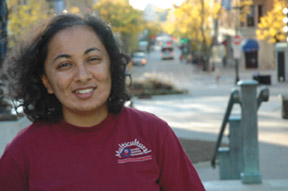
Pabitra Benjamin was one of those graduating high school seniors who stand out. While I wrote about dozens of high school seniors of color graduating with a 3.0 GPA or higher each year, Benjamin stood out for the level of social activism that she exhibited during her studies at West High School. Her level of activism jumped off the page.
Five years later, at the Dashai 2062 Celebration -- the Nepali Hindu festival in honor of the goddess Durga -- held at the Eagle Heights Community Center on October 15, I met Benjamin and still remembered her activism. I was curious whether or not she still had that activist fire and got her to agree to an interview. We met outside a coffee house on State Street, but the noise of the buses interfered and so we retreated to the relative quiet of a bench on the capitol grounds.
Benjamin came to the United States from her native Nepal at age seven. Her mom is Nepali and her father Euro-American. "We moved to Chapel Hill, NC, and then Bloomington, Ind., Urbana, Ill., and then back to Nepal in a very different context," Benjamin said. "I was very American by that time. When I moved here, I didn't know a word of English. Now I only speak English. I do speak some Nepali. We moved back here to Wisconsin under some real bad circumstances." Those circumstances were political oppression back in Nepal.
While she identifies herself as American, Benjamin grew up in a household where they ate Nepali food, had Nepali friends over, and went to Nepali functions. "It's really hard because you know you're not totally an American," Benjamin said. "You know you are a little bit. But you have been raised in a household that isn't like every other household in the U.S."
Benjamin can trace her interest in activism to the year she attended Sun Prairie High School when her mother tried to establish a Nepali restaurant there. Benjamin became involved in the Bridges program that was led by Steve Levine, former head of PICADA. The Bridges program allowed Benjamin to open up and see a broader world out there. "They would take us out of classes once a month and they would have us discuss these issues," Benjamin said. "'What were we facing in the school?' They had White students and students of color in there talking about race and gender. That really pushed me to think about these issues more intensely. They wanted us to do youth organizing in the city of Sun Prairie around loitering issues. That really got me involved. And then you meet and it's all about networking. People recommend you to go to another group because they realize you are really dedicated and you can do the work. That was really the defining moment, that group and being with those students, talking about these issues."
When the family moved back to Madison, Benjamin attended West High School and remained an activist. Benjamin and her classmates raised the level of activism at West to another level. Many student organizations including the Gay/Straight Alliance and Shoulders-to-Shoulders were established during this era. And, in Benjamin's view, they made student activism acceptable at West. "My class really pushed more activism to the point where it became something normal for people to do," Benjamin reflected. "When we were doing it, it wasn't a normal thing. It was like 'Oh my God, you all are really out there as high school students.'"
Benjamin was also involved in Multico, a student theater group that was being formed at the time. It had a big impact on Benjamin and on succeeding generations of students. "Still today, I will have kids come up to me who are now in college or high school and saw me when they were in elementary or middle school," Benjamin said. "They will say 'I remember you.' And I will ask who they were. And they'll say 'I saw you in this play.' And the play and the message stick to them. I wish there were more of that. Even when we do radical plays or we do speeches or panels, if you don't take it to an audience, it's the same people who keep coming back. And to whom are you really teaching? You're just preaching to the choir. There is some point to that. But you need things like theater to go out in a fun way to convey a message to people. I would love to be able to do an assessment of the impact of Multico to see how a lot of these kids changed. '
It was during her high school years that Benjamin opened up to her mother and revealed to her that she was gay. Benjamin was very fearful that her mother would reject her. "My mom was going to hate me and she is so Nepali," Benjamin recalled feeling. "But I didn't know what that meant. I would like to learn about how gender and sexuality works in different cultures. When I came out to my mother, she said, 'I know. You don't think I know? I've known for a long time. I don't like that you didn't tell me.'"
While Benjamin wanted to skip college and go directly into community organizing when she graduated from West, her mom prevailed upon her to go to college, using a guilt trip that there are many children back in Nepal who would love to go to college, but didn't have the chance.
While attending the University of Wisconsin-Madison where she received a B.A. degree in Political Science, Benjamin networked with other student activists, including Shaka Barrows who was the driving force behind the creation of the Multicultural Student Coalition (MCSC). "Even though Shaka and I would fight here and there, he was really my mentor," Benjamin said.
After Benjamin graduated from UW-Madison, she continued to be a social activist, joining Action Wisconsin in its campaign to defeat the proposed amendment to the Wisconsin state constitution to ban gay marriage and civil unions that will most likely be on the ballot in November 2006 at the same time that Governor James Doyle and Congresswoman Tammy Baldwin are up for reelection. Some would say this is not a coincidence.
While Benjamin signed on to the effort, she hasn't personally been overly concerned with gay marriage even though she is a lesbian. "When the whole issue about "gay marriage"was pushed, I was like 'Come on, gay people have so many other things to worry about,'" Benjamin said. "I was talking about poverty in the LGBT community or the gentrification, all these issues. Unfortunately, if you really want to organize, you're still somewhat working for 'The Man.' There are only certain things that are funded to organize around. And I am someone who needs income. I ended up getting this job because I thought maybe I could take a unique stance in looking at fighting against this ban."
Benjamin feels that this battle is about a lot more than "gay marriage" and civil unions. "'Gay marriage' is not going to be my main battle for the next 20 years," Benjamin said. "But the ban itself is pretty detrimental. What people don't realize about the constitutional ban is the people who would be affected the most are poor people. Some people say, 'No, it's just for people who have a retirement benefit or has a house that their partner should get.' But really, we're talking about that and basic health care. We're talking about if you have a job or if your place offers a heath care benefit, why can't your partner get in it? You can fight for health care in general, but it's also about caring for your child. There are stories of man and a man or a woman and a woman couple raising a child and only one of them has custody. And if they have to take them to a hospital and they don't have the papers, they aren't the ones who have 'ownership' over the child; it's hard for them to get service for the child. Even though they are raising the child, they don't have the authority as an actual parent. Everything comes down to the law and what the law allows."
Benjamin has found in her organizing that most people, once they get beyond the initial sensationalism of "gay marriage" and talk about all of the issues, become supportive of her efforts. "This would be the first time that discrimination is legalized in the constitution, not just in the law," Benjamin emphasized. "I had an argument with someone who thought the constitution was meant to discriminate because it sets the precedence of what people can and cannot do. But I told them no because it talks about rights. It's an uphill battle that is being fought right now. The hard thing is that most people will let their prejudices come first. They'll hear gay and say 'Oh, no!' Right away the first thing that pops into their mind is 'That's gross.' The good thing is that once you start talking to people, start talking about the legal ramifications of discrimination and life as it is, people understand and are willing to move if they themselves haven't thought a lot about the issue. Most people will say 'I'm not for gay marriage, but I won't vote for this ban.' The hard part is you don't have a conversation with everyone about it. The media coverage is five-minute snippets or not even a sound bite, so you don't get to hear all the stories."
Benjamin is pretty cynical about the motivations behind the constitutional amendment. "The Republicans in the House and Senate have decided to vote on it a second time and they are going to pass it again next spring just in time for the ballot when the governor is up for re-election," Benjamin said. "They really do believe this issue will turn out the conservative vote. They believe this issue helped get Bush in office. They think it is a sure bet. To me, they don't really care one way or the other about gay marriage. It's always about staying in power to them. This is just another way to divide people and communities."
After the Action Wisconsin effort ends in November 2006, Benjamin is considering a trip back to her native Nepal because of the freedom movement that is currently taking place there. "I'm starting to get interested in how I can get more involved in the politics in Nepal because there is a lot of stuff going on in Nepal," Benjamin reflected. "The next step is to save some money and go back and live there for a year and get involved. I want to be a part on what is going on there. People are very nice to me when I go back. There is so much energy there, that I want to go back and be a part of it."
Ever since Benjamin attended high school in Sun Prairie, social activism has been in her blood. "I was working with students of color and with White gay students and with everything in between," Benjamin recalled. "From there, I haven't been able to stop. It's almost like an addiction."
There is always another battle to be fought; another cause to rally around; and a need for true believers like Benjamin to rally people to do the right thing.
Jonathan Gramling is the award-winning former editor of a multicultural community newspaper in Madison, Wis. Watch for "The Capital City Hues" special insert in the December issue of Asian Wisconzine. Jon can be reached at gramljon@aol.com. -Ed.
