

After the spotlight faded
During the past 25 years, I've almost considered the wrath of hurricanes -- and the relief recovery efforts afterwards -- to be business as usual, just a part of the natural ebb and flow of the seasons. I have probably been influenced by too many insurance commercials that show their portable office placed right in the midst of the devastation handing out checks on the spot and the television images of houses being quickly repaired.
There were interviews with African American homeowners from the area whose homes were leveled. There was no reconstruction going on. These homeowners didn't have insurance. And those that did might find that the small print in their policy excluded flood damage. They will have to start from scratch with the only resources at their disposal being what the federal government may or may not give them. And the way our government seems to be acting these days -- Halliburton already got their multimillion-dollar contracts -- the little property owner might be last in line waiting for the leftovers.
There already is talk about interests from California buying up property in New Orleans -- sight unseen -- based on where it is on the map. And with last spring's U.S. Supreme Court ruling that municipalities can condemn people's property through eminent domain and sell (give?) the land to private development interests, who knows what kind of shenanigans might happen during the planning for the redevelopment of New Orleans. It just may be the poor -- mostly African American -- folks who experience a real tragedy after the tragedy of Katrina.
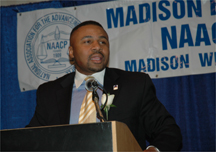
The NAACP, the Congressional Black Caucus (CBC), and other African American organizations are keenly aware of the dynamics that may play out in New Orleans and are poised to aid the residents and fight for their rights. John Jackson, chief policy officer for the NAACP was in Madison October 19 for the Madison branch's Freedom Fund Banquet. After his talk, he sat down with me to discuss the NAACP's efforts to aid the residents of New Orleans. NAACP President/CEO Bruce Gordon sat down with other civil rights leaders to develop a call for action. "At the top of that list was giving citizens the right to return to New Orleans and the right to participate in the rebuilding process," Jackson said. "We're talking about somewhere between $60-$100 billion going to that community. Those community advocates and those from the New Orleans community should have the right to help rebuild it and return to their homes. We've been working with some attorneys to give the citizens first right of refusal over any commercial developer."
The NAACP has established command centers in Houston, Baton Rouge, Gulfport, Miss., and Fort Walton, Fla. to ensure the equitable distribution of resources. Since Katrina struck, the NAACP has raised over $1.5 million to finance its relief efforts. Its first order of business was to help meet the immediate needs of the victims. "We have been providing food and connecting citizens with shelter," Jackson said. "We've provided airline tickets for over 100 citizens to reunite them with their families. We're providing housing assistance and educational grants as well as direct assistance grants to help families reconstruct some level of normalcy over the next couple of months."
The next order of business will be to ensure that the small property owners are benefiting from the reconstruction efforts. When asked about eminent domain concerns, Jackson stated that the NAACP was monitoring the situation. "The city would like to use that eminent domain to try and claim some of the land," Jackson said. "But again, if that takes hold, the NAACP will be in court fighting that battle on behalf of those citizens. They should have the right to return to their home. They should have the right to vote for their elected officials. We just have to make sure that opportunity and access back to New Orleans is provided to them."
The NAACP is supportive of the CBC's legislative proposal to aid the Katrina victims. The Hurricane Katrina Recovery. Reclamation, Restoration, Reconstruction and Reunion Act of 2005 (HR4197) was endorsed by all 42 members of the CBC and introduced to the House on November 5. The Katrina Recovery Act is a comprehensive proposal that includes a number of key economic and housing titles in it. This bill would establish a Victims Compensation Fund under the control of a special master. "The special master's job would be to determine what compensation is necessary to restore each individual Hurricane Katrina claimant to his or her pre-Katrina condition," the act states. The special master would be required to offset recoveries to each claimant from collateral sources (insurance, government sources, etc.) and would be authorized to accept non-government funds to help reduce the financial burden on the Federal government." This fund could go a long way to ensuring that the poor homeowners will remain a part of New Orleans' future.
The act goes further than just restoring New Orleans to its pre-Katrina conditions. It would also incorporate housing programs that would improve the living conditions of the poor of New Orleans and the rest of the Gulf Coast. It proposes over $2.5 billion in housing and community development assistance including $1 billion in HOME funds and another billion in CDBG funds.
Yet, even if the relief and redevelopment resources are there and steps are taken to ensure an equitable benefit, Jackson is concerned that many residents may not be there to take advantage of it because of media speculation that many people will not return, creating a self-fulfilling prophecy. "To some degree, the speculation begins to discourage individuals," Jackson said. "I read in a couple of articles where they are projecting 50 percent will not return. There has to be some level of responsibility in reporting, recognizing the impact of those reports could determine the life or death of individuals. It could determine whether or not individuals have the right to return to their property."
Jackson is confident that the residents will return. Why is he so confident? As a former resident of New Orleans, Jackson knows the heart and soul of its people. "The people of New Orleans have a special love for the city," Jackson emphasized. "The hardest thing to do is to get someone from New Orleans to leave New Orleans. I believe that the people will return to New Orleans."
What the future of New Orleans holds and what kind of city it will be will depend upon the residents of New Orleans and their allies like the NAACP and the CBC.
The NAACP is still accepting donations for its Katrina Relief Fund. To find out how you can donate, visit the NAACP Web site at www.naacp.org.
