| But they both lived the same nightmare, each spending more than a decade in prison for crimes they did not commit. Recently, these men had their names cleared and were released from prison thanks to the Wisconsin Innocence Project, a program of the University of Wisconsin Law School. On October 19, as part of the Voices Beyond Bars program, these two men and some of the lawyers and students who fought for their freedom spoke about their experience at the South Madison Library in S. Park St. in Madison Their stories are fantastic, even more so the faith they still have in America and humanity as a whole despite their having suffered the worst of both. UW law professor and co-director of the Wisconsin Innocence Project Keith Findley spoke first, introducing the students who worked on the Project and then explaining how two innocent men -- and countless others like them -- could become convicted, and how Project Innocence was able to free them. Steven Avery's erroneous conviction was a result of mistaken identity compounded by sloppy police work. On a summer day in 1985, while Avery was working and running errands with his family, a woman was attacked, sexually assaulted, and nearly murdered on a beach in Manitowoc County. When the woman was able to give a description of her attacker, the resulting sketch looked remarkably like Avery. The resemblance was not lost in the small community in which Avery lived, and later that night he was arrested by the police and remained in their custody for more than 18 years. The witness confirmed Avery as her attacker in two visual tests; first selecting him from eight pictures, and later in a line-up in which Avery was the only man also in the original set of pictures, the only blonde man, and the shortest. The unfortunate result of these manipulated line-ups and similar tactics, Findley explained, is to create a 'tunnel vision' effect in witnesses, causing them to focus on one likely suspect and become more certain of their imperfect memories as lineups and police questioning focus around details that they originally provided themselves. Unsurprisingly, it is faulty eyewitness reports that lead to most wrongful convictions. Eyesight and memory are both far more fallible than most people think, and Findley proved this point by asking his audience to watch a video of two teams of students playing basketball and count the number of successful passes. After a minute, Findley stopped the tape and asked if anybody in the audience had noticed anything unusual. He replayed the tape again, pointing out what almost the entire audience had missed while focusing on the balls: a man in a huge, hairy gorilla costume had walked right across the middle of the screen, pausing briefly to dance. But it was not shoddy lineups and shaky eyewitness testimony that led the Wisconsin Innocence Project to fighting for Avery's freedom. Many other factors that should have kept him from prison came to their attention: There was confirmation from friends, family, and retail staff at the places he shopped of his alibis; and a convicted sex offender on parole with a strong resemblance to Avery had committed virtually the same crime several years previously at the same location, and had been insufficiently monitored on the day of Avery's arrest. With so many third parties -- including Avery's own 'victim,' who had met him after his conviction and did not believe him to be attacker -- attesting to Avery's innocence and a likely suspect for the real criminal, the students and faculty of the Wisconsin Innocence Project decided to take Avery's case and used the modern methods that are continuing to revolutionize criminal law: DNA evidence. Ten years ago, a cruder form of DNA testing was done on scrapings from the victim's fingernails, which neither confirmed nor denied Avery's presence at the scene of the crime. With that physical source of evidence depleted, the Innocence Project was left with only 13 decades-old hairs to find the proof they needed. Eleven of the hairs lacked the root which was necessary for testing. Of the two remaining, one proved to be female, likely the victim's. Finally, on September 10, 2003, lab results for the final hair were released, proving Avery's innocence, as the hair in fact belonged to Gregory Allen, the sex-offender resembling Avery, who had gone on to commit more sexual assaults and was already serving a 60-year sentence for them. Christopher Ochoa's experience in being arrested for a murder in Austin, Texas was, if possible, even more frightening because his wrongful conviction was deliberate and most likely racially motivated. The murder had of course been big news when it occurred, and so when Ochoa and his friend Richard Danzinger found themselves eating at the same Pizza Hut where the murder had occurred, it is not surprising that they discussed and conjectured as to the motivation. Employees at the Pizza Hut found the two men -- one Caucasian and one Mexican American -- suspicious and called the police. Ochoa and Danzinger became the prime suspects, and were interrogated for days. The officer interrogating Ochoa was Mexican American himself, and told him that he was sure to get the death penalty if he didn't confess. Ochoa recalled the officer saying "somebody has to pay for it. The community wants someone to die," and that it would certainly be the Hispanic and not the White. The officer tapped his vein, indicating where the lethal injection would go, assuring him that they had evidence and that Danzinger had already confessed (neither was true). During that time, an unknown person repeatedly called Ochoa's mother at home, telling her to "make him confess or you will lose your son." Eventually, the frightened Ochoa became convinced that his only choice was life in prison or execution and so he signed a confession the police had written out for him full of fabricated details. With a signed confession, Ochoa had little chance of overturning his conviction, and the attorneys he had access to were not inclined to help him. Ochoa thought his luck might change when the man who had actually committed the murder, Achim Josef Marino, underwent a religious conversion in prison (while serving time for crimes committed after the one Ochoa was blamed for) and began sending letters to authorities at all levels declaring his own guilt and urging that Ochoa and Danzinger be released. Still, despite this confession, and despite the fact that the mother of the victim had met and spent time with Ochoa and insisted that he was not the culprit, nobody was interested in fighting for him. Until Ochoa wrote a letter to the Wisconsin Innocence Project. The Project fought an uphill battle to retry Ochoa with the new confession and DNA evidence to back them up. Ochoa's own attorney at the time scoffed, insisted that he was guilty, and declared that "his fingerprints were all over the weapon," which of course they were not. But after several months, the Project succeeded in proving that and Ochoa was released -- but perhaps a little too late for Ochoa's friend Danzinger, who had suffered serious brain damage as a result of a prison beating. Having explained the circumstances surrounding their wrongful imprisonment and eventual release, Keith Findley stepped down so that the two men could speak in their own words. Avery spoke in a low, quiet, steady voice, giving a step-by-step reconstruction of his last day of freedom and his time in custody, as he slowly lost his friends and family to a terrible mistake. He developed an intense hatred for the system that had put him wrongfully behind bars, but as he stepped out into the fresh air and freedom after 18 years, accompanied by friends and a daughter who had been less than a week old when he was imprisoned, he felt lightheaded and swore that all the anger left him immediately. Ochoa spoke about the fear he experienced during the interrogation, and the despair and loss he felt throughout his 12 years in prison. The interrogation was especially unnerving because Ochoa, an honor student who "had been to the principal's office once," had never before been on the wrong side of the law. The pain in his voice relented only when describing the few people who had made his life in prison bearable, including Jeanette Popp, the victim's mother, and one of his cellmates who had been a good friend and always helped him laugh ? although Ochoa found out later the man was a member of the Mexican mafia serving time for several murders. The Wisconsin Innocence Project is still fighting to free the unjustly imprisoned and change the methods -- such as undue reliance on eyewitness testimony and the practice of not recording interrogations -- that are causing them. As of last year, they have help from a man with exceptional experience in the area of wrongful imprisonment: Christopher Ochoa began studying law after his release and is now a member of the Wisconsin Innocence Project, saving others like himself. For more information on the Wisconsin Innocence Project, visit http://www.law.wisc.edu/fjr/innocence/. Writer's Note: Shortly after this event at South Madison Library, Avery was arrested for the murder of Teresa Helbach, a freelance photographer. Considerable evidence was found in Avery's possession and the family's property, including the victim's SUV. As of this writing, Avery claims his innocence, saying that he is being framed because he has filed a case against the county for his wrongful imprisonment for 18 years. |
| The Wisconsin Innocence Project: Righting wrongs and saving lives in the name of justice By Ben Freund |
 |
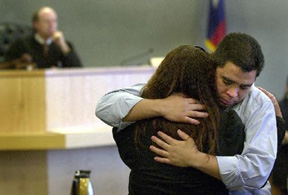 |
| (Above photo) Steven Avery experiences freedom for the first time in 18 years, one month, and 13 days. (Right) Christopher Ochoa embraces his mother upon finally being declared innocent. |
| Chris Ochoa and Steven Avery do not appear to have a great deal in common. They come from different backgrounds, and before their lives took a tragic turn, they pursued different lives: Ochoa was a promising young honor student while Avery was a hardworking family man with five children. |
 |
| Homepage |
|
| November '05 Issue Preview |