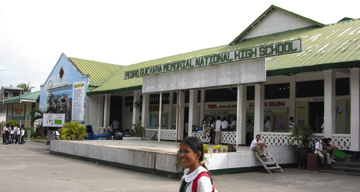
| During my recent trip to the Philippines, I went to my hometown, Santa Cruz, in the province of Laguna, a beautiful place south of Manila. The reason was to visit my relatives and my high school, Pedro Guevara Memorial National High School. This is where I learned the basics of journalism as features editor of The Lagunian, the |
| My province is famous for being the birthplace of Jose Rizal, the Philippines' national hero; its tourist attractions like Pagsanjan Falls and Hidden Valley Springs; wood carvings of Paete; the hot springs in Los Baņos; Caliraya Lake; Makiling National Park; and the internationally known University of the Philippines' Colleges of Agriculture and Forestry. Most of all, Laguna is well known for being one of the first provinces to join the Philippine Revolution against Spain. Thoroughly exposed to the writings and work of its most famous son, Jose Rizal, who was shot in Bagumbayan in 1896, thousands of Lagunenses lost their lives in their search for freedom. When the Philippine-American War erupted (1899-1901), folks from my province did not take it sitting down either. While it was a hopeless cause, the sense of patriotism/activism has been planted in the hearts of succeeding generations. During the American regime (1901-1941), Laguna progressed rapidly as roads and schools were built, including a railroad service up to the town of Pagsanjan. |
| On this visit, I saw new developments -- widened highways, malls, and trade centers. Being very close to the center of the Philippine government and business -- Manila -- has its advantages. However, the once huge lands of green ricefields are now housing subdivisions, resorts, or corporate offices. Laguna de Bay has a fishing industry that has attracted big business as well. That's probably one reason some relatives who used to depend on fishing for their livelihood have switched occupations. Nevertheless, I was happy to see the same lush forests of Mt. Makiling, still with the magical curve of legendary Maria Makiling on its peak. |
| The Iglesia Filipina Independiente |
| It was a hot and steamy Friday afternoon in March, but the woman selling candles at the gate of the church called Iglesia Filipina Independiente along Mabini Street seemed not at all affected by it. After all, this climate is what we have always had in the Philippines, whether it's rainy or dry season. "Bili na kayo ng kandila," (Please buy some candles) she smiled as she offered her candles to me. She had a small child with her, just like "Aling Nita" ? the woman who used to sell candles on the same spot in the '60s. It isn't uncommon for street vendors in my hometown to carry their children with them while "working." Some things never change. |
| The Iglesia Filipina Independiente (Philippine Independent Church) is also called Aglipay Church, named after the Filipino Catholic priest Gregorio Aglipay who severed his ties from Rome and started his own "Filipino Independent Church." This church rode the tide of anti-Spanish friar nationalism and was supported by the Katipunan revolutionary leader Emilio Aguinaldo, who became the first president of the Philippines in 1898. Formally organized in 1902, the Iglesia Filipina Independiente succeeded in attracting into the fold one out of every 16 diocesan priests and one out of four Filipino Catholics in its early years. Its members dwindled, however, as soon as more Filipinos and Americans replaced Spanish priests. Today, the Iglesia still exists, though its membership is much smaller compared to the Catholic Church. Be that as it may, its roots from the revolutionary period against Spain would forever be part of Philippine history. It was founded by Filipinos themselves because of their desire to be free -- religiously, politically, and socially. My parents got married in this church and I was baptized here, too. I remember coming to this church every Sunday with my mother and younger brothers. My mother left this church to become Catholic when my parents broke up in the early '60s. In my young mind, I thought my mom must have believed that moving to another church would help rebuild her life -- as well as ours. |
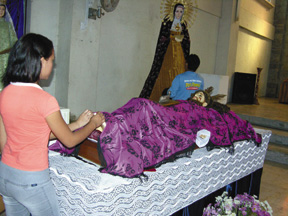
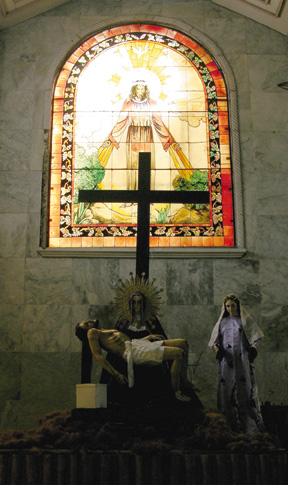
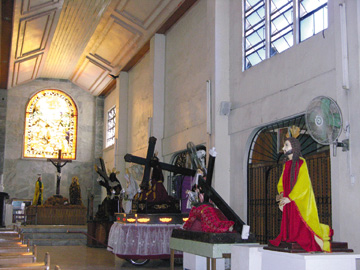
| I went inside the renovated church and saw that nothing much has changed. There was the life-size image of Jesus, the Nazarene, the Church's patron, lying down and covered with a an embroidered dark purplish silk blanket, handcrafted so well that one can guess the long hours spent to perfect it. People lined up to kiss the Nazarene's "bloodied" feet and hands, while others recited their novenas or the rosary before the figures of Mother Mary. The right aisle of the church facing the altar was lined with life-size images of Jesus. They are mounted on carts during processions. You see, in my hometown, evening processions are much-awaited community gatherings during religious festivals, such as Christmas, Easter, and saints' birthdays. The streets would brighten up with people in two rows carrying lighted candles, praying and singing, accompanied with a community brass band. The saints' images, wheeled between these rows and lighted with electric bulbs powered by generators, are said to remind the neighborhood to go to church, thank God for blessings, and praise Him by loving others and leading a Christian life. |
| I remember being part of such numerous processions while growing up. I couldn't help but say a prayer of thanks. I know that part of me carries values that I had learned long ago from this church. Christianity is Spain's colonial legacy, but the Iglesia Filipina Independiente added a local flavor to it and a sense of nationalism and love of freedom that put this church apart from any other. |
| The streets of Santa Cruz |
| Santa Cruz is a first class urban municipality in the province of Laguna, and it is also the seat of the provincial government. Because it was developed as a commercial, administrative, and service center, my hometown is the heart of Laguna and the first stop for people who are going to other parts of the province. |
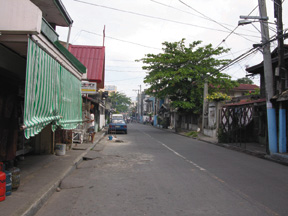
| Initially, I thought the streets were narrower and the town looked smaller, but then I noticed there were many more buildings and vehicles. (Aside from passenger jeepneys that clogged the streets, there were many tricycles that literally choke their passengers when the engines are running.) The elementary and high schools I attended had several annex buildings around their original buildings. My hometown has also been invaded by McDonalds, KFC, Burger King, Pizza Hut, Wendy's, Western Union offices and other familiar American corporations. If the clogged streets and heavy traffic were an indication of progress, then my hometown must be bustling with business. It has become part of the global community. But I missed the part of my youth when I didn't have to cover my nose and mouth with a handkerchief while crossing the streets of Santa Cruz. |
| Pedro Guevara Memorial High School |
| As in many societies, education is at the top of every family's list; and in my culture, we were "required" to do the best we can if and when we are fortunate enough to get an education. For poor families like mine, having an honor student among the children is a sign of "future wealth" of sorts. As the eldest in the family, I was also "required" to be the role model for my siblings. |
| I became the features editor of The Lagunian, the official publication of PGMHS, not only because involvement in extracurricular activities gave a student vying for honors additional "points" when final ratings came, but more so because I loved (and still do) to write. I found writing as an expression of my soul. I discovered early on that things my culture wouldn't allow me to say could be expressed in writing, with much more force and effect. Through writing, I also honed my communication skills, something that truly helped me get ahead. This I told Noel Surbano, current adviser of the school's paper, who spoke with me during my visit to PGMHS, now a nationalized high school. Surbano was glad to know that one alumna of the school actually applied her learning from a small, non-credit journalism class in high school. I learned that journalism is now a regular credit course in PGMNHS, and that The Lagunian has been reaping honors for the school, including this year's top national journalism awards for Surbano and PGMHNS student Roannne Jemae Yara. |
| It was great to learn that more and more students in my hometown are attracted to journalism. I am proud that my high school, my alma mater, is at the forefront in developing good writers among students. It may not be a future career for many of them; but the training, discipline, focus, and communication skills The Lagunian provides will be very handy in whatever field they pursue, and wherever in the global community they find themselves in. |
| I went back to just say, "Thank you," because I was one of the few who took that road after high school and never regretted it. |
| A traveler's journal/ by Heidi M. Pascual My hometown, my province |
 |
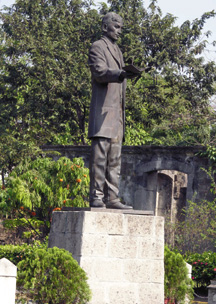 |
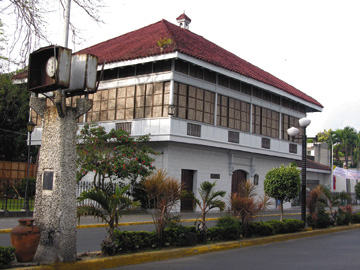
| Jose Rizal, the Philippine National Hero, came from my province; His home in Calamba, Laguna (r). |
| school's official publication. I wanted to share with my school the product of that learning - Asian Wisconzine. On my way "home," I thought of my province's rich history and the things that made me proud of it. When I reached my hometown, I found myself getting off in front of the church on the street where I was born. Laguna, my province (lalawigan or probinsiya, Fil.) Laguna was named after Laguna de Bay, a freshwater lake which separates it from the northern provinces and Metro Manila. When I was a child, I would look at the map with awe, comparing it to an open palm of the hand with a "giving" spirit because of its rich natural resources, including forests and scores of rivers. Water has always been my province's greatest resource, capable of generating energy for the expanding power needs of towns and cities. |
 |
 |
| A devotee prays before the Nazarene. |
 |
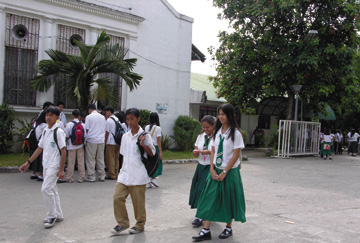 |
| "This is where I built my dream for my future," I told myself while I was entering the gate of Pedro Guevara Memorial High School (PGMHS). For four years (1964-68), I worked very hard at getting high grades in order to graduate with honors. |
 |
 |
 |
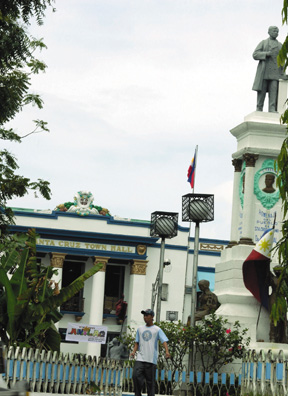 |
| (Left) Santa Cruz town hall; (r) Mabini Street; inside Aglipay Church |