| There are 105,300 Asian American doctors, and a small number of them are cardiothoracic surgeons. Dr. Paramjeet S. Chopra of Madison, Wis. is one of these few. Recently, Dr. Chopra received the 2006 Lifetime Achievement Award for Humanitarian Service by the Association of Indians in America, Wisconsin Chapter because of his distinguished medical service for more than 30 years not only to the people of Wisconsin through the UW-Hospital and Clinics but also to the medical students at the University of Wisconsin. In addition, his humanitarian service has extended to lesser-privileged people of Nicaragua, by performing life-saving complex heart surgeries there. Born in Punjab, Dr. Chopra was exposed early on to the idea of entering the medical profession by his parents. "Your career is directed by your parents; that's the custom in our part of the world," Dr. Chopra admitted to this writer in a recent interview. "It was the most valuable thing, in addition to their encouragement." Seriously pursuing this "direction," Chopra was fortunate to have received merit scholarships that helped him complete his medical course in the University of Calcutta in the early '60s. Shortly thereafter, Dr. Chopra trained in general surgery at New York State University for seven years, and at the University of Michigan in cardiac surgery. Recalling his first surgery, Dr. Chopra said, "It's very awe-inspiring. I admired my mentors and teachers, both in New York and in Michigan. I assisted for many years and then gradually was given greater responsibility as I progressed." He went back to India, but found that "there wasn';t much opportunity to do the forms of complex surgery" that he had trained for, so he returned to the States. As a cardiothoracic surgeon, Dr. Chopra does all forms of open heart surgery: aneurysms, coronary bypass, and valve replacements and repairs. Does he have many Asian Americans under his care? "I have been fortunate to be asked to do some of the work that falls into the category of cardiac surgery for our fellow Asians," Dr. Chopra said. "Fortunately they are quite well and healthy because of their eating habits." The good doctor, however, warned, "But they do change because they come here and adopt the high-cholesterol diet, so one has to be careful." The University of Wisconsin Medical School has been Dr. Chopra's professional home for more than 35 years for a reason. "It's a leading medical school; it's nationally known in medicine in various aspects -- in cancer, in cardiac and general surgery, in trauma, and last but no means the least, in cardiac and pulmonary transplantations," Dr. Chopra explained proudly. "We are among the leaders in the country; in fact the solution for the preservation of the heart (the so called 'UW solution&' used for transporting the hearts from donors across the country) was invented here, right across the hall from here by the cardiovascular and renal team." Describing his most challenging and unforgettable experience as a cardiothoracic surgeon, Dr. Chopra said, "If I were to recall the surgeries that I've done, which are really rather too numerous to remember, I think it was when I was actively doing pediatric surgery. Operating on newborns was one of the most challenging things in my profession." And the most satisfaction? "The biggest reward is to be able to tell the family members that you were successful, and I don't think anything can overshadow that kind of joy," he said. &"But in difficult cases, the sorrow is also hard to share, but it's also rewarding to be able to comfort the families in rare cases or difficult, complex situations, that we may not be able to help." In the area of adapting to modern technology in complex surgery, Dr. Chopra described it as "part of the practice," and that while there are a lot of technologies that are usually not suitable or long lasting, his work requires him to "use and keep up with all developments." Although his specialization makes him one of the most sought-after medical professionals in the state and in the country, Dr. Chopra highly respects and has good words for general practitioners. "General practitioners in any country are the backbone in the medical care system. They are the people in the forefront and without them, I think medical care would suffer tremendously," he said. "They are the people who do most of the difficult work, and they also recognize patients who may need a special form of care and surgery. That's when they refer them to the appropriate medical center where specialists can take care of them. The overall care of the patient has been superbly done in this country and many countries of the world by family doctors or general practitioners, so they are one of our most valuable team members." Dr. Chopra may not be a primary physician, but he quickly asserted that his "door is open" to anyone who needs his help. "We can help and direct patients to any further areas where specialized diagnostic work may be needed. If "they need any cardiac care especially, we are here to help." The problem, he said is that the information may not be available readily to people who need help. "Especially among people from Cambodia or Laos, they may not know about resources available to them. It would be great if they know that there is a place, there is a number they can call, that they can come and be taken care of if they need the cardio aspect of health care." The doctor has a philosophical thought for fellow Asians in America. "I am very fortunate to be a part of the Asian community. I think we have a lot to contribute and we are a group of people who have brought our traditional cultures to this great land and have also benefited from being here," he said. "This is now our country and it has given us the opportunity available for everybody." Dr. Chopra also encourages Asian American youth to consider going into the medical field like he did. "I encourage our young people to try to explore the medical field, to feel being a part of this culture, and to never feel that you can't achieve something that you put your mind into," he advised. "I think you would make superb physicians. Our cultural and family guidance are such that you are eminently suited to this field ... and also to other fields." To our general readers, Dr, Chopra's advise is: "Take care of your health; there's nothing like it," he asserted. "For those who may need cardiovascular care, our division is always willing to help in any way we can. This University and our division welcome people with open arms." As we concluded this interview, Dr. Chopra shook my hand firmly, with a smile that seemed to come from his heart. Dr. Chopra may be reached at: UW Medical School, Department of Surgery, H4/350 Clinical Science Center, 600 Highland Avenue, Madison, WI 53792; (608) 263-6054; chopra@surgery.wisc.edu. |
| Dr. Paramjeet S. Chopra An Indian American humanitarian |
| by Heidi M. Pascual |
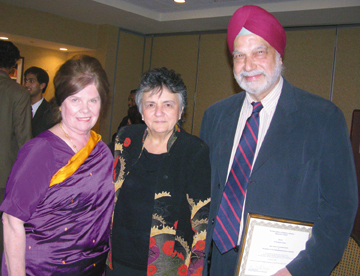 |
| Dr. and Mrs. Paramjeet S. Chopra with Supreme Court Chief Justice Shirley Abrahamson at the AIA awarding ceremony on April 28 |
 |