Page Title


A Travelogue
Italy in all its glory
Italy in all its glory
Part 1
By Susie R. Cuñada
Ricky and I got back from our “Best of Italy” Tour last October 2nd. There is no other way or word to
describe it. It simply is fantabulous that I would go back in a heartbeat. It is a living museum – in
that its public structures comprise vivid, visible art and architecture that stand as testaments to the
country’s history and culture, and where its tangible and timeless legacies can be witnessed in
every major Italian city and town. That’s how much I loved it. In fact, I pine for it – still.
Rome
Sistine Chapel
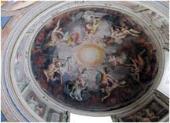
After going through the exhibits at the Vatican Museum, we moved into the Sistine Chapel. We
were read the riot act about not talking, not taking photos, and not pulling the pigtails of the girls
sitting in front of us. Then we filed in.
My first impression was that it was dark in there. The only light came from windows in the
walls high above the floor. But it was absolutely stunning and it was one of those moments one
never forgets. Every available space, either on the walls or on the ceilings, was filled with
frescoes. I stood there in the middle and looked around while considering the history that had taken
place there, realizing that ordinary men became Popes right where I stood. Or that one of the
greatest artists in history poised himself on scaffolding directly above my head and painted the most
famous fresco in history. It was a powerful moment. Once again words cannot describe the
frescoes in this room. You have to see it with your own eyes to be able to experience goose bumps
on your body. For me, it was one of the highlights of the trip. Although the time given does not
allow you to see everyone of them, sensory overload was taking over anyway, so I sat or stood
there for 20 minutes getting a neck ache looking at the ceiling, yet feeling overwhelmed of it all.
St. Peter’s Basilica
After the Sistine Chapel, we were then led into St. Peter’s Basilica. As soon as we entered, I
By Susie R. Cuñada
Ricky and I got back from our “Best of Italy” Tour last October 2nd. There is no other way or word to
describe it. It simply is fantabulous that I would go back in a heartbeat. It is a living museum – in
that its public structures comprise vivid, visible art and architecture that stand as testaments to the
country’s history and culture, and where its tangible and timeless legacies can be witnessed in
every major Italian city and town. That’s how much I loved it. In fact, I pine for it – still.
Rome
Sistine Chapel
After going through the exhibits at the Vatican Museum, we moved into the Sistine Chapel. We
were read the riot act about not talking, not taking photos, and not pulling the pigtails of the girls
sitting in front of us. Then we filed in.
My first impression was that it was dark in there. The only light came from windows in the
walls high above the floor. But it was absolutely stunning and it was one of those moments one
never forgets. Every available space, either on the walls or on the ceilings, was filled with
frescoes. I stood there in the middle and looked around while considering the history that had taken
place there, realizing that ordinary men became Popes right where I stood. Or that one of the
greatest artists in history poised himself on scaffolding directly above my head and painted the most
famous fresco in history. It was a powerful moment. Once again words cannot describe the
frescoes in this room. You have to see it with your own eyes to be able to experience goose bumps
on your body. For me, it was one of the highlights of the trip. Although the time given does not
allow you to see everyone of them, sensory overload was taking over anyway, so I sat or stood
there for 20 minutes getting a neck ache looking at the ceiling, yet feeling overwhelmed of it all.
St. Peter’s Basilica
After the Sistine Chapel, we were then led into St. Peter’s Basilica. As soon as we entered, I

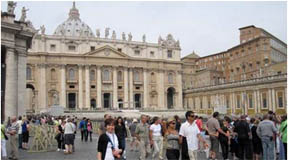
was immediately blown away by its sheer size. Words can't adequately
explain it and even pictures don't do it justice. One really must stand at
one end and gain the sense of length, width and depth all at once. The
magnificence of the interior can only be described by actually being
there. Sun streamed into the dome from the large windows embedded in
it while casting brilliant rays against the gold trim of the base. We then
worked our way back to the rear of the church and took shots of
Michelangelo's Pieta, which is an unbelievable work of unsurpassed
genius. I simply couldn’t take it all in, moved by the majesty of the place.
In short, it was overwhelmingly powerful!
As one observer wrote: "St Peter's Basilica is the reason why Rome is
still the center of the civilized world. For religious, historical, and
architectural reasons, it by itself justifies a journey to Rome, and its
explain it and even pictures don't do it justice. One really must stand at
one end and gain the sense of length, width and depth all at once. The
magnificence of the interior can only be described by actually being
there. Sun streamed into the dome from the large windows embedded in
it while casting brilliant rays against the gold trim of the base. We then
worked our way back to the rear of the church and took shots of
Michelangelo's Pieta, which is an unbelievable work of unsurpassed
genius. I simply couldn’t take it all in, moved by the majesty of the place.
In short, it was overwhelmingly powerful!
As one observer wrote: "St Peter's Basilica is the reason why Rome is
still the center of the civilized world. For religious, historical, and
architectural reasons, it by itself justifies a journey to Rome, and its
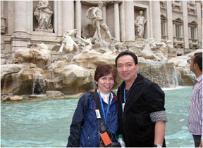
And as you can imagine, the Trevi was packed!!! We had to fight our way to get down to the fountain level so we could throw the
traditional coins over our shoulders with a wish to return to Rome.
After taking the perfunctory photo op, we walked over to the nearby gelato shop to have our first taste of the much talked about
gelato. Besides, there is an unwritten law in Italy that you have to eat gelato at least once a day, and that’s exactly what we did.
Anyhow, in the same plaza area we saw the Colonna di Marco Aurelio, a massive obelisk/column inscribed with the exploits of the
Roman Emperor that unfold in a spiral pattern along its length. It was beautiful!
The Pantheon
A short walk from there put us in front of the Pantheon. The first massively domed structure in the world built by Hadrian 2000
years ago, it is still impressive today with its oculus opening in its ceiling. Since the Renaissance, the Pantheon has been used as a
tomb. Among those buried there are Raphael, King Vittorio and King Umberto (whose tomb is shown below). The building is now a
basilica.
I scurried over to Raphael's tomb. Raphael was a gifted painter of the Renaissance but his private life was more colorful than his
many paintings. Evidently he had quite a reputation with the ladies and his activities had much to do with his shortened life span. It's
often interesting to think about stories like this. I've always pictured the great masters who most often created works having to do
with biblical topics as being righteous, conscientious men of honor. Obviously that wasn't the case in many instances, Raphael chief
amongst them.
Fontana dei Quattro Fiumi
Continuing our walking tour, we went through an alley and entered into the famous Piazza Navona. This may have been the
busiest place in Rome in olden times. Once the site of the old chariot races and the Circus Agonalis, the plaza is now dominated by
the Church of Saint Agnes and Bernini's most spectacular fountain, Fontana dei Quattro Fiumi, or “The Fountain of the Four Rivers”.
The four gods on the corners of the fountain represent the four major rivers of the world known at that time: the Nile, Danube, Ganges,
and Plate. Apparently there is a story that Bernini and the architect of the adjacent church, Borromini, were not fond of each other and
as a result, Bernini had one of his fountain characters covering his face in horror at the church. It's all false, of course, as the fountain
was built before the dome of the church, but it makes for great theater. I chose to ignore the facts and bought the more interesting story
-- hook, line, and sinker.
Assissi
I noticed that the scenery along the valleys on the ride to Assisi was phenomenal. Little villages were perched on bluffs in the
green slopes along the Autostrada. We then arrived at St. Mary of the Angels Church where St. Francis lived and later died and
established his Franciscan Order.
But Assisi is much more than a pretty hill town. Thousands come to worship in Assisi's magnificent churches, and to pray to
Francis of Assisi, a much-beloved saint.
The Basilica of St. Francis-
The church is located at the end of a long colonnaded plaza. Inside are large
traditional coins over our shoulders with a wish to return to Rome.
After taking the perfunctory photo op, we walked over to the nearby gelato shop to have our first taste of the much talked about
gelato. Besides, there is an unwritten law in Italy that you have to eat gelato at least once a day, and that’s exactly what we did.
Anyhow, in the same plaza area we saw the Colonna di Marco Aurelio, a massive obelisk/column inscribed with the exploits of the
Roman Emperor that unfold in a spiral pattern along its length. It was beautiful!
The Pantheon
A short walk from there put us in front of the Pantheon. The first massively domed structure in the world built by Hadrian 2000
years ago, it is still impressive today with its oculus opening in its ceiling. Since the Renaissance, the Pantheon has been used as a
tomb. Among those buried there are Raphael, King Vittorio and King Umberto (whose tomb is shown below). The building is now a
basilica.
I scurried over to Raphael's tomb. Raphael was a gifted painter of the Renaissance but his private life was more colorful than his
many paintings. Evidently he had quite a reputation with the ladies and his activities had much to do with his shortened life span. It's
often interesting to think about stories like this. I've always pictured the great masters who most often created works having to do
with biblical topics as being righteous, conscientious men of honor. Obviously that wasn't the case in many instances, Raphael chief
amongst them.
Fontana dei Quattro Fiumi
Continuing our walking tour, we went through an alley and entered into the famous Piazza Navona. This may have been the
busiest place in Rome in olden times. Once the site of the old chariot races and the Circus Agonalis, the plaza is now dominated by
the Church of Saint Agnes and Bernini's most spectacular fountain, Fontana dei Quattro Fiumi, or “The Fountain of the Four Rivers”.
The four gods on the corners of the fountain represent the four major rivers of the world known at that time: the Nile, Danube, Ganges,
and Plate. Apparently there is a story that Bernini and the architect of the adjacent church, Borromini, were not fond of each other and
as a result, Bernini had one of his fountain characters covering his face in horror at the church. It's all false, of course, as the fountain
was built before the dome of the church, but it makes for great theater. I chose to ignore the facts and bought the more interesting story
-- hook, line, and sinker.
Assissi
I noticed that the scenery along the valleys on the ride to Assisi was phenomenal. Little villages were perched on bluffs in the
green slopes along the Autostrada. We then arrived at St. Mary of the Angels Church where St. Francis lived and later died and
established his Franciscan Order.
But Assisi is much more than a pretty hill town. Thousands come to worship in Assisi's magnificent churches, and to pray to
Francis of Assisi, a much-beloved saint.
The Basilica of St. Francis-
The church is located at the end of a long colonnaded plaza. Inside are large
interior offers a palimpsest of artistic styles at their best..." I couldn’t agree more.
Colosseum
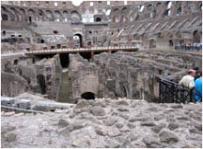
The Colosseum is an amazing place. The impression you may have from the outside
belies what you see on the inside. The "stage" level of the interior is exposed, so you can
see (and imagine) the underground corridors where animals and performers gathered before
appearing on the stadium floor. Many animals or performers were hoisted up to this level on
pulleys or other ancient "lifts" or elevators, similar to what you may have seen in the movie
"Gladiator" when the tigers popped out of trap doors to attack Russell Crowe. Of all the
monuments in Rome, the Colosseum thrilled me the most. It was here that gladiators met in
mortal combat and condemned prisoners fought off hungry lions. This great symbol of
eternal Rome still excites the imagination as you'll see from the hordes of people waiting to
get in.
Walking Tour
The Trevi
During the walking tour and, as expected, we were ushered over to the Trevi Fountain.
I've never grown tired of looking at pictures of anything in Rome, particularly the Trevi, and
seeing it in person for the first time was as exciting as I had imagined it to be. The enormity
of it and its seeming contextual problems with its neighborhood made for a surreal moment.
The panorama was phenomenal. I could not believe I was in Rome, walking through Italian
squares with great people. I loved it!
Colosseum
The Colosseum is an amazing place. The impression you may have from the outside
belies what you see on the inside. The "stage" level of the interior is exposed, so you can
see (and imagine) the underground corridors where animals and performers gathered before
appearing on the stadium floor. Many animals or performers were hoisted up to this level on
pulleys or other ancient "lifts" or elevators, similar to what you may have seen in the movie
"Gladiator" when the tigers popped out of trap doors to attack Russell Crowe. Of all the
monuments in Rome, the Colosseum thrilled me the most. It was here that gladiators met in
mortal combat and condemned prisoners fought off hungry lions. This great symbol of
eternal Rome still excites the imagination as you'll see from the hordes of people waiting to
get in.
Walking Tour
The Trevi
During the walking tour and, as expected, we were ushered over to the Trevi Fountain.
I've never grown tired of looking at pictures of anything in Rome, particularly the Trevi, and
seeing it in person for the first time was as exciting as I had imagined it to be. The enormity
of it and its seeming contextual problems with its neighborhood made for a surreal moment.
The panorama was phenomenal. I could not believe I was in Rome, walking through Italian
squares with great people. I loved it!


frescoes by the artist Giotto and, as with all the basilicas, unbelievably ornate
woodwork and ceilings. There are basically three churches built more or less one
atop the other as part of the complex. Francis is buried in the lower chapel. The
guide gave us a brief overview of what we would see in the lower chapel and
then we descended through the mid-level church into the lower chapel. It was
very crowded in the small chapel with pilgrims filling the pews and many walking
up through the main aisle and around the altar containing the sarcophagus of St.
Francis. It was a bit eerie, frankly, and we quickly made our way to the altar,
making a U-turn, and then back out again.
Spello
Soon thereafter, we were on our way for an optional tour of a cute little town of
Spello, which is just in the outskirts of Assisi. If you want to experience the
charm of a small Italian village and live like a local for a few days, then Spello is
the place to be.
From a distance, the medieval town of Spello seems to melt down the hill
which it graces. Tiny stone houses that dot the Umbrian countryside form this
mesmerizing and charming town. Only occasionally do tourists stop in Spello; it’s
not part of the "usual" foreigner’s travel itinerary. It’s one of those places that if
you happen to drive past, you feel compelled to detour and discover. Mostly,
Spello exists for the locals. But it’s that small town charm that the accidental
tourist finds endearing.
Spello is a pleasure for those who love walking. Three well-preserved
Roman stone arches form the entry points to the town: Porta Venere, with its
towers, Porta Urbica and Porta Consolare. Once inside, the cobblestone streets
meander in and out of mysterious alleyways that lead to simple, yet elegant stone
houses.
Venice
I was looking forward to see Venice, a city which I had always been obsessed
with, because I always felt it was a marvel of engineering that it even existed.
Being a hopeless romantic sap that I am, the idea of wandering the streets while
visiting little shops or traversing the canals via a gondola really appealed to me.
Anyhow, we arrived in Venice under sunny skies and proceeded to the gondola
area beside the bus parking lot. I don’t care how touristy you think it is, but riding
in a gondola is part of the Venetian experience and something you must do at least
once in your lifetime. Anyhow, they were stashing 5 or 6 of us into each gondola.
Our gondolier, who was a little too good looking and charming to be believed,
navigated us through the labyrinth of canals that make up Venice. What struck me
most about Venice was the muffled silence around me. There were no cars or
scooters and not many motorized boats. All you hear is the swish of the gondolier
poles and your boat as it cuts its way through the water. Looking up at the scenes
woodwork and ceilings. There are basically three churches built more or less one
atop the other as part of the complex. Francis is buried in the lower chapel. The
guide gave us a brief overview of what we would see in the lower chapel and
then we descended through the mid-level church into the lower chapel. It was
very crowded in the small chapel with pilgrims filling the pews and many walking
up through the main aisle and around the altar containing the sarcophagus of St.
Francis. It was a bit eerie, frankly, and we quickly made our way to the altar,
making a U-turn, and then back out again.
Spello
Soon thereafter, we were on our way for an optional tour of a cute little town of
Spello, which is just in the outskirts of Assisi. If you want to experience the
charm of a small Italian village and live like a local for a few days, then Spello is
the place to be.
From a distance, the medieval town of Spello seems to melt down the hill
which it graces. Tiny stone houses that dot the Umbrian countryside form this
mesmerizing and charming town. Only occasionally do tourists stop in Spello; it’s
not part of the "usual" foreigner’s travel itinerary. It’s one of those places that if
you happen to drive past, you feel compelled to detour and discover. Mostly,
Spello exists for the locals. But it’s that small town charm that the accidental
tourist finds endearing.
Spello is a pleasure for those who love walking. Three well-preserved
Roman stone arches form the entry points to the town: Porta Venere, with its
towers, Porta Urbica and Porta Consolare. Once inside, the cobblestone streets
meander in and out of mysterious alleyways that lead to simple, yet elegant stone
houses.
Venice
I was looking forward to see Venice, a city which I had always been obsessed
with, because I always felt it was a marvel of engineering that it even existed.
Being a hopeless romantic sap that I am, the idea of wandering the streets while
visiting little shops or traversing the canals via a gondola really appealed to me.
Anyhow, we arrived in Venice under sunny skies and proceeded to the gondola
area beside the bus parking lot. I don’t care how touristy you think it is, but riding
in a gondola is part of the Venetian experience and something you must do at least
once in your lifetime. Anyhow, they were stashing 5 or 6 of us into each gondola.
Our gondolier, who was a little too good looking and charming to be believed,
navigated us through the labyrinth of canals that make up Venice. What struck me
most about Venice was the muffled silence around me. There were no cars or
scooters and not many motorized boats. All you hear is the swish of the gondolier
poles and your boat as it cuts its way through the water. Looking up at the scenes
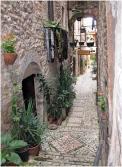

above us was surreal. The large, open shuttered windows, the ivy colored walls, the
large arched doorways, despite being rotted by the constant exposure to the canal, all
contributed to a memorable experience. For me, it was the highlight of Venice.
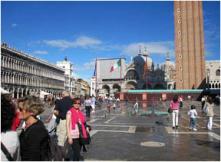
After the gondola ride, Shona escorted us through some back laneways leading to St.
Mark’s Square. As expected, Piazza San Marco was packed with people and pigeons.
Moreover, the square was a little bit flooded because of the high tide. The tour guide
gave us a very brief overview of the square but I barely heard her as I was busy trying to
feel and experience my dream.
Notably, Venice is a thriving tourist trap and you’re hit with it the moment you get off
the gondola. There are shops, kiosks, restaurants and artisans in every conceivable
nook and cranny. But if you can look past all that, you can see the beauty and character
of this ancient city. Its charm will overwhelm you. The facades of the buildings looking
down onto the lagoon and canals are beautiful in their stately yet weathered condition.
But before we could get started on our own, we were offered the opportunity to see a
glass-blowing demonstration at a Venetian glass-blowing factory. We were led upstairs
to a room where we watched one of the few remaining masters blow molten glass into a
unique creation. It was actually pretty interesting overall, with him first creating a glass
vase in about 2 minutes and then, amazingly, creating a glass horse of excellent detail in
about 5 minutes.
Piazza San Marco in the evening is magical! [I have to apologize for always using
the word “magical," but there is no other word to describe it.] It simply was – magical!
All the tourists AND PIGEONS were gone, and we practically had the entire square to
ourselves. I can’t believe I was at St. Mark’s Square, listening to the band with a drink
in my hand, with the Doge’s Palace in the background. The ambience simply drenched
me with magic and memories. No wonder Napoleon said that San Marco was Europe’s
most elegant dining room. It was unreal! I was in 7th heaven!!!
large arched doorways, despite being rotted by the constant exposure to the canal, all
contributed to a memorable experience. For me, it was the highlight of Venice.
After the gondola ride, Shona escorted us through some back laneways leading to St.
Mark’s Square. As expected, Piazza San Marco was packed with people and pigeons.
Moreover, the square was a little bit flooded because of the high tide. The tour guide
gave us a very brief overview of the square but I barely heard her as I was busy trying to
feel and experience my dream.
Notably, Venice is a thriving tourist trap and you’re hit with it the moment you get off
the gondola. There are shops, kiosks, restaurants and artisans in every conceivable
nook and cranny. But if you can look past all that, you can see the beauty and character
of this ancient city. Its charm will overwhelm you. The facades of the buildings looking
down onto the lagoon and canals are beautiful in their stately yet weathered condition.
But before we could get started on our own, we were offered the opportunity to see a
glass-blowing demonstration at a Venetian glass-blowing factory. We were led upstairs
to a room where we watched one of the few remaining masters blow molten glass into a
unique creation. It was actually pretty interesting overall, with him first creating a glass
vase in about 2 minutes and then, amazingly, creating a glass horse of excellent detail in
about 5 minutes.
Piazza San Marco in the evening is magical! [I have to apologize for always using
the word “magical," but there is no other word to describe it.] It simply was – magical!
All the tourists AND PIGEONS were gone, and we practically had the entire square to
ourselves. I can’t believe I was at St. Mark’s Square, listening to the band with a drink
in my hand, with the Doge’s Palace in the background. The ambience simply drenched
me with magic and memories. No wonder Napoleon said that San Marco was Europe’s
most elegant dining room. It was unreal! I was in 7th heaven!!!