Earth Talk
EarthTalk®
From the Editors of E/The Environmental Magazine
EarthTalk®
From the Editors of E/The Environmental Magazine
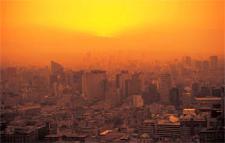
"Global dimming occurs when particulate
pollution (primarily sulphur dioxide, soot and
ash) from the burning of fossil fuels absorbs
solar energy and reflects sunlight otherwise
bound for the Earth’s surface back into
space. Some scientists blame the
phenomenon for causing the droughts in
Ethiopia in the 1970s and 80s because the
northern hemisphere oceans were not warm
enough to allow rain formation. Pictured:
Particulate pollution over Mexico City.”
-Photo credit: "Stockbyte."
pollution (primarily sulphur dioxide, soot and
ash) from the burning of fossil fuels absorbs
solar energy and reflects sunlight otherwise
bound for the Earth’s surface back into
space. Some scientists blame the
phenomenon for causing the droughts in
Ethiopia in the 1970s and 80s because the
northern hemisphere oceans were not warm
enough to allow rain formation. Pictured:
Particulate pollution over Mexico City.”
-Photo credit: "Stockbyte."
Global dimming is a less well-known but real phenomenon resulting from atmospheric pollution. The burning of fossil
fuels by industry and internal combustion engines, in addition to releasing the carbon dioxide that collects and traps
the sun’s heat within our atmosphere, causes the emission of so-called particulate pollution—composed primarily of
sulphur dioxide, soot and ash. When these particulates enter the atmosphere they absorb solar energy and reflect
sunlight otherwise bound for the Earth’s surface back into space. Particulate pollution also changes the properties of
clouds—so-called “brown clouds” are more reflective and produce less rainfall than their more pristine counterparts.
The reduction in heat reaching the Earth’s surface as a result of both of these processes is what researchers have
dubbed global dimming.
“At first, it sounds like an ironic savior to climate change problems,” reports Anup Shah of the website GlobalIssues.
org. “However, it is believed that global dimming caused the droughts in Ethiopia in the 1970s and 80s where
millions died, because the northern hemisphere oceans were not warm enough to allow rain formation.” He adds that
global dimming is also hiding the true power of global warming: “By cleaning up global dimming-causing pollutants
without tackling greenhouse gas emissions, rapid warming has been observed, and various human health and
ecological disasters have resulted, as witnessed during the European heat wave in 2003, which saw thousands of
people die.”
Just how big an issue is global dimming? Columbia University climatologist Beate Liepert notes a reduction by some
four percent of the amount of solar radiation reaching the Earth’s surface between 1961 and 1990, a time when
particulate emissions began to skyrocket around the world. But a 2007 study by the National Aeronautics and Space
Administration (NASA) found an overall reversal of global dimming since 1990, probably due to stricter pollution
standards adopted by the U.S. and Europe around that time.
Whether or not to try to reduce global dimming in a fast-warming world is a conundrum. Most climate scientists
believe global dimming is serving to counteract some of the warming effects brought on by increased carbon
emissions. “The conventional thinking is that brown clouds have masked as much as 50 percent of global warming
by greenhouse gases through so-called global dimming,” reports Veerabhadran Ramanathan, an atmospheric chemist
at California’s Scripps Institution of Oceanography. He adds, however, that brown clouds have been known to amplify
warming as a result of various environmental factors, especially in regions of southern and eastern Asia.
Some scientists have gone so far as to propose deliberate manipulation of the dimming effect to reduce the impact of
global warming, in other words increasing particulate emissions. But Gavin Schmidt, an atmospheric scientist and
one of the voices behind the RealClimate blog, argues that such a scheme would hardly provide a long term fix to our
environmental excesses and ills and amount to a Faustian bargain, bringing with it “ever increasing monetary and
health costs.”
CONTACTS: Global Issues Blog, www.globalissues.org; Scripps Institution of Oceanography, www.sio.ucsd.edu;
RealClimate Blog, www.realclimate.org.
SEND YOUR ENVIRONMENTAL QUESTIONS TO: EarthTalk®, c/o E – The Environmental Magazine, P.O. Box 5098,
Westport, CT 06881; earthtalk@emagazine.com. E is a nonprofit publication. Subscribe: www.emagazine.
com/subscribe; Request a Free Trial Issue: www.emagazine.com/trial.
fuels by industry and internal combustion engines, in addition to releasing the carbon dioxide that collects and traps
the sun’s heat within our atmosphere, causes the emission of so-called particulate pollution—composed primarily of
sulphur dioxide, soot and ash. When these particulates enter the atmosphere they absorb solar energy and reflect
sunlight otherwise bound for the Earth’s surface back into space. Particulate pollution also changes the properties of
clouds—so-called “brown clouds” are more reflective and produce less rainfall than their more pristine counterparts.
The reduction in heat reaching the Earth’s surface as a result of both of these processes is what researchers have
dubbed global dimming.
“At first, it sounds like an ironic savior to climate change problems,” reports Anup Shah of the website GlobalIssues.
org. “However, it is believed that global dimming caused the droughts in Ethiopia in the 1970s and 80s where
millions died, because the northern hemisphere oceans were not warm enough to allow rain formation.” He adds that
global dimming is also hiding the true power of global warming: “By cleaning up global dimming-causing pollutants
without tackling greenhouse gas emissions, rapid warming has been observed, and various human health and
ecological disasters have resulted, as witnessed during the European heat wave in 2003, which saw thousands of
people die.”
Just how big an issue is global dimming? Columbia University climatologist Beate Liepert notes a reduction by some
four percent of the amount of solar radiation reaching the Earth’s surface between 1961 and 1990, a time when
particulate emissions began to skyrocket around the world. But a 2007 study by the National Aeronautics and Space
Administration (NASA) found an overall reversal of global dimming since 1990, probably due to stricter pollution
standards adopted by the U.S. and Europe around that time.
Whether or not to try to reduce global dimming in a fast-warming world is a conundrum. Most climate scientists
believe global dimming is serving to counteract some of the warming effects brought on by increased carbon
emissions. “The conventional thinking is that brown clouds have masked as much as 50 percent of global warming
by greenhouse gases through so-called global dimming,” reports Veerabhadran Ramanathan, an atmospheric chemist
at California’s Scripps Institution of Oceanography. He adds, however, that brown clouds have been known to amplify
warming as a result of various environmental factors, especially in regions of southern and eastern Asia.
Some scientists have gone so far as to propose deliberate manipulation of the dimming effect to reduce the impact of
global warming, in other words increasing particulate emissions. But Gavin Schmidt, an atmospheric scientist and
one of the voices behind the RealClimate blog, argues that such a scheme would hardly provide a long term fix to our
environmental excesses and ills and amount to a Faustian bargain, bringing with it “ever increasing monetary and
health costs.”
CONTACTS: Global Issues Blog, www.globalissues.org; Scripps Institution of Oceanography, www.sio.ucsd.edu;
RealClimate Blog, www.realclimate.org.
SEND YOUR ENVIRONMENTAL QUESTIONS TO: EarthTalk®, c/o E – The Environmental Magazine, P.O. Box 5098,
Westport, CT 06881; earthtalk@emagazine.com. E is a nonprofit publication. Subscribe: www.emagazine.
com/subscribe; Request a Free Trial Issue: www.emagazine.com/trial.
Dear EarthTalk:
I’ve heard of global warming, of course, but what on Earth is “global dimming?”
-- Max S., Seattle, WA