
A Hand up out of Poverty for Cambodia’s Poorest


Laura
Salinger is a
freelance
writer based
in Madison,
Wis.
Salinger is a
freelance
writer based
in Madison,
Wis.
By Laura Salinger
What started as a small project to help Cambodian grade school children has taken wings and grown into a project that serves nearly 1,200
Cambodian children in the country’s poorest rural villages. The Cambodian School Project, based in Madison, Wis., has built four schools and
adopted a fifth in villages across Cambodia. The goal is to educate poor children so that they can succeed in Cambodia’s ever-changing
economic landscape. According to project organizers, many of these children are living the lives of their parents: farming on small plots of
land and spending the day working instead of attending school. Modernization and the increase of speculators who are purchasing farmland
put these children at an even higher risk for extreme poverty in the future. The Cambodian School Project hopes to change this dire prediction
for a least some of the country’s poorest children.
In a recent interview with Asian Wisconzine, Cambodian School Project Secretary and clinical psychologist/trauma expert Roger Garms
explained how the project got started and what impact the project is currently having on Cambodian children and their families.
Garms says that the project really got started when his friend Sarith Ou, board president of the Cambodian School Project, went back to visit
his native country in 1994. (Ou and Garms were earlier instrumental in the creation of a support group for Cambodian veterans-led by Garms
under the Mental Health Center-and the development of the Cambodian Buddhist temple near Madison.) Ou is a former guerilla fighter who fled
Cambodia in 1975 and (many hardships later) became a citizen of the United States. He returned to his country in 1994 to search for relatives
who had survived Cambodia’s bloody holocaust. Unfortunately, there were many deaths and few survivors. Yet, Ou’s return would plant the
seeds of hope for some of Cambodia’s poorest children.
“When he first went back to see what members of his family survived the holocaust, he was appalled at the state of the schools and how
poor the attendance was,” Garms says. “Especially in the rural areas,” he adds.
Ou started out with a small scale project, hoping to change children’s mindsets toward education.
“He started trying to change (children’s) attitudes toward school,” Garms explains. “He did this first by giving out school uniforms; a nice set
of clothes was a big reward for poor children who may have only one shirt. When I found out about it, I gave him some money.”
From these small beginnings, grew the Cambodian School Project. In 2002, as contributions grew, the project built their first school. One of
Cambodia’s poorest (and school-less) villages-Poum Steung- was chosen for the first site and Ou’s brother, Pran, oversaw construction. The
What started as a small project to help Cambodian grade school children has taken wings and grown into a project that serves nearly 1,200
Cambodian children in the country’s poorest rural villages. The Cambodian School Project, based in Madison, Wis., has built four schools and
adopted a fifth in villages across Cambodia. The goal is to educate poor children so that they can succeed in Cambodia’s ever-changing
economic landscape. According to project organizers, many of these children are living the lives of their parents: farming on small plots of
land and spending the day working instead of attending school. Modernization and the increase of speculators who are purchasing farmland
put these children at an even higher risk for extreme poverty in the future. The Cambodian School Project hopes to change this dire prediction
for a least some of the country’s poorest children.
In a recent interview with Asian Wisconzine, Cambodian School Project Secretary and clinical psychologist/trauma expert Roger Garms
explained how the project got started and what impact the project is currently having on Cambodian children and their families.
Garms says that the project really got started when his friend Sarith Ou, board president of the Cambodian School Project, went back to visit
his native country in 1994. (Ou and Garms were earlier instrumental in the creation of a support group for Cambodian veterans-led by Garms
under the Mental Health Center-and the development of the Cambodian Buddhist temple near Madison.) Ou is a former guerilla fighter who fled
Cambodia in 1975 and (many hardships later) became a citizen of the United States. He returned to his country in 1994 to search for relatives
who had survived Cambodia’s bloody holocaust. Unfortunately, there were many deaths and few survivors. Yet, Ou’s return would plant the
seeds of hope for some of Cambodia’s poorest children.
“When he first went back to see what members of his family survived the holocaust, he was appalled at the state of the schools and how
poor the attendance was,” Garms says. “Especially in the rural areas,” he adds.
Ou started out with a small scale project, hoping to change children’s mindsets toward education.
“He started trying to change (children’s) attitudes toward school,” Garms explains. “He did this first by giving out school uniforms; a nice set
of clothes was a big reward for poor children who may have only one shirt. When I found out about it, I gave him some money.”
From these small beginnings, grew the Cambodian School Project. In 2002, as contributions grew, the project built their first school. One of
Cambodia’s poorest (and school-less) villages-Poum Steung- was chosen for the first site and Ou’s brother, Pran, oversaw construction. The
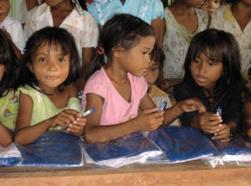
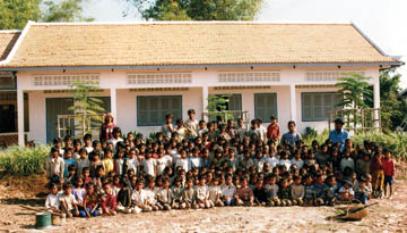
(Above) Kouy girls admiring the first ball point pens
they have ever owned. Their first school uniforms
can also be seen. (Right) The first school built,
with the yard shaded by the trees Sarith
planted,and there is a two-room addition on the
right side, a fence to keep wandering water buffalo
out of the school-grounds, bathrooms, a kitchen
and a lovely organic garden.
they have ever owned. Their first school uniforms
can also be seen. (Right) The first school built,
with the yard shaded by the trees Sarith
planted,and there is a two-room addition on the
right side, a fence to keep wandering water buffalo
out of the school-grounds, bathrooms, a kitchen
and a lovely organic garden.

“It always amazes me how poor people are,”
Garms says. “The more I learn, the more I realize
that there is some incomprehension when you
come from a wealthy country like ours. In
Cambodia, people don’t go to the doctor because
they don’t have the money. They don’t know
where their next meal is coming from. It’s a
struggle.”
To learn more about the Cambodian School
Project or to donate please visit
www.khmerschool.org.
Garms says. “The more I learn, the more I realize
that there is some incomprehension when you
come from a wealthy country like ours. In
Cambodia, people don’t go to the doctor because
they don’t have the money. They don’t know
where their next meal is coming from. It’s a
struggle.”
To learn more about the Cambodian School
Project or to donate please visit
www.khmerschool.org.

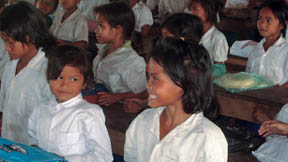
| "Happy as a kid with a new set of clothes." |
school drew 200 children in its first year, and each child was provided with a
school uniform but more importantly a chance for an education. Pran would go on
to be central to the next two school projects (one in an area settled by the
displaced Kuoy population) until his tragic death. Yet, his name would live on
with the project’s fourth school Pran Ou School, which was built in Sarith and
Pran’s home village. The project would later go on to adopt a fifth school and the
group now impacts well-over a thousand children.
Out of their school projects grew more ideas. While the project previously
purchased uniforms from larger towns, they then saw an opportunity to further
impact the economy in their school’s villages.
“We decided to hire some village girls and teach them to sew,” Garms says.
“We sought out the poorest of the poor. We now make about 1500 uniforms a year
ourselves.” Garms adds, "One of the things I am most happy about with our
project is, we do not charge any expenses, we're paying for this ourselves (the
board members). This means every dollar contributed goes to the project in
Cambodia."
school uniform but more importantly a chance for an education. Pran would go on
to be central to the next two school projects (one in an area settled by the
displaced Kuoy population) until his tragic death. Yet, his name would live on
with the project’s fourth school Pran Ou School, which was built in Sarith and
Pran’s home village. The project would later go on to adopt a fifth school and the
group now impacts well-over a thousand children.
Out of their school projects grew more ideas. While the project previously
purchased uniforms from larger towns, they then saw an opportunity to further
impact the economy in their school’s villages.
“We decided to hire some village girls and teach them to sew,” Garms says.
“We sought out the poorest of the poor. We now make about 1500 uniforms a year
ourselves.” Garms adds, "One of the things I am most happy about with our
project is, we do not charge any expenses, we're paying for this ourselves (the
board members). This means every dollar contributed goes to the project in
Cambodia."
The group also began evening English instruction in their schools. According to the Cambodian School Project, “English is the lingua
franca in Cambodia, spoken by most tourists and by those who work for them. It is also the language of automobile, computer and cell phone
repair manuals and spec sheets. English skills are a gateway to employment and highly sought after.” By providing English lessons, they
hope to provide children with the skills they need to obtain family-supporting jobs that will prevent increasing poverty.
When Susan O’Leary threw her 60th birthday party, she decided to use this as a way to raise more money for the Cambodian School
Project. This money was put towards bicycles and the group has been able to provide 120 bicycles to the poorest of the poor. For these
families, who lack mobility because of poverty, the bicycles mean that their children may be able to attend high school (often a long journey
for rural village students) and engage in other activities that improve their families’ lot.
The Cambodian School Project has also recently been working on improvements to school grounds, including tree-planting and
additions, and they continue to support the very communities that they have impacted. They are introducing computers to some of their
schools and employing women to help grow and maintain organic gardens. All-in-all, they are laying footprints towards a better future for
some of Cambodia’s poorest.
For those born and raised in the United States, it is sometimes easy to take for granted the education offered (and expected of) our
children. In Cambodia, a school is a life gift for children living in a level of poverty that is hard to imagine without actually seeing it. Garms,
who visits Cambodia roughly once a year, says it is hard for many people to even comprehend such levels of poverty.
franca in Cambodia, spoken by most tourists and by those who work for them. It is also the language of automobile, computer and cell phone
repair manuals and spec sheets. English skills are a gateway to employment and highly sought after.” By providing English lessons, they
hope to provide children with the skills they need to obtain family-supporting jobs that will prevent increasing poverty.
When Susan O’Leary threw her 60th birthday party, she decided to use this as a way to raise more money for the Cambodian School
Project. This money was put towards bicycles and the group has been able to provide 120 bicycles to the poorest of the poor. For these
families, who lack mobility because of poverty, the bicycles mean that their children may be able to attend high school (often a long journey
for rural village students) and engage in other activities that improve their families’ lot.
The Cambodian School Project has also recently been working on improvements to school grounds, including tree-planting and
additions, and they continue to support the very communities that they have impacted. They are introducing computers to some of their
schools and employing women to help grow and maintain organic gardens. All-in-all, they are laying footprints towards a better future for
some of Cambodia’s poorest.
For those born and raised in the United States, it is sometimes easy to take for granted the education offered (and expected of) our
children. In Cambodia, a school is a life gift for children living in a level of poverty that is hard to imagine without actually seeing it. Garms,
who visits Cambodia roughly once a year, says it is hard for many people to even comprehend such levels of poverty.