Texas Travelogue
Historic, diverse, and growing
Historic, diverse, and growing


Part 1
By Susie R. Cuňada
I had long wanted to go to Texas, particularly San Antonio, because I heard that it’s one of the five “must-see” cities in America. So, you
can just imagine my excitement when I learned that we were going to hold our High School class reunion ((April 12-18, 2011) thereat.
As you know, Texas is the second largest U.S. state, behind Alaska. It is 10% larger than France and almost twice as large as Germany
or Japan. Therefore, when my former classmates have finally decided to hold it in San Antonio, I immediately started looking at flights
and really behaved at work so that my bosses will gladly be happy to grant me my much-needed respite.
And thanks to Facebook, I have reconnected with my former classmate, Glory Anne, who now resides in Houston, and who has
extended an invitation for me to visit her since last year.
Houston / Galveston
It was a long and arduous 4.5-hour flight to Houston, and to make matters worse, I had the most uncomfortable seat ever! The next
time you fly, never ever take the row BEFORE the row where the exit doors are located because your seat does not recline. But in spite
of the discomfort, I slept like a baby pretty much during the entire flight. That snooze during the flight surely perked me up, because
when Glory Anne and Carlos, her hubby, picked me up at the airport, I was ready to paint the town red. I haven’t seen Glory Anne since
we graduated from high school, which was about 37 years ago, so we surely made up for lost time by chatting endlessly during the
entire ride from the airport.
Along the way, I had a chance to look around my first impression of Houston is that it is not only BIG but HUGE! In fact, everything is
vast and expansive. Just imagine having eight lanes on one side of the highway and another eight lanes on the other side, not to
mention the flyovers which are all over the place. The city definitely lives up to the slogan: "everything's bigger in Texas"!
As a backgrounder, Houston, affectionately known as "H-Town" by locals, was once the capital of the Republic of Texas. It was named
after Sam Houston, general of the Texas army that won independence from Mexico and president of the Republic of Texas.
Houston is the largest city in the state of Texas, and the fourth largest city in the United States. With an All American flair, cosmopolitan
charm, and plenty of things to do and places to see, Houston is a great destination city for tourists. Visitors can spend days enjoying all
that Houston has to offer. The city has experienced phenomenal growth since a small riverboat landing was established on Buffalo
Bayou by the Allen brothers in August of 1836. Today, it is an industrial and financial hub for much of the state.
Built on a drained swamp, this is where you will find the swampland that is still home to cotton fields dating back to before the Civil War.
It is thick with pine forests and long winding bayous that drain into the Gulf of Mexico. Visitors expecting to find arid desert are often
shocked to find this region, albeit dominated by a bright and hot sun, so full of greenery. The city contains impressive skyscrapers and
is home to NASA's Mission Control, and the Johnson Space Center. There is a large metropolitan population, a significant portion of
which consists of immigrants from all over the world, especially Latin America and the Far East.
Nearby is the historic city of Galveston on the Gulf Coast. This is a resort town known for its beaches, Victorian architecture, and history
as a free port for French pirates in the pre-state period. Elsewhere in southeast Texas are many national and state parks, as well as
excellent places for freshwater fishing and camping. You will also find quiet towns where a large Cajun and Creole population still
barbecue and make soul food and Cajun food, rivaling the cuisine of any other region in the country.
And that was exactly where we were headed to. I remember seeing on TV some shots of Galveston being devastated by hurricane Ike
some years back, so I was eager to see for myself how it looks now. Carlos drove me around the Galveston Island State Park and I
saw many of the park’s buildings destroyed. The damage to the park and the cost of cleanup put the state in a position of stating they
had no idea when the park would reopen, if it would at all. To give you an idea, below are before and after shots of the park ravaged by
the storm. The dune has been flattened and part of this beach is now gone.
Austin
Glory Anne and I left really early as our appointment for the segway tour was at 9 a.m., and Austin is about 2 hours away from Houston. I
was raring to go, not only because I can’t wait to be under the blazing sun for some Vitamin D infusion, but also because I can’t wait to
experience the segway. The segway is a two-wheeled, self-balancing electric vehicle invented by Dean Kamen. Computers and
motors in the base of the device keep the Segway upright when powered on with balancing enabled. A user commands the Segway to
go forward by shifting his weight forward on the platform, and backward by shifting his weight backward. The Segway notices, as it
balances, the change in its center of mass, and first establishes and then maintains a corresponding speed, forward or backward.
Gyroscopic sensors and fluid-based leveling sensors are used to detect the shifting weight. To turn, the user manipulates the
handlebar left or right.
Austin is the capital of the state of Texas, despite the fact that it is only the fourth largest city in the state. It is known for its lively nightlife,
as an incubator for innovative IT companies and a development center for civil and military technology.
As a backgrounder, in 1839, five mounted scouts searched a broad area of wilderness seeking a site for a new capital city for the
Republic of Texas. They chose this location on the north bank of the Colorado River, where rich black lands meet scenic hills. At the
time, the site was occupied by a four-family settlement called Waterloo. It was renamed to honor Stephen F. Austin, the “Father of
Texas.” In early 1839, archives and furniture of the Texas government were transported from Houston to Austin by 50 ox-drawn wagons.
Austin is, first and foremost, more liberal than other cities in Texas. The main reason lies in the presence of the University of Texas,
with its approximately 50,000 student population who make their mark on the city. It is the starting point for the Presidential Corridor via
U.S. 290, Texas 21 to Texas 6 connecting the George Bush Presidential Library and Museum in Bryan/College Station with the Lyndon
Baines Johnson Library and Museum. Upbeat and high tech, it is home to many computer chip makers and other computer industries.
The city is also home to the nation’s largest urban bat population, which every summer settles down under the Congress Avenue
Bridge. And unlike many other U.S. cities, Austin is well adapted for bicycle traffic, with Lance Armstrong, the winner of the Tour de
France, being one of its most famous inhabitants.
When you travel to Austin, you will experience a city with a very vibrant music scene, which is why it is sometimes marketed as the “Live
Music Capital of the World.” Austin has it all – blues, country, reggae, jazz, Tejano, swing and rock – performing in nearly 200 live music
venues around the city.
Yet, in spite of all these, Austin is different from the other big cities in Texas. Not only is it less metropolitan than Dallas and Houston, it
has also kept some of its provincial charm. So, do you now understand why I love Austin?
By Susie R. Cuňada
I had long wanted to go to Texas, particularly San Antonio, because I heard that it’s one of the five “must-see” cities in America. So, you
can just imagine my excitement when I learned that we were going to hold our High School class reunion ((April 12-18, 2011) thereat.
As you know, Texas is the second largest U.S. state, behind Alaska. It is 10% larger than France and almost twice as large as Germany
or Japan. Therefore, when my former classmates have finally decided to hold it in San Antonio, I immediately started looking at flights
and really behaved at work so that my bosses will gladly be happy to grant me my much-needed respite.
And thanks to Facebook, I have reconnected with my former classmate, Glory Anne, who now resides in Houston, and who has
extended an invitation for me to visit her since last year.
Houston / Galveston
It was a long and arduous 4.5-hour flight to Houston, and to make matters worse, I had the most uncomfortable seat ever! The next
time you fly, never ever take the row BEFORE the row where the exit doors are located because your seat does not recline. But in spite
of the discomfort, I slept like a baby pretty much during the entire flight. That snooze during the flight surely perked me up, because
when Glory Anne and Carlos, her hubby, picked me up at the airport, I was ready to paint the town red. I haven’t seen Glory Anne since
we graduated from high school, which was about 37 years ago, so we surely made up for lost time by chatting endlessly during the
entire ride from the airport.
Along the way, I had a chance to look around my first impression of Houston is that it is not only BIG but HUGE! In fact, everything is
vast and expansive. Just imagine having eight lanes on one side of the highway and another eight lanes on the other side, not to
mention the flyovers which are all over the place. The city definitely lives up to the slogan: "everything's bigger in Texas"!
As a backgrounder, Houston, affectionately known as "H-Town" by locals, was once the capital of the Republic of Texas. It was named
after Sam Houston, general of the Texas army that won independence from Mexico and president of the Republic of Texas.
Houston is the largest city in the state of Texas, and the fourth largest city in the United States. With an All American flair, cosmopolitan
charm, and plenty of things to do and places to see, Houston is a great destination city for tourists. Visitors can spend days enjoying all
that Houston has to offer. The city has experienced phenomenal growth since a small riverboat landing was established on Buffalo
Bayou by the Allen brothers in August of 1836. Today, it is an industrial and financial hub for much of the state.
Built on a drained swamp, this is where you will find the swampland that is still home to cotton fields dating back to before the Civil War.
It is thick with pine forests and long winding bayous that drain into the Gulf of Mexico. Visitors expecting to find arid desert are often
shocked to find this region, albeit dominated by a bright and hot sun, so full of greenery. The city contains impressive skyscrapers and
is home to NASA's Mission Control, and the Johnson Space Center. There is a large metropolitan population, a significant portion of
which consists of immigrants from all over the world, especially Latin America and the Far East.
Nearby is the historic city of Galveston on the Gulf Coast. This is a resort town known for its beaches, Victorian architecture, and history
as a free port for French pirates in the pre-state period. Elsewhere in southeast Texas are many national and state parks, as well as
excellent places for freshwater fishing and camping. You will also find quiet towns where a large Cajun and Creole population still
barbecue and make soul food and Cajun food, rivaling the cuisine of any other region in the country.
And that was exactly where we were headed to. I remember seeing on TV some shots of Galveston being devastated by hurricane Ike
some years back, so I was eager to see for myself how it looks now. Carlos drove me around the Galveston Island State Park and I
saw many of the park’s buildings destroyed. The damage to the park and the cost of cleanup put the state in a position of stating they
had no idea when the park would reopen, if it would at all. To give you an idea, below are before and after shots of the park ravaged by
the storm. The dune has been flattened and part of this beach is now gone.
Austin
Glory Anne and I left really early as our appointment for the segway tour was at 9 a.m., and Austin is about 2 hours away from Houston. I
was raring to go, not only because I can’t wait to be under the blazing sun for some Vitamin D infusion, but also because I can’t wait to
experience the segway. The segway is a two-wheeled, self-balancing electric vehicle invented by Dean Kamen. Computers and
motors in the base of the device keep the Segway upright when powered on with balancing enabled. A user commands the Segway to
go forward by shifting his weight forward on the platform, and backward by shifting his weight backward. The Segway notices, as it
balances, the change in its center of mass, and first establishes and then maintains a corresponding speed, forward or backward.
Gyroscopic sensors and fluid-based leveling sensors are used to detect the shifting weight. To turn, the user manipulates the
handlebar left or right.
Austin is the capital of the state of Texas, despite the fact that it is only the fourth largest city in the state. It is known for its lively nightlife,
as an incubator for innovative IT companies and a development center for civil and military technology.
As a backgrounder, in 1839, five mounted scouts searched a broad area of wilderness seeking a site for a new capital city for the
Republic of Texas. They chose this location on the north bank of the Colorado River, where rich black lands meet scenic hills. At the
time, the site was occupied by a four-family settlement called Waterloo. It was renamed to honor Stephen F. Austin, the “Father of
Texas.” In early 1839, archives and furniture of the Texas government were transported from Houston to Austin by 50 ox-drawn wagons.
Austin is, first and foremost, more liberal than other cities in Texas. The main reason lies in the presence of the University of Texas,
with its approximately 50,000 student population who make their mark on the city. It is the starting point for the Presidential Corridor via
U.S. 290, Texas 21 to Texas 6 connecting the George Bush Presidential Library and Museum in Bryan/College Station with the Lyndon
Baines Johnson Library and Museum. Upbeat and high tech, it is home to many computer chip makers and other computer industries.
The city is also home to the nation’s largest urban bat population, which every summer settles down under the Congress Avenue
Bridge. And unlike many other U.S. cities, Austin is well adapted for bicycle traffic, with Lance Armstrong, the winner of the Tour de
France, being one of its most famous inhabitants.
When you travel to Austin, you will experience a city with a very vibrant music scene, which is why it is sometimes marketed as the “Live
Music Capital of the World.” Austin has it all – blues, country, reggae, jazz, Tejano, swing and rock – performing in nearly 200 live music
venues around the city.
Yet, in spite of all these, Austin is different from the other big cities in Texas. Not only is it less metropolitan than Dallas and Houston, it
has also kept some of its provincial charm. So, do you now understand why I love Austin?
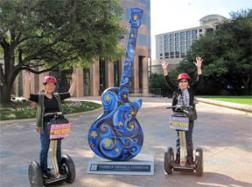
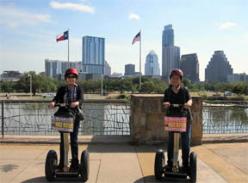
Back to my segway experience, Glory Anne and I made it at the appointed place and
time. I was overjoyed when I learned that there were only two of us booked for that
particular time. Zack, our tour guide, first showed us how to use the segway and made
us practice before releasing us into the wild. Wahoo!!! I really, really enjoyed it. It was
actually the highlight of my trip to Texas. The photos on the right speak for themselves:
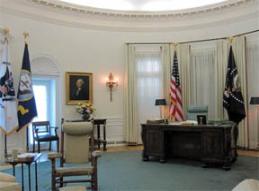
After lunch, Glory Anne took me to The Lyndon Baines Johnson Museum and Library,
which was underscored in my itinerary as a “must-see.” If you must know, Lyndon
Baines Johnson, often referred to as LBJ, served as the 36th President of the U.S. He
is one of four people who served in all four elected federal offices of the U.S.:
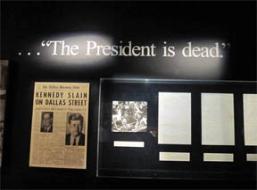
Representative, Senator, Vice President, and President. LBJ succeeded to the
presidency following the assassination of John F. Kennedy, completed Kennedy’s term,
and was elected President in his own right. LBJ was responsible for designing the
“Great Society” legislation that included laws that upheld civil rights, public
broadcasting, Medicare, Medicaid, environmental protection, aid to education, and his
“war on poverty.” He was renowned for his domineering personality and the “Johnson
treatment,” his coercion of powerful politicians in order to advance legislation.
Simultaneously, he greatly escalated direct American involvement in the Vietnam War
which, as the war dragged on, pushed his popularity as President on the downward
slope. But despite the failures of his foreign policy, LBJ was ranked favorably by some
historians because of his domestic policies.
The LBJ Library and Museum is one of 13 presidential libraries administered by the
National Archives and Records Administration. The library houses 45 million pages of
historical documents which include the papers from the entire public career of LBJ and
also from those of close associates. The museum features permanent, traveling, and
time. I was overjoyed when I learned that there were only two of us booked for that
particular time. Zack, our tour guide, first showed us how to use the segway and made
us practice before releasing us into the wild. Wahoo!!! I really, really enjoyed it. It was
actually the highlight of my trip to Texas. The photos on the right speak for themselves:
After lunch, Glory Anne took me to The Lyndon Baines Johnson Museum and Library,
which was underscored in my itinerary as a “must-see.” If you must know, Lyndon
Baines Johnson, often referred to as LBJ, served as the 36th President of the U.S. He
is one of four people who served in all four elected federal offices of the U.S.:
Representative, Senator, Vice President, and President. LBJ succeeded to the
presidency following the assassination of John F. Kennedy, completed Kennedy’s term,
and was elected President in his own right. LBJ was responsible for designing the
“Great Society” legislation that included laws that upheld civil rights, public
broadcasting, Medicare, Medicaid, environmental protection, aid to education, and his
“war on poverty.” He was renowned for his domineering personality and the “Johnson
treatment,” his coercion of powerful politicians in order to advance legislation.
Simultaneously, he greatly escalated direct American involvement in the Vietnam War
which, as the war dragged on, pushed his popularity as President on the downward
slope. But despite the failures of his foreign policy, LBJ was ranked favorably by some
historians because of his domestic policies.
The LBJ Library and Museum is one of 13 presidential libraries administered by the
National Archives and Records Administration. The library houses 45 million pages of
historical documents which include the papers from the entire public career of LBJ and
also from those of close associates. The museum features permanent, traveling, and
special exhibits centered around the life and times of President Johnson. President
Johnson insisted that the library bearing his name be available to all; therefore, it is
the only presidential library that does not charge admission.
Thereafter, Glory Anne drove around the University of Texas campus, so I can have a
glimpse of one of the largest public universities in the country. Because the campus
area is so expansive, a car ride is the best way to get a feel for the area.
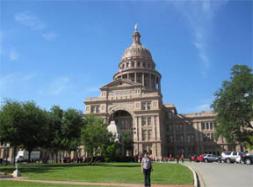
Since the State Capitol (Texas Capitol Building) was just a few blocks away, and
with my penchant for the Legislature (having worked for the Philippine Parliament
before), I decided to avail of the guided tour offered so I would know more about the
building, the Texas legislature, and some Texas history.
This architecturally stunning building opened in 1888 to much pomp and
circumstance and remains one of the great symbols of Texas history and politics. It
is also a major Austin attraction and major tourist spot. It is a favorite part of the
Austin skyline, in view of which, there are actually building restrictions to keep it
easily viewable from all parts of town. The Capitol grounds span 22 acres and
feature historical buildings, 17 monuments, and beautifully landscaped lawns in
addition to the Capitol building itself, which is still as majestic as the day it opened.
The Capitol houses the chambers of the Texas Legislature and the Office of the
Governor of Texas. The legislature is a bicameral body composed of a 31-member
Senate and a 150-member House of Representatives. But what interested me
most is the fact that the legislature meets in regular session on the 2nd Tuesday in
January of each odd-numbered year (therefore every other 2 years) and limits the
regular session to only 140 calendar days. And because their salary is pegged at
only $7200 a year, it’s the only legislature in the country whose members have full-
time jobs outside of the legislature. Cool, eh?
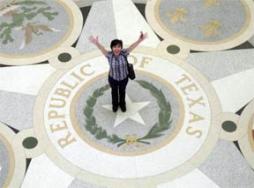
Moreover, the Capitol rotunda features portraits of every person who has served as
president of the Republic of Texas or governor of the state of Texas. What is so
unique about this is that the rotunda is also a whispering gallery. If you should
know, a whispering gallery is a gallery beneath a dome, vault or enclosed in a
circular or elliptical area in which “whispers” can be heard clearly in other parts of
the building.
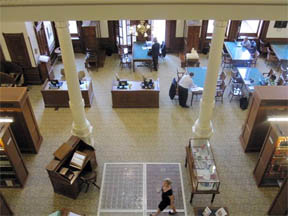
The library shown below is the only public library in the country that is housed inside
the Capitol Building.
I really enjoyed my tour of the Capitol where Texas history was made and continues
to be made each day.
Johnson insisted that the library bearing his name be available to all; therefore, it is
the only presidential library that does not charge admission.
Thereafter, Glory Anne drove around the University of Texas campus, so I can have a
glimpse of one of the largest public universities in the country. Because the campus
area is so expansive, a car ride is the best way to get a feel for the area.
Since the State Capitol (Texas Capitol Building) was just a few blocks away, and
with my penchant for the Legislature (having worked for the Philippine Parliament
before), I decided to avail of the guided tour offered so I would know more about the
building, the Texas legislature, and some Texas history.
This architecturally stunning building opened in 1888 to much pomp and
circumstance and remains one of the great symbols of Texas history and politics. It
is also a major Austin attraction and major tourist spot. It is a favorite part of the
Austin skyline, in view of which, there are actually building restrictions to keep it
easily viewable from all parts of town. The Capitol grounds span 22 acres and
feature historical buildings, 17 monuments, and beautifully landscaped lawns in
addition to the Capitol building itself, which is still as majestic as the day it opened.
The Capitol houses the chambers of the Texas Legislature and the Office of the
Governor of Texas. The legislature is a bicameral body composed of a 31-member
Senate and a 150-member House of Representatives. But what interested me
most is the fact that the legislature meets in regular session on the 2nd Tuesday in
January of each odd-numbered year (therefore every other 2 years) and limits the
regular session to only 140 calendar days. And because their salary is pegged at
only $7200 a year, it’s the only legislature in the country whose members have full-
time jobs outside of the legislature. Cool, eh?
Moreover, the Capitol rotunda features portraits of every person who has served as
president of the Republic of Texas or governor of the state of Texas. What is so
unique about this is that the rotunda is also a whispering gallery. If you should
know, a whispering gallery is a gallery beneath a dome, vault or enclosed in a
circular or elliptical area in which “whispers” can be heard clearly in other parts of
the building.
The library shown below is the only public library in the country that is housed inside
the Capitol Building.
I really enjoyed my tour of the Capitol where Texas history was made and continues
to be made each day.