


Jin-Wen Yu Presents TIERS during UW-Madison’s Taiwanese Arts Week:
A Journey of Movement
A Journey of Movement

recovered from the surgery, I really couldn’t dance much. So I recovered with Tai Chi exercise, which is Chinese martial art.
Physically, I couldn’t do dynamic movement. I could appreciate slower movement because of that. It put my life in
perspective. I had less ego after that. I was just happy to be alive. That life experience enhanced my performance. I studied
Tai Chi and after that, I went to get my doctorate degree. My dissertation is on Tai Chi philosophy and the input of Chinese
contemporary art. So my dance is rooted in Chinese martial art. I feel that it is more me. I still dance, but I don’t do a lot of
jumping around. Now it shows inner strength. It’s more what I like to do rather than all of the fancy stuff.”
Yu has choreographed over 50 dances. Some of his most recent compositions trace back to his experience in Brazil and
Guatemala this past summer.
“I took 15 students and two other faculty members to Brazil for a 25 day program to study samba and capoeira, which is a
Brazilian martial art,” Yu said. “We had a wonderful time in Brazil, culturally and educationally.”
Yu is always searching for new materials and styles to incorporate into his choreography, pushing the boundaries of his
art. He is going on a sabbatical from UW-Madison duties so that he can explore some new directions.
“During the coming two years, my project is to see how I can forge Tai Chi, Brazilian martial arts and tango into a new
reality,” Yu said.
While modern dance can incorporate messages in the movement, for Yu, sometimes the movement is the message.
“Sometimes I have meaning in my work and sometimes not,” Yu said. “I like to stretch my scope from the content itself.
Dance is about body movement. It’s not like a written language nor like a spoken language, which can be so expressive
and literal. But body movement can sometimes reveal something that one cannot talk about. One can feel it, but you cannot
talk about it. You cannot describe it, so you have to experience it. That’s the beauty of the movement. It is an essence. At the
same time, it is also true that movement and dance can also give a lot of messages, if not stories. For example, in March, I
choreographed this whole 35 minute dance the dealt with the Vietnamese War and the demonstrations in the temples in
the 1960s. But sometimes, I just like to play with the movement.”
And he incorporates other disciplines into his art, even video and other media.
“Sometimes video is very powerful and everyone wants to watch a film rather than to see a movement,” Yu said with a
laugh. “So it’s a craft, not just to put them together, but also working together with the videographer, the media artist. It is
very interesting for me to see the perspective of the video artist. They have their perspective and I try to remain open. But at
the same time, I need to be clear in the direction I want it to go. So the end of the collaboration is always very interesting to
me. And sometimes it is like pulling teeth because it is so difficult. But most of the time, I would say it is very fulfilling and
very satisfying. The process is very interesting. For example, I want to choreograph something and so we talk about their
ideas before I choreograph. Also when I am in the process and then when we talk, you say, ‘Oh, it seems like we need a
dimension here.’ That will help me to continue shaping the piece itself.”
During the coming week, Yu and other members of the Taiwanese community are commemorating the 100th anniversary
of the founding of the Republic of China with Taiwanese Arts Week on the UW-Madison campus.
In 1912, Chiang Kai-Shek and the Nationalist Chinese established the Republic of China that eventually retreated to the
island of Taiwan after losing the Chinese Civil War to Mao Zedong and the Communists.
For his contributions, Yu has brought together several works that will be making their Madison premier at the Margaret H’
Doubler Performance Space at Lathrop Hall in a production he calls TIERS.
“In the first half, there are four pieces,” Yu said. “In the second half, it is one piece, but in this one piece, it includes three
pieces. So you can say there are five or seven performances. In the first half, there is a duet that will have its Madison
premier. It was created in 2010, but I only performed that piece in San Francisco. We haven’t had the opportunity to perform
it in Madison yet. In the second half, I just created the solo while I was In Brazil this summer. This will also be its Madison
premiere. The trio is new. I just created it this summer when I was working with my dancers. Almost half of the pieces are
new to Madison.”
As he continues to explore life and movement, Yu is bound to grace Madison’s stages with works of art that he has
collaborative created with other people and cultures.
Physically, I couldn’t do dynamic movement. I could appreciate slower movement because of that. It put my life in
perspective. I had less ego after that. I was just happy to be alive. That life experience enhanced my performance. I studied
Tai Chi and after that, I went to get my doctorate degree. My dissertation is on Tai Chi philosophy and the input of Chinese
contemporary art. So my dance is rooted in Chinese martial art. I feel that it is more me. I still dance, but I don’t do a lot of
jumping around. Now it shows inner strength. It’s more what I like to do rather than all of the fancy stuff.”
Yu has choreographed over 50 dances. Some of his most recent compositions trace back to his experience in Brazil and
Guatemala this past summer.
“I took 15 students and two other faculty members to Brazil for a 25 day program to study samba and capoeira, which is a
Brazilian martial art,” Yu said. “We had a wonderful time in Brazil, culturally and educationally.”
Yu is always searching for new materials and styles to incorporate into his choreography, pushing the boundaries of his
art. He is going on a sabbatical from UW-Madison duties so that he can explore some new directions.
“During the coming two years, my project is to see how I can forge Tai Chi, Brazilian martial arts and tango into a new
reality,” Yu said.
While modern dance can incorporate messages in the movement, for Yu, sometimes the movement is the message.
“Sometimes I have meaning in my work and sometimes not,” Yu said. “I like to stretch my scope from the content itself.
Dance is about body movement. It’s not like a written language nor like a spoken language, which can be so expressive
and literal. But body movement can sometimes reveal something that one cannot talk about. One can feel it, but you cannot
talk about it. You cannot describe it, so you have to experience it. That’s the beauty of the movement. It is an essence. At the
same time, it is also true that movement and dance can also give a lot of messages, if not stories. For example, in March, I
choreographed this whole 35 minute dance the dealt with the Vietnamese War and the demonstrations in the temples in
the 1960s. But sometimes, I just like to play with the movement.”
And he incorporates other disciplines into his art, even video and other media.
“Sometimes video is very powerful and everyone wants to watch a film rather than to see a movement,” Yu said with a
laugh. “So it’s a craft, not just to put them together, but also working together with the videographer, the media artist. It is
very interesting for me to see the perspective of the video artist. They have their perspective and I try to remain open. But at
the same time, I need to be clear in the direction I want it to go. So the end of the collaboration is always very interesting to
me. And sometimes it is like pulling teeth because it is so difficult. But most of the time, I would say it is very fulfilling and
very satisfying. The process is very interesting. For example, I want to choreograph something and so we talk about their
ideas before I choreograph. Also when I am in the process and then when we talk, you say, ‘Oh, it seems like we need a
dimension here.’ That will help me to continue shaping the piece itself.”
During the coming week, Yu and other members of the Taiwanese community are commemorating the 100th anniversary
of the founding of the Republic of China with Taiwanese Arts Week on the UW-Madison campus.
In 1912, Chiang Kai-Shek and the Nationalist Chinese established the Republic of China that eventually retreated to the
island of Taiwan after losing the Chinese Civil War to Mao Zedong and the Communists.
For his contributions, Yu has brought together several works that will be making their Madison premier at the Margaret H’
Doubler Performance Space at Lathrop Hall in a production he calls TIERS.
“In the first half, there are four pieces,” Yu said. “In the second half, it is one piece, but in this one piece, it includes three
pieces. So you can say there are five or seven performances. In the first half, there is a duet that will have its Madison
premier. It was created in 2010, but I only performed that piece in San Francisco. We haven’t had the opportunity to perform
it in Madison yet. In the second half, I just created the solo while I was In Brazil this summer. This will also be its Madison
premiere. The trio is new. I just created it this summer when I was working with my dancers. Almost half of the pieces are
new to Madison.”
As he continues to explore life and movement, Yu is bound to grace Madison’s stages with works of art that he has
collaborative created with other people and cultures.

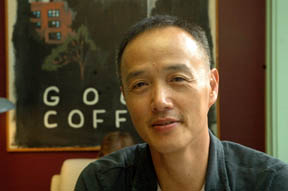
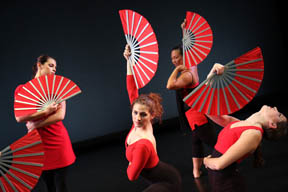
| Jin-Wen Yu (above) has choreographed over 50 dance pieces including Unconcealing (below). Yu has joined with other members of Madison’s Taiwanese community to celebrate the 100th anniversary of the founding of the Republic of China. |
By Jonathan Gramling
While he just celebrated turning 50 year-old last year with the
production of Meta-50, Jin-Wen Yu, chair of the UW Dance Program,
still has a youthful exuberance about learning new techniques and
styles that will allow him to continue to evolve his dance craft and
technique. As we sat in Ground Zero, Yu’s eyes lit up as he
discussed his newest endeavors.
Yu has always been interested in the inter-connectedness of art
forms. As a student in his native Taiwan, You pursued a number of
interests including literature and art.
“I took different classes in theater and music and sure dance,” Yu
said. “Somehow, I found out that I like to move and I could coordinate
my body well. And I love to choreograph. And it allowed me to
synthesize music, acting, literature and movement all together.”
Eventually Yu became a soloist in the Cloud Gate Dance Theater
before he came to the United States to study at the University of
Illinois. At Cloud Gate, Yu studied three types of dance: Modern
dance, ballet and Chinese Opera. This interdisciplinary study would
serve him well in later years.
Yu loves movement and as a youth, he was a very physical and active
dancer, thrilling in the pure movement of the art. But while he was at
Illinois, Yu required a nine and a half hour back surgery that changed
his life.
“The surgery was like a death and dying experience because the
success rate was 50 percent and if it failed, I would be paralyzed for
the rest of my life,” Yu said. “They literally cut out the left side of one
section of the vertebrae out. They took a big chunk out. Once I
While he just celebrated turning 50 year-old last year with the
production of Meta-50, Jin-Wen Yu, chair of the UW Dance Program,
still has a youthful exuberance about learning new techniques and
styles that will allow him to continue to evolve his dance craft and
technique. As we sat in Ground Zero, Yu’s eyes lit up as he
discussed his newest endeavors.
Yu has always been interested in the inter-connectedness of art
forms. As a student in his native Taiwan, You pursued a number of
interests including literature and art.
“I took different classes in theater and music and sure dance,” Yu
said. “Somehow, I found out that I like to move and I could coordinate
my body well. And I love to choreograph. And it allowed me to
synthesize music, acting, literature and movement all together.”
Eventually Yu became a soloist in the Cloud Gate Dance Theater
before he came to the United States to study at the University of
Illinois. At Cloud Gate, Yu studied three types of dance: Modern
dance, ballet and Chinese Opera. This interdisciplinary study would
serve him well in later years.
Yu loves movement and as a youth, he was a very physical and active
dancer, thrilling in the pure movement of the art. But while he was at
Illinois, Yu required a nine and a half hour back surgery that changed
his life.
“The surgery was like a death and dying experience because the
success rate was 50 percent and if it failed, I would be paralyzed for
the rest of my life,” Yu said. “They literally cut out the left side of one
section of the vertebrae out. They took a big chunk out. Once I