

Madison Budget Process
Madison people provide priority preference
Madison people provide priority preference

By Paul H. Kusuda
On July 26, 2011, City of Madison Mayor Paul Soglin, department staff, and Madison City Council
members hosted the first of five community budget discussions at the offices of the Urban
League of Greater Madison . As some anticipated, participation was great, the meeting room
was full on a standing-room basis, and the hallway was filled with an overflow crowd. Time was
available for participant observations, questions, input, etc., and questions were answered by the
discussion leader.
Jonathan Gramling, publisher/editor-in-chief of The Capital City Hues, made an interesting
statement to the attendees. He noted that participants included many people of color. That was
an excellent observation because it brought to public attention the fact that city programs and
services are of vital interest to racial minority groups as well as to the rest of the citizenry.
Concepts relating to the values of diversity are not always recognized as a positive. Mr.


basis of perspective of self, neighborhood, or citywide. However, priority choices were made by those who elected to
participate in the exercise. The results were immediately visible because of the method chosen to obtain individual inputs
of their decisions.
Because city staff will be provided information about residents’ views of their priorities as to city program and services,
people need to avail themselves of the opportunities to become involved in the remaining 2011 community budget
discussions. More participation of people of color, Asian Americans, Hispanic Americans, African Americans, Native
Americans, will bring to the forefront the fact that their interests, issues, and needs may not always be exactly the same as
participate in the exercise. The results were immediately visible because of the method chosen to obtain individual inputs
of their decisions.
Because city staff will be provided information about residents’ views of their priorities as to city program and services,
people need to avail themselves of the opportunities to become involved in the remaining 2011 community budget
discussions. More participation of people of color, Asian Americans, Hispanic Americans, African Americans, Native
Americans, will bring to the forefront the fact that their interests, issues, and needs may not always be exactly the same as
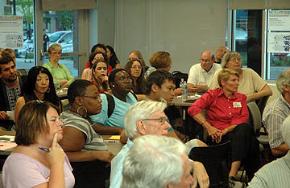
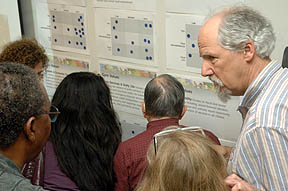
Photos courtesy of Jon Gramling
Gramling’s comment sensitized everyone that program priority issues
must recognize needs not always visible to the “powers that be.”
The primary purpose of the five community budget discussions, sited
in different locations throughout the city, is to provide the opportunity
for everyone to work with elected officials, city staff, citizen committee
members, and other residents to help designate city programs and
services in terms of desirability and priority. The information will be
valuable in planning how public funds will be budgeted and expended
each year. Mayor Soglin plans to hold budget discussions in 2012
and in the future because he believes resident input is a vital
component of proposed budget development. Further, he believes
that the more all residents understand and have input into the
process, the better the result. City programs and services can be
better developed and provided to meet expressed priorities of city
residents.
The July 26 session dealt primarily with the Community Development
Authority, Community Development Division, and their programs and
services. Included was consideration of Community Development
Block Grants, a variety of community services and programs, and the
Madison Senior Center. After listening to a PowerPoint presentation of
programs and services, all participants were provided a method by
which each could record anonymously priority choices of programs
and services. Each person was able to indicate low, medium, or high
priority for individual selection of programs or services. Some
participants encountered difficulty in differentiating selection on the
must recognize needs not always visible to the “powers that be.”
The primary purpose of the five community budget discussions, sited
in different locations throughout the city, is to provide the opportunity
for everyone to work with elected officials, city staff, citizen committee
members, and other residents to help designate city programs and
services in terms of desirability and priority. The information will be
valuable in planning how public funds will be budgeted and expended
each year. Mayor Soglin plans to hold budget discussions in 2012
and in the future because he believes resident input is a vital
component of proposed budget development. Further, he believes
that the more all residents understand and have input into the
process, the better the result. City programs and services can be
better developed and provided to meet expressed priorities of city
residents.
The July 26 session dealt primarily with the Community Development
Authority, Community Development Division, and their programs and
services. Included was consideration of Community Development
Block Grants, a variety of community services and programs, and the
Madison Senior Center. After listening to a PowerPoint presentation of
programs and services, all participants were provided a method by
which each could record anonymously priority choices of programs
and services. Each person was able to indicate low, medium, or high
priority for individual selection of programs or services. Some
participants encountered difficulty in differentiating selection on the
| We Build, Manage, Operate, and Improve Quality Care Systems for Persons with Chronic Health Conditions. For current employment opportunities, please visit: www.tmg-wis.com |
| We Build, Manage, Operate, and Improve Quality Care Systems for Persons with Chronic Health Conditions. For current employment opportunities, please visit: www.tmg-wis.com |

that for the majority of residents and that provision of
programs and services may have to include
consideration of unique differences or impediments
that might exist. Examples might be English language
proficiency, cultural differences, traditions, food
choices, social values, and entertainment preferences.
Community budget discussions provide opportunity for
people of color to learn more about the variety of
programs and services provided by our city government
and to sensitize not only fellow participants in the
discussion but also the Mayor, City Council members,
and department staffs. The responsibility is ongoing,
and more of us must make use of the chances when
they become available. It’s not always easy to venture
outside an ethnic or racial group to make ourselves
visible, but if we don’t, we continue to be almost
invisible as to our needs, interests, and issues.
programs and services may have to include
consideration of unique differences or impediments
that might exist. Examples might be English language
proficiency, cultural differences, traditions, food
choices, social values, and entertainment preferences.
Community budget discussions provide opportunity for
people of color to learn more about the variety of
programs and services provided by our city government
and to sensitize not only fellow participants in the
discussion but also the Mayor, City Council members,
and department staffs. The responsibility is ongoing,
and more of us must make use of the chances when
they become available. It’s not always easy to venture
outside an ethnic or racial group to make ourselves
visible, but if we don’t, we continue to be almost
invisible as to our needs, interests, and issues.