


Kazoua Moua named UW System Outstanding
Woman of Color: Bi-Cultural Nutritionist
Woman of Color: Bi-Cultural Nutritionist

By Jonathan Gramling
Kazoua Moua, named a 2011 Outstanding Woman of Color in Education
by the UW System, has often put family first, in the traditional Hmong
way. But through persistence and the right timing, she is serving the
needs of a larger family now, the Hmong community in Dane County.
Moua came to the U.S. when she was 10 years old after fleeing Laos
with her family and living in a Thai refugee camp. As a newly arrived fifth
grader, Moua felt like a pre-schooler as she learned the English
language and would eventually enter a two-year accounting program in
California where her family had settled.
“Just when I was going to graduate, my husband (Thao) came,” Moua
said. “We got married in the traditional way. We didn’t know each other.
So we just married and he said he had a job and he was already
Kazoua Moua, named a 2011 Outstanding Woman of Color in Education
by the UW System, has often put family first, in the traditional Hmong
way. But through persistence and the right timing, she is serving the
needs of a larger family now, the Hmong community in Dane County.
Moua came to the U.S. when she was 10 years old after fleeing Laos
with her family and living in a Thai refugee camp. As a newly arrived fifth
grader, Moua felt like a pre-schooler as she learned the English
language and would eventually enter a two-year accounting program in
California where her family had settled.
“Just when I was going to graduate, my husband (Thao) came,” Moua
said. “We got married in the traditional way. We didn’t know each other.
So we just married and he said he had a job and he was already
accepted as a pastor of a church in Georgia.
After we married, I didn’t wait for graduation, so we just moved to Atlanta. So I postponed my education.”
Eventually, the Thaos made their way to Madison via St. Paul, MN when her husband became pastor of Victory Hmong
Alliance Church, which is partnered with Rev. Rick Badger’s New Beginnings Alliance Church on Acewood Blvd. As their
children began to grow up and spend most of their days in school, Moua began to work outside of the house.
“I went to work at WPS,” Moua said. “But I didn’t like it. It had two weeks training and I didn’t like it because I feel like I am
more of a people person. So when I applied for WPS, I was sitting at my desk and I didn’t see anyone. I felt this was not
what I wanted to do. I wanted to help people. That’s why, when this position opened up and they said they wanted
someone to go and teach the Hmong community about healthy eating, I said ‘I like that,’ so I applied for it.”
Dane County UW Extension invested heavily in Moua for there were no Hmong nutritional educators in the state and the
Hmong community population was growing quickly. Moua spent her first few months in the classroom learning nutritional
standards and job shadowing other nutrition educators to learn the ropes. The investment was worth it. Ever since then,
Moua has been humming along, providing an eight-week nutrition education course to about 30 Hmong families in their
homes each year in addition to providing nutrition education to the elderly at Kajsiab House and food pantries.
Life for the Hmong families is drastically different for them in the United States, especially as it relates to food and its
preparation. Moua must, in essence, bridge the gap between the cultures in order to ensure that the Hmong community is
eating healthy and eating right, incorporating American food standards into the Hmong diet.
“When I go in, I teach them based on anything such as cooking healthy, snacks and food safety,” Moua said. “Food safety
is very important in the Hmong community because back in Laos, we didn’t have refrigerators and we ate everything fresh.
We would kill chickens fresh and we don’t store anything in a refrigerator. So when we came to this country, everything was
frozen and we didn’t know how to thaw it. We would put it in the sink for overnight and would then cook it. Some would
leave the food on the stove for later or leave it overnight. It could put pregnant women, small children and elders or people
with immune system problems at risk.”
And while something may have been healthy to eat in Laos, it might not be true in the U.S.
“We use a lot of coconut milk with curry, noodle curry,” Moua said. “Coconut milk has a lot of saturated fat. If we cook a lot
with the curry noodles, then it’s not healthy because there is a lot of salt and the hot chili has salt too. It’s just not healthy.
But that is only in this country. Back in Laos, we don’t have all these canola oils and things because it is a poor country. We
don’t use preservatives and things in the food.”
So Moua must teach the families what to look out for and how to make an adjustment.
“With instant noodles, you just put them in hot water and soak them for a while,” Moua said. “But the noodles have a lot of
salt. So with the curriculum, we teach them to shake the seasoning off. I also tell them to rinse once because even though
you shake the noodles, there is some seasoning that will stick top the dry noodles. So we rinse them one time and then
pour hot water on them again and put some frozen vegetables in with them. That’s one way that I show them to eat in a
healthier way.”
Moua has helped to redesign the UW Extension curriculum so that it is more relevant to the Hmong whom she sees. In
many ways, Moua is the mother to a larger family now. And the future health of the Hmong community rests in her hands.
After we married, I didn’t wait for graduation, so we just moved to Atlanta. So I postponed my education.”
Eventually, the Thaos made their way to Madison via St. Paul, MN when her husband became pastor of Victory Hmong
Alliance Church, which is partnered with Rev. Rick Badger’s New Beginnings Alliance Church on Acewood Blvd. As their
children began to grow up and spend most of their days in school, Moua began to work outside of the house.
“I went to work at WPS,” Moua said. “But I didn’t like it. It had two weeks training and I didn’t like it because I feel like I am
more of a people person. So when I applied for WPS, I was sitting at my desk and I didn’t see anyone. I felt this was not
what I wanted to do. I wanted to help people. That’s why, when this position opened up and they said they wanted
someone to go and teach the Hmong community about healthy eating, I said ‘I like that,’ so I applied for it.”
Dane County UW Extension invested heavily in Moua for there were no Hmong nutritional educators in the state and the
Hmong community population was growing quickly. Moua spent her first few months in the classroom learning nutritional
standards and job shadowing other nutrition educators to learn the ropes. The investment was worth it. Ever since then,
Moua has been humming along, providing an eight-week nutrition education course to about 30 Hmong families in their
homes each year in addition to providing nutrition education to the elderly at Kajsiab House and food pantries.
Life for the Hmong families is drastically different for them in the United States, especially as it relates to food and its
preparation. Moua must, in essence, bridge the gap between the cultures in order to ensure that the Hmong community is
eating healthy and eating right, incorporating American food standards into the Hmong diet.
“When I go in, I teach them based on anything such as cooking healthy, snacks and food safety,” Moua said. “Food safety
is very important in the Hmong community because back in Laos, we didn’t have refrigerators and we ate everything fresh.
We would kill chickens fresh and we don’t store anything in a refrigerator. So when we came to this country, everything was
frozen and we didn’t know how to thaw it. We would put it in the sink for overnight and would then cook it. Some would
leave the food on the stove for later or leave it overnight. It could put pregnant women, small children and elders or people
with immune system problems at risk.”
And while something may have been healthy to eat in Laos, it might not be true in the U.S.
“We use a lot of coconut milk with curry, noodle curry,” Moua said. “Coconut milk has a lot of saturated fat. If we cook a lot
with the curry noodles, then it’s not healthy because there is a lot of salt and the hot chili has salt too. It’s just not healthy.
But that is only in this country. Back in Laos, we don’t have all these canola oils and things because it is a poor country. We
don’t use preservatives and things in the food.”
So Moua must teach the families what to look out for and how to make an adjustment.
“With instant noodles, you just put them in hot water and soak them for a while,” Moua said. “But the noodles have a lot of
salt. So with the curriculum, we teach them to shake the seasoning off. I also tell them to rinse once because even though
you shake the noodles, there is some seasoning that will stick top the dry noodles. So we rinse them one time and then
pour hot water on them again and put some frozen vegetables in with them. That’s one way that I show them to eat in a
healthier way.”
Moua has helped to redesign the UW Extension curriculum so that it is more relevant to the Hmong whom she sees. In
many ways, Moua is the mother to a larger family now. And the future health of the Hmong community rests in her hands.

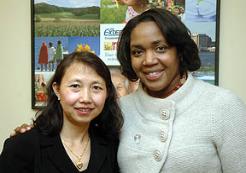
Kazoua Moua (l), with her supervisor Tracy
Smith, was the first Hmong bilingual nutition
educator in the UW-Extension system.
Smith, was the first Hmong bilingual nutition
educator in the UW-Extension system.