


UW-Association of Asian American Graduate Students presents
John Choi: A Political Voice in the Asian American
Community
John Choi: A Political Voice in the Asian American
Community
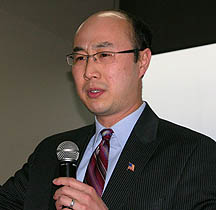
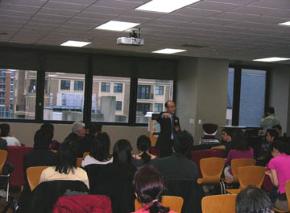
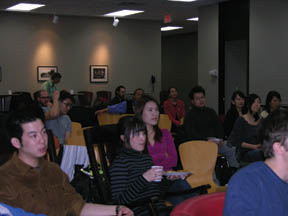
(Left photos) University of
Wisconsin-Madison
Association of Asian
American Graduate Students
(AAAGS) and guests listen
to John Choi (right), elected
Ramsey County Attorney,
talk about how he, an
immigrant from South Korea
when he was three years
old, succeeded in getting
elected county attorney in a
predominantly White
community.
Wisconsin-Madison
Association of Asian
American Graduate Students
(AAAGS) and guests listen
to John Choi (right), elected
Ramsey County Attorney,
talk about how he, an
immigrant from South Korea
when he was three years
old, succeeded in getting
elected county attorney in a
predominantly White
community.
Part 2
By Heidi M. Pascual
“Contrary to what many may assume, Asian Americans are not
reluctant to participate in politics. Yen Le Espiritu points out that next
to Jews, Asian Americans contribute more money per person to
political parties and candidates than any other racial/ethnic or
religious group. But as past and recent history shows, that doesn't
mean that Asian Americans are always welcomed in the political
arena.”—C.N Le
It has become fashionable to say “First Asian American ….” to be
elected governor of an American state, or to be elected to any position
on U.S. soil. But this is the 21st Century, and Asian Americans –
although very productive citizens of this country—still dream about
By Heidi M. Pascual
“Contrary to what many may assume, Asian Americans are not
reluctant to participate in politics. Yen Le Espiritu points out that next
to Jews, Asian Americans contribute more money per person to
political parties and candidates than any other racial/ethnic or
religious group. But as past and recent history shows, that doesn't
mean that Asian Americans are always welcomed in the political
arena.”—C.N Le
It has become fashionable to say “First Asian American ….” to be
elected governor of an American state, or to be elected to any position
on U.S. soil. But this is the 21st Century, and Asian Americans –
although very productive citizens of this country—still dream about
being in the center of the American political map. At this day and age, we still marvel at how a fellow Asian American got
elected to office. In addition to extraordinary achievement, experience and education, it takes a great sense of community
and leadership to do it. And not many Asian Americans are willing to undergo the sacrifice of public service, unfortunately.
According to statistics, in 2005, only 555 Asian Americans were elected into office, which included two U.S. Senators, five U.
S. Representatives, 64 State Senators, 97 State Representatives, three State Governors, 19 city mayors, 123 city or county
council members, and 236 judges. Most of these elected officials came from states whose Asian American population is
greater than that of any other ethnic groups.
In the state of Minnesota, however, Asian Americans are not the majority among its minority populations. Yet John Choi
was elected District Attorney of Ramsey County in 2010. According to his bio, he is one of the first Asian Americans to be
elected in this position. The reasons were explained during his presentation at the Association of Asian American
Graduate Students’(AAAGS) annual “Voices” gathering, held at the University of Wisconsin Memorial Library on April 21.
Choi’s presence was meant to inspire the students to consider public service as a career option.
It was John Choi’s first opportunity to do real public service by working as City Attorney in St. Paul, Minnesota, but it wasn’t
an easy decision. “I worked so hard in private practice and I had lots of clients, and I had to give all that up and take a pay
cut to be in the city.”
Choi thought about it seriously and conferred with his wife and parents. His wife was excited about it. “But I didn’t tell her
about the pay cut, though.” (laughter)
His parents were equally excited and were so proud about their son. “My parents – who immigrated here in 1973 when I
was three years old-- would have never thought that their son would have the opportunity to be appointed St. Paul City
Attorney. They were also proud of the choice that they made to come to this country. I could see just looking at their faces
just how proud they were of their son!”
So Choi took the job, admitting that he came into the job really with no experience on running a city attorney’s office nor an
experience on criminal prosecution. “I have never done a criminal justice case before, and the City Attorney’s Office does a
lot of things (in this area), such as prosecution of misdemeanors, and we defend the city with lawsuits.”
This hands-on experience and the fact that Choi came as an outsider and not part of the “system,” brought some
advantages to the job. “In terms of my public leadership, interestingly, I gravitated towards the area of prosecution. I think it
was actually an advantage for me not to have that prosecution experience because I wasn’t part of the system. I wasn’t
somebody who was doing all these cases every day. I came in with a really different fresh perspective and I came in to the
job with the values going back to the work that I did in Student Enhancing Education, recognizing (some of the roots of) the
problems in our society.
“What I focused on was thinking outside the box and thinking of a lot of ways to get outcomes. The system is like that giant
assembly line that starts with the operator, then the police officer who investigate the scene, and then the public defender,
prosecutor, judge, corrections. It is made up of people and agencies that are dealing with something that happened within
the criminal justice system. And a lot of this is we’re focused on a lot of things that we should do. We were thinking of our
work to be done as efficiently as possible and to do it the best way. My job was to put the tire on the car and devising ways
of how to put that tire on the car more efficiently. “
What Choi saw of the system, because he came from the outside, was not pretty. The “outcomes” of the system were not
working well. “It doesn‘t matter whether you’re the prosecutor or the accused —they’re people. I was thinking about the
outcomes that we want to achieve. And those outcomes is that we want to keep victims and the public safe but we also
want to make sure that people who are committing the crimes know that there are consequences especially if they are
serious offenses. But we also want to make sure nonviolent offenders don’t come back to the criminal justice system
again.”
This policy distinguished Choi’s leadership among prosecutors throughout the country. Being “tough on crime” carried a
new meaning to the phrase in Choi’s dictionary. “Chief prosecutors are supposed to be tough on crime, so we’re
supposed to think very narrowly and make sure that you are being perceived as tough on crime. But I want to push the
envelope a little bit and think about the broader context and think about trying to get people—the community and our elected
officials -- engaged in that concept of outcomes.”
As City Attorney, Choi started things that are now being talked about in the national level. He championed the inclusion of
restorative justice into the criminal justice system by working on cases within the concept of mediation. This stopped
prosecution of minor cases that involve obstructing legal processes, for instance. “One of the things that we recognized in
St. Paul is that if you really believe in community policing, we want to make sure that we have good relationships with the
community. When I first became City Attorney in 2006, crime obstructing legal process was an all-time high. What we did
was to work with the arresting police officer to forgive, get the person arrested to think about and articulate and reflect on
the fact that they were in the wrong, at the same time recognizing that police officer is a human being. So we forged
relationships with our community because of undertaking that process. It was a long process to understand and to accept
it, but it happened.”
Another issue that kept the court really busy was about drivers driving without a license or their license has expired. “What
we’re doing is racking up time, fining people and a lot of people just don’t care. A lot of people just don’t have the money to
pay fines (which are a must to get back their licenses.) So they just walk away. The criminal justice system didn’t care. The
DMV, they just want the money right now, today. So the system never helped these individuals trapped in the criminal
justice system. As the city attorney I recognized that we had to do something. We created the innovative drivers’ diversion
program.”
Choi worked with Legislators to create a diversion program to provide these drivers a responsible path to get their licenses
back. In addition to paying off their fees, offenders must take a class to learn how to manage their finances and make
better life choices.
During his tenure as the Saint Paul City Attorney, Choi was the 2009 recipient of the Joseph Mulligan Award, which is given
to the top city attorney in North America for public leadership. He was also the 2009 recipient of the Saint Paul Jaycees'
Warren B. Hart Award for Public Leadership and the Dispute Resolution Center's Kay Pranis Award for Leadership in
Restorative Justice.—Choi’s Campaign website
Running for County Attorney
So having these programs started, Choi decided to run for county attorney since the current is not running for reelection.
While admittedly it was very difficult to enter into politics, again, the outcomes were too attractive to resist. “After much
reflection I really felt that this really was my calling. But it was a lot of work. And yet it paid off. Campaigning is such a great
experience in the sense that you get to connect with people—the public. And one thing I recognize about the public and the
criminal justice system is that there is a big disconnect. During the campaign I talked a lot about what I have accomplished
as city attorney, about getting outcomes, not about getting tough on crime and it worked. The public wants to make sure
there are consequences for breaking the law. I also believe that the public, regardless of where you may be in the political
spectrum, whatever government you have, it should be effective.”
The “Super Lawyer” of the Minnesota Bar Association is now busy creating new initiatives on a bigger scale at Ramsey
County. While making good his pledge to be tough on violent crimes, Choi also wants to make sure there will be cost-
effective solutions like diversion and restorative justice for nonviolent crimes to reduce repeat offenders. He is also
committed to make into reality a drug court and mental health court to ensure better outcomes in the criminal justice
system.
After Choi’s inspiring message to the AAAGS membership and guests, he was asked lots of questions by students who,
hopefully, would follow his footsteps in the direction of public service.
elected to office. In addition to extraordinary achievement, experience and education, it takes a great sense of community
and leadership to do it. And not many Asian Americans are willing to undergo the sacrifice of public service, unfortunately.
According to statistics, in 2005, only 555 Asian Americans were elected into office, which included two U.S. Senators, five U.
S. Representatives, 64 State Senators, 97 State Representatives, three State Governors, 19 city mayors, 123 city or county
council members, and 236 judges. Most of these elected officials came from states whose Asian American population is
greater than that of any other ethnic groups.
In the state of Minnesota, however, Asian Americans are not the majority among its minority populations. Yet John Choi
was elected District Attorney of Ramsey County in 2010. According to his bio, he is one of the first Asian Americans to be
elected in this position. The reasons were explained during his presentation at the Association of Asian American
Graduate Students’(AAAGS) annual “Voices” gathering, held at the University of Wisconsin Memorial Library on April 21.
Choi’s presence was meant to inspire the students to consider public service as a career option.
It was John Choi’s first opportunity to do real public service by working as City Attorney in St. Paul, Minnesota, but it wasn’t
an easy decision. “I worked so hard in private practice and I had lots of clients, and I had to give all that up and take a pay
cut to be in the city.”
Choi thought about it seriously and conferred with his wife and parents. His wife was excited about it. “But I didn’t tell her
about the pay cut, though.” (laughter)
His parents were equally excited and were so proud about their son. “My parents – who immigrated here in 1973 when I
was three years old-- would have never thought that their son would have the opportunity to be appointed St. Paul City
Attorney. They were also proud of the choice that they made to come to this country. I could see just looking at their faces
just how proud they were of their son!”
So Choi took the job, admitting that he came into the job really with no experience on running a city attorney’s office nor an
experience on criminal prosecution. “I have never done a criminal justice case before, and the City Attorney’s Office does a
lot of things (in this area), such as prosecution of misdemeanors, and we defend the city with lawsuits.”
This hands-on experience and the fact that Choi came as an outsider and not part of the “system,” brought some
advantages to the job. “In terms of my public leadership, interestingly, I gravitated towards the area of prosecution. I think it
was actually an advantage for me not to have that prosecution experience because I wasn’t part of the system. I wasn’t
somebody who was doing all these cases every day. I came in with a really different fresh perspective and I came in to the
job with the values going back to the work that I did in Student Enhancing Education, recognizing (some of the roots of) the
problems in our society.
“What I focused on was thinking outside the box and thinking of a lot of ways to get outcomes. The system is like that giant
assembly line that starts with the operator, then the police officer who investigate the scene, and then the public defender,
prosecutor, judge, corrections. It is made up of people and agencies that are dealing with something that happened within
the criminal justice system. And a lot of this is we’re focused on a lot of things that we should do. We were thinking of our
work to be done as efficiently as possible and to do it the best way. My job was to put the tire on the car and devising ways
of how to put that tire on the car more efficiently. “
What Choi saw of the system, because he came from the outside, was not pretty. The “outcomes” of the system were not
working well. “It doesn‘t matter whether you’re the prosecutor or the accused —they’re people. I was thinking about the
outcomes that we want to achieve. And those outcomes is that we want to keep victims and the public safe but we also
want to make sure that people who are committing the crimes know that there are consequences especially if they are
serious offenses. But we also want to make sure nonviolent offenders don’t come back to the criminal justice system
again.”
This policy distinguished Choi’s leadership among prosecutors throughout the country. Being “tough on crime” carried a
new meaning to the phrase in Choi’s dictionary. “Chief prosecutors are supposed to be tough on crime, so we’re
supposed to think very narrowly and make sure that you are being perceived as tough on crime. But I want to push the
envelope a little bit and think about the broader context and think about trying to get people—the community and our elected
officials -- engaged in that concept of outcomes.”
As City Attorney, Choi started things that are now being talked about in the national level. He championed the inclusion of
restorative justice into the criminal justice system by working on cases within the concept of mediation. This stopped
prosecution of minor cases that involve obstructing legal processes, for instance. “One of the things that we recognized in
St. Paul is that if you really believe in community policing, we want to make sure that we have good relationships with the
community. When I first became City Attorney in 2006, crime obstructing legal process was an all-time high. What we did
was to work with the arresting police officer to forgive, get the person arrested to think about and articulate and reflect on
the fact that they were in the wrong, at the same time recognizing that police officer is a human being. So we forged
relationships with our community because of undertaking that process. It was a long process to understand and to accept
it, but it happened.”
Another issue that kept the court really busy was about drivers driving without a license or their license has expired. “What
we’re doing is racking up time, fining people and a lot of people just don’t care. A lot of people just don’t have the money to
pay fines (which are a must to get back their licenses.) So they just walk away. The criminal justice system didn’t care. The
DMV, they just want the money right now, today. So the system never helped these individuals trapped in the criminal
justice system. As the city attorney I recognized that we had to do something. We created the innovative drivers’ diversion
program.”
Choi worked with Legislators to create a diversion program to provide these drivers a responsible path to get their licenses
back. In addition to paying off their fees, offenders must take a class to learn how to manage their finances and make
better life choices.
During his tenure as the Saint Paul City Attorney, Choi was the 2009 recipient of the Joseph Mulligan Award, which is given
to the top city attorney in North America for public leadership. He was also the 2009 recipient of the Saint Paul Jaycees'
Warren B. Hart Award for Public Leadership and the Dispute Resolution Center's Kay Pranis Award for Leadership in
Restorative Justice.—Choi’s Campaign website
Running for County Attorney
So having these programs started, Choi decided to run for county attorney since the current is not running for reelection.
While admittedly it was very difficult to enter into politics, again, the outcomes were too attractive to resist. “After much
reflection I really felt that this really was my calling. But it was a lot of work. And yet it paid off. Campaigning is such a great
experience in the sense that you get to connect with people—the public. And one thing I recognize about the public and the
criminal justice system is that there is a big disconnect. During the campaign I talked a lot about what I have accomplished
as city attorney, about getting outcomes, not about getting tough on crime and it worked. The public wants to make sure
there are consequences for breaking the law. I also believe that the public, regardless of where you may be in the political
spectrum, whatever government you have, it should be effective.”
The “Super Lawyer” of the Minnesota Bar Association is now busy creating new initiatives on a bigger scale at Ramsey
County. While making good his pledge to be tough on violent crimes, Choi also wants to make sure there will be cost-
effective solutions like diversion and restorative justice for nonviolent crimes to reduce repeat offenders. He is also
committed to make into reality a drug court and mental health court to ensure better outcomes in the criminal justice
system.
After Choi’s inspiring message to the AAAGS membership and guests, he was asked lots of questions by students who,
hopefully, would follow his footsteps in the direction of public service.