New Zealand Travelogue: Nature at its best
invitation to discover the very essence of NZ in this exceptional region.
Voted New Zealand’s Most Beautiful City in 1999, 2000 and 2002, Rotorua’s
striking gardens, cobbled streets and fascinating mix of Maori and English Tudor
architecture give the city a significant point of difference. Beyond the urban centre, a
backdrop of geothermal steam, volcanic mountains and huge crater lakes remind
you that this region rests immediately above the Pacific Ring of Fire. Beneath
Rotorua, the forces that have shaped the landscape are still at work. Over millions
of years, volcanic action has created mountains, lakes and large areas of
geothermal activity. The scenery has a highly unique type of beauty.
Since it was raining most of the time, I just browsed through shops and finally
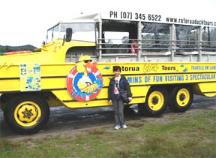
booked myself for the “duck” tour – a 90-minute fun-filled and scenic journey that
took us into three spectacular lakes in the comfort of a fully restored World War II
amphibious vehicle, able to travel on land and water, accompanied by an
entertaining and informative commentary (not to mention a very cute tour guide
who looks like Tom Cruise!)Pix
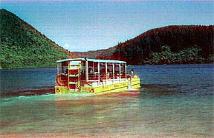
It was quite an experience to be in the middle of “Blue Lake” on a vehicle and
not on a boat.Pix
Of the 14 lakes, Lake Rotorua is the largest. There is another lake called
“Green Lake” but we were not allowed to go in there as it’s considered sacred by
the Maori people because it has their burial ground in the middle of the lake.
The following day, we went to Te Whakarewarewa Thermal Reserve to look at the
geysers. (Take note, the Maori people pronounce “wh” as “F” so it should be
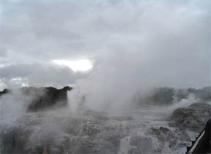
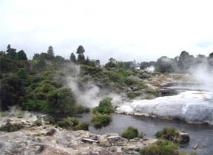
pronounced as “Te Fakarewarewa.”) Scalding water shoots 30 meters into the sky
as the geyser plays almost constantly. It was unbelievable! Pix
Then we saw traditional Maori arts preserved at the New Zealand Maori Arts
and Crafts Institute, as well as listened to expert carvers and weavers and learned
the history and processes involved with each art form. I also learned some Maori
words, such as “Kia Ora” meaning “hello, thank you, goodbye” rolled into one; “Te
Whare Paku” (pronounced Te Fare Paku) meaning “restrooms.” They also call
shopping as “retail therapy.”
Anyhow, we then went to Rainbow Springs, a wildlife reserve of flora and fauna.
Rainbow Springs works with New Zealand’s Department of Conservation to
ensure the survival of many protected species through careful management
techniques. One animal that interested me most was the Tuatara, a specie
endemic to NZ. Apparently, it is a true dinosaur of the past with a lineage
stretching back more than 225 million years. Unbelievable! I also came to know
that trouts are cannibalistic, which is why they are being fed every two hours to
prevent them from eating each other.
After that wildlife experience, we were brought to a farm show, where I saw
firsthand how to shear a sheep, to milk a cow, feed lambs and saw sheep dogs in
action. It was a farming experience that was very educational and entertaining.
Voted New Zealand’s Most Beautiful City in 1999, 2000 and 2002, Rotorua’s
striking gardens, cobbled streets and fascinating mix of Maori and English Tudor
architecture give the city a significant point of difference. Beyond the urban centre, a
backdrop of geothermal steam, volcanic mountains and huge crater lakes remind
you that this region rests immediately above the Pacific Ring of Fire. Beneath
Rotorua, the forces that have shaped the landscape are still at work. Over millions
of years, volcanic action has created mountains, lakes and large areas of
geothermal activity. The scenery has a highly unique type of beauty.
Since it was raining most of the time, I just browsed through shops and finally
booked myself for the “duck” tour – a 90-minute fun-filled and scenic journey that
took us into three spectacular lakes in the comfort of a fully restored World War II
amphibious vehicle, able to travel on land and water, accompanied by an
entertaining and informative commentary (not to mention a very cute tour guide
who looks like Tom Cruise!)Pix
It was quite an experience to be in the middle of “Blue Lake” on a vehicle and
not on a boat.Pix
Of the 14 lakes, Lake Rotorua is the largest. There is another lake called
“Green Lake” but we were not allowed to go in there as it’s considered sacred by
the Maori people because it has their burial ground in the middle of the lake.
The following day, we went to Te Whakarewarewa Thermal Reserve to look at the
geysers. (Take note, the Maori people pronounce “wh” as “F” so it should be
pronounced as “Te Fakarewarewa.”) Scalding water shoots 30 meters into the sky
as the geyser plays almost constantly. It was unbelievable! Pix
Then we saw traditional Maori arts preserved at the New Zealand Maori Arts
and Crafts Institute, as well as listened to expert carvers and weavers and learned
the history and processes involved with each art form. I also learned some Maori
words, such as “Kia Ora” meaning “hello, thank you, goodbye” rolled into one; “Te
Whare Paku” (pronounced Te Fare Paku) meaning “restrooms.” They also call
shopping as “retail therapy.”
Anyhow, we then went to Rainbow Springs, a wildlife reserve of flora and fauna.
Rainbow Springs works with New Zealand’s Department of Conservation to
ensure the survival of many protected species through careful management
techniques. One animal that interested me most was the Tuatara, a specie
endemic to NZ. Apparently, it is a true dinosaur of the past with a lineage
stretching back more than 225 million years. Unbelievable! I also came to know
that trouts are cannibalistic, which is why they are being fed every two hours to
prevent them from eating each other.
After that wildlife experience, we were brought to a farm show, where I saw
firsthand how to shear a sheep, to milk a cow, feed lambs and saw sheep dogs in
action. It was a farming experience that was very educational and entertaining.
Part 2
By Susie R. Cuñada
Milford Sound
On the way to Milford Sound, which is about five hours from Queenstown, we traveled along the shores of Lake Wakatipu
and had a close-up view of “The Remarkables” mountain, another location for the film, “The Lord of the Rings.” The tour guide
told us that it was called “Remarkables” because the mountain changes its hues depending on the weather and the season,
and people would always gasp in amazement and say “it’s remarkable,” thus the name. We then traveled through what they
call the “Devil’s Staircase,” a winding road that they built on the side of the mountain with a fascinating view of the lake on the
other side.
As we moved farther inland, one would notice the change in topography, climate and vegetation. Even the sheep are
different. There were lots of Merino sheep, whose wool are known the world over. It’s the most expensive wool in the world
and is shipped mostly to Italy. New Zealand sheep are categorized into merino, half-breed and cross-breeds. Majority (about
80%) of the sheep are cross-breeds. The grasses are greener due to high rainfall, and the greener the grass, the heavier the
sheep. I would like to add my own version: “The heavier the sheep, the more wool there is; and the more wool there is, the
more money you have in the pocket.”
We traveled farther until we reached Te Anau, the gateway to the Fiordland National Park. From then on, one could see
acres and acres of the Manuka tree, which is said to contain medicinal properties. It’s actually a bush, its flowers of which
produce oil and the bush itself made into honey. There are also lots of Tussock grass, which could either be red or brown.
You would see lots of plants and animals, native only to NZ, which is why it is very interesting and educational.
We finally reached Fiordland National Park, which is the “walking capital of the world.” When we reached the park, I finally
saw some trees, real trees this time that I’m familiar with. But they only have beech trees. I learned that in this part of the
world, nature repairs itself. Because of the high rainfall, there is soil erosion and eventually the trees would fall. Then moss
would appear, then the bushes and the ferns, after which the beech trees would eventually come back. We also learned that
NZ does not have any dangerous animals, not even a snake. So it’s very safe to go camping. We passed through what they
call the “Mirror Lakes” towards Eglinton Valley.
Continuing on, we crossed the 45th parallel, the border that divides the North and South Poles. (The 49th parallel is the
border between U.S. and Canada). Then we passed along the Main Divide, wherein you would see two rivers (Lake Fergus
and Lake Gunn) whose waters flow in opposite direction. One flows toward the east into the Pacific Ocean, while the other
flows toward the west into the Tasman Sea. You have to see it to be able to appreciate the magnificence of how the world
came into being.
We then passed through the Homer Tunnel, a 1.2 km tunnel drilled through a solid mountain of granite rock, and emerged
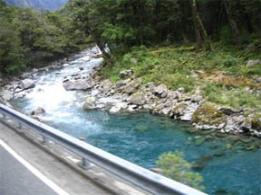
into the Cleddau Valley, which they call the “Valley of the Waterfalls.” It’s simply spectacular. We were told that we can drink it
straight from the river because there are no people or animals that pollute it. Pix
However, there was one thing that annoyed me most: sand flies. There were millions of them and they’re blood suckers,
too, just like mosquitoes. That’s the reason why I did not leave the coach when we stopped along the way for a walk in the
park.
Finally, we reached Milford Sound, which was described by Rudyard Kipling as the ‘Eighth Wonder of the World.’ Milford
Sound, which lies at the heart of the Fiordland National Park, is the most famous and accessible of the grand, glacier-carved
fiords along the South Island’s lower western coast. While it was named a ‘sound,’ it is actually a fiord, because it was
created by glaciers. A sound is a river valley that has been flooded by the sea.
We took a cruise to Milford Sound. When still, Milford Sound is like a mirror. When wet, it comes alive with waterfalls,
spectacular enough that they have sculpted rock over time. You could see glacier-scarred rock walls that rise 1,200 meters
vertically from the sea, and waterfalls that tumble from hanging valleys and crash into the sound far below. You could just feel
the mist of the waterfalls, while watching out for the seals on the rocks and, at the same time, marveling at the steep sides of
the fiord. It is, in essence, nature at its unspoilt best.
To recap, I left Milford Sound, captivated by some of the world’s most magnificent scenery, with an intimate understanding
of the region, and some wonderful memories that went with it.
By Susie R. Cuñada
Milford Sound
On the way to Milford Sound, which is about five hours from Queenstown, we traveled along the shores of Lake Wakatipu
and had a close-up view of “The Remarkables” mountain, another location for the film, “The Lord of the Rings.” The tour guide
told us that it was called “Remarkables” because the mountain changes its hues depending on the weather and the season,
and people would always gasp in amazement and say “it’s remarkable,” thus the name. We then traveled through what they
call the “Devil’s Staircase,” a winding road that they built on the side of the mountain with a fascinating view of the lake on the
other side.
As we moved farther inland, one would notice the change in topography, climate and vegetation. Even the sheep are
different. There were lots of Merino sheep, whose wool are known the world over. It’s the most expensive wool in the world
and is shipped mostly to Italy. New Zealand sheep are categorized into merino, half-breed and cross-breeds. Majority (about
80%) of the sheep are cross-breeds. The grasses are greener due to high rainfall, and the greener the grass, the heavier the
sheep. I would like to add my own version: “The heavier the sheep, the more wool there is; and the more wool there is, the
more money you have in the pocket.”
We traveled farther until we reached Te Anau, the gateway to the Fiordland National Park. From then on, one could see
acres and acres of the Manuka tree, which is said to contain medicinal properties. It’s actually a bush, its flowers of which
produce oil and the bush itself made into honey. There are also lots of Tussock grass, which could either be red or brown.
You would see lots of plants and animals, native only to NZ, which is why it is very interesting and educational.
We finally reached Fiordland National Park, which is the “walking capital of the world.” When we reached the park, I finally
saw some trees, real trees this time that I’m familiar with. But they only have beech trees. I learned that in this part of the
world, nature repairs itself. Because of the high rainfall, there is soil erosion and eventually the trees would fall. Then moss
would appear, then the bushes and the ferns, after which the beech trees would eventually come back. We also learned that
NZ does not have any dangerous animals, not even a snake. So it’s very safe to go camping. We passed through what they
call the “Mirror Lakes” towards Eglinton Valley.
Continuing on, we crossed the 45th parallel, the border that divides the North and South Poles. (The 49th parallel is the
border between U.S. and Canada). Then we passed along the Main Divide, wherein you would see two rivers (Lake Fergus
and Lake Gunn) whose waters flow in opposite direction. One flows toward the east into the Pacific Ocean, while the other
flows toward the west into the Tasman Sea. You have to see it to be able to appreciate the magnificence of how the world
came into being.
We then passed through the Homer Tunnel, a 1.2 km tunnel drilled through a solid mountain of granite rock, and emerged
into the Cleddau Valley, which they call the “Valley of the Waterfalls.” It’s simply spectacular. We were told that we can drink it
straight from the river because there are no people or animals that pollute it. Pix
However, there was one thing that annoyed me most: sand flies. There were millions of them and they’re blood suckers,
too, just like mosquitoes. That’s the reason why I did not leave the coach when we stopped along the way for a walk in the
park.
Finally, we reached Milford Sound, which was described by Rudyard Kipling as the ‘Eighth Wonder of the World.’ Milford
Sound, which lies at the heart of the Fiordland National Park, is the most famous and accessible of the grand, glacier-carved
fiords along the South Island’s lower western coast. While it was named a ‘sound,’ it is actually a fiord, because it was
created by glaciers. A sound is a river valley that has been flooded by the sea.
We took a cruise to Milford Sound. When still, Milford Sound is like a mirror. When wet, it comes alive with waterfalls,
spectacular enough that they have sculpted rock over time. You could see glacier-scarred rock walls that rise 1,200 meters
vertically from the sea, and waterfalls that tumble from hanging valleys and crash into the sound far below. You could just feel
the mist of the waterfalls, while watching out for the seals on the rocks and, at the same time, marveling at the steep sides of
the fiord. It is, in essence, nature at its unspoilt best.
To recap, I left Milford Sound, captivated by some of the world’s most magnificent scenery, with an intimate understanding
of the region, and some wonderful memories that went with it.
Rotorua
As a backgrounder, Rotorua is one of the most famous destinations in
NZ. From the moment you arrive, you will know you're somewhere quite
different – there is a scent of sulphur in the air. Steam escapes from
crevices in the ground, gardens bloom alongside bubbling craters and
geysers shoot for the sky. As the heartland of New Zealand’s Maori culture,
there is an enveloping warmth and deep sense of history.
Rotorua’s community philosophy is beautifully expressed with the word
manaakitanga. In the spirit of hospitality, manaakitanga encompasses the
cultural strength of Rotorua’s people; the amazing geothermal earth forces
of the region; the natural beauty of the forests, lakes and rivers; and the
development of sustainable tourism.
Manaakitanga is a deep-rooted concept in Maori culture. It is a
challenge to Rotorua to offer visitors the best experience. It is also an
As a backgrounder, Rotorua is one of the most famous destinations in
NZ. From the moment you arrive, you will know you're somewhere quite
different – there is a scent of sulphur in the air. Steam escapes from
crevices in the ground, gardens bloom alongside bubbling craters and
geysers shoot for the sky. As the heartland of New Zealand’s Maori culture,
there is an enveloping warmth and deep sense of history.
Rotorua’s community philosophy is beautifully expressed with the word
manaakitanga. In the spirit of hospitality, manaakitanga encompasses the
cultural strength of Rotorua’s people; the amazing geothermal earth forces
of the region; the natural beauty of the forests, lakes and rivers; and the
development of sustainable tourism.
Manaakitanga is a deep-rooted concept in Maori culture. It is a
challenge to Rotorua to offer visitors the best experience. It is also an