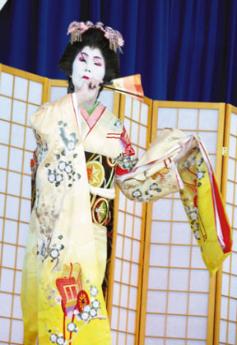
Kabuki is a form of traditional Japanese theater. It is known for the stylization of
drama and for the elaborate make-up worn by its performers.
Izumo no Okuni (1572-1613) was the main founder of kabuki theater. She was a
miko at the Izumo Shrine who began a new style of dance in the dry riverbeds of
Kyoto. (Miko are young women in the service of Shinto shrines of Japan.) Okuni's
style was instantly popular. She was even asked to perform before the Imperial
Court. Because of her success, rival troupes quickly formed, and kabuki was born
as an ensemble dance performed by women. Its appeal in this era was due to the
ribald, suggestive performances put on by many imitators. It was said that many
actresses were often also available for "other services."
During the Edo Period (1600-1868), specifically in 1629, the government banned
women from performing onstage "for the stated purpose of protecting public
morals." Some historians suggest that the government then was also concerned by
the popularity of kabuki plays expressing what it considered dangerous thoughts.
Young male actors took over after women were banned from performing. Along
with the change in the performersÂ’ gender came a change in the emphasis of
performance: more on drama than dance. Their performances were equally ribald;
audiences frequently became rowdy; and the actors also became available for
"other services." The Shogunate clamped the theater down in 1652.
As a result, the style developed into a sophisticated, highly stylized form called
yaro kabuki (roughly, "fellow's kabuki," or "guy kabuki"). This metamorphosis in style
was heavily influenced by kyogen comic theater, which was extremely popular at the
time.
Today the yaro has been dropped, but all roles in a kabuki play are still performed
by men. The male actors who specialize in playing women's roles are called
onnagata.
Important characteristics of kabuki theater include the mie, in which the actor
holds a picturesque pose to establish his character. Kesho, or make-up, provides
an element of style easily recognizable even by those unfamiliar with the art form.
Rice powder is used to create the white oshiroi base, and kumadori enhances or
exaggerates facial lines to produce dramatic animal or supernatural masks for the
actors. -- Condensed from http://wikipedia.org/wiki/Kabuki
drama and for the elaborate make-up worn by its performers.
Izumo no Okuni (1572-1613) was the main founder of kabuki theater. She was a
miko at the Izumo Shrine who began a new style of dance in the dry riverbeds of
Kyoto. (Miko are young women in the service of Shinto shrines of Japan.) Okuni's
style was instantly popular. She was even asked to perform before the Imperial
Court. Because of her success, rival troupes quickly formed, and kabuki was born
as an ensemble dance performed by women. Its appeal in this era was due to the
ribald, suggestive performances put on by many imitators. It was said that many
actresses were often also available for "other services."
During the Edo Period (1600-1868), specifically in 1629, the government banned
women from performing onstage "for the stated purpose of protecting public
morals." Some historians suggest that the government then was also concerned by
the popularity of kabuki plays expressing what it considered dangerous thoughts.
Young male actors took over after women were banned from performing. Along
with the change in the performersÂ’ gender came a change in the emphasis of
performance: more on drama than dance. Their performances were equally ribald;
audiences frequently became rowdy; and the actors also became available for
"other services." The Shogunate clamped the theater down in 1652.
As a result, the style developed into a sophisticated, highly stylized form called
yaro kabuki (roughly, "fellow's kabuki," or "guy kabuki"). This metamorphosis in style
was heavily influenced by kyogen comic theater, which was extremely popular at the
time.
Today the yaro has been dropped, but all roles in a kabuki play are still performed
by men. The male actors who specialize in playing women's roles are called
onnagata.
Important characteristics of kabuki theater include the mie, in which the actor
holds a picturesque pose to establish his character. Kesho, or make-up, provides
an element of style easily recognizable even by those unfamiliar with the art form.
Rice powder is used to create the white oshiroi base, and kumadori enhances or
exaggerates facial lines to produce dramatic animal or supernatural masks for the
actors. -- Condensed from http://wikipedia.org/wiki/Kabuki
| KABUKI |