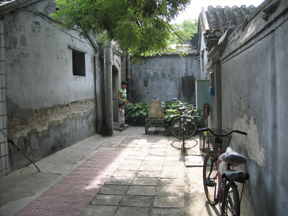
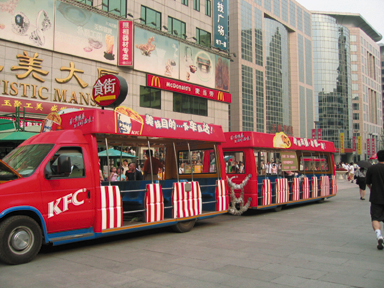
On shopping streets like Beijing's Wanfujing Dajie and Shanghai's Nanjing Dong Lu, neon lights flare announcements of the booming consumer culture. Kentucky Fried Chicken was everywhere, and the pedestrians in Shanghai looked like they had just stepped off a fashion runway in Paris or New York. But just a few blocks from this affluence were typically hutongs, narrow residential alley-like streets off of which people live in one-room homes. In these neighborhoods, people would often be cooking on or near the sidewalk, selling this food alongside whatever material belongings they could part with.
The side-by-side existence of tremendous wealth and astounding poverty was perhaps most apparent in the countryside. At one point, when my train was passing through a rural area outside Shanghai, MTV blasted from the overhead television while outside the window, farmers worked in rice paddies with just the help of oxen and simple farming implements. Between their homes and the railroad tracks were piles of styrofoam, cardboard and plastic bottles.
When I remark to people how astonished I was by the changes underfoot in China, they often suggest that the processes are similar to those experienced by people who lived during the industrial revolution in the United States in the 19th century. It is a "brutal process" one friend said. I agree. I wonder, then, if part of the world has already gone through this, and we know it to be brutal, why, should a country of so many people endure it yet again? The pollution, the poverty and unemployment, the government corruption -- are all of these things necessary byproducts of progress?
The art museums and gardens I visited were places of arresting solitude and placidity. I was enchanted by the rooms full of calligraphy, whose literal meaning I could not translate, but whose beauty I was able to appreciate. The ancient and modern scrolls of landscapes in the Shanghai Museum of Art literally took my breath away. In the Yu Yuan, a classical garden in Shanghai, the stunning mix of water, rock and greens beckoned me to sit and drink it in ? for hours. In those spaces, it was hard to remember the ruptures taking place in the cities and countryside beyond the walls.
Some people are thriving in this new China. Scores of tinted-window BMWs flood the streets, the high-end shops are full, and construction is everywhere. A businessman on my flight back to the United States said "China is on the move" and "people in the United States need to notice what is going on in China" and that in places like Shanghai, everyone is progressing-- "no one is standing still."
But it seems to me some people in China are standing still, or are at least lagging behind in the wake of those who have the resources to jump into the capitalist surge. In the mish-mash of traffic in Beijing's intersections, there is usually at least one bicycle-driven cart loaded with construction scraps or other discards the driver has collected to try to sell. Some say these people are fortunate capitalist entrepreneurs, pleasing the society by filling a social need, and pleasing themselves by making money at it. But are they beneficiaries or casualties of the changed, capitalist economy?
It seems that the Chinese government would like the rest of the world, as well as its own people, to believe these changes are for the best. One step toward doing so appears to be a society-wide face-lift. In preparation for the 2008 Olympics, they are knocking down old Beijing, and putting up a newer, taller, flashier Beijing in its place. Everywhere, one can see the underpaid migrant workers laboring to construct this newness. I call this a face-lift, because it seems only skin deep. The result will be some amazing architecture and vistas for foreign media to focus on, but they may obscure problems of inequality and lack of liberties deeper within.
I left China enchanted, fascinated, and worried. I worry about what the Chinese government is doing to its people and its environment, and I especially worry that in its attempt to become a superpower, it is sugarcoating its excesses and shortcomings and preventing the prosperity from benefiting all of Chinese society. I wonder and worry what all of this tells us about our own place in the world. It seems to me that we do indeed need to wake up and notice what is going on in China --but not so that we can take advantage of its economy. Instead, we ought to learn the Chinese language and study Chinese culture so that we can understand this amazing country, help heal the environmental, social and political wounds of the brutal processes underway, and understand and deal with our own role in this process. The changes underway in China will affect us all. |