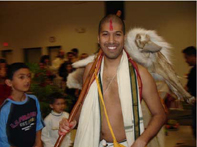
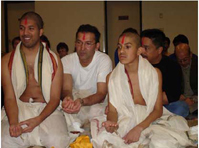
Upanayanam is a boy ritualistically becoming a man. The journey begins with the transition in a young man?s life with the Upanayanam Samskara or the sacred thread ceremony. The ceremony is usually performed for boys between the ages of 7 and 13. If, for some reason, it has not been done by then, it needs to be completed before he gets married. This initiation rite marks his second spiritual birth after his first physical one, for not only is he now admitted to the privileges of his caste and into society, but also embarks on adolescence. "It means not just culture, but it holds a deep and pure reason to create a good human being, a good family, a good society, a good nation, and thus a good world to live in."
Upanayanam is also the rite in which a young boy is initiated into the Gayatri -- the holiest of all mantras in the legacy of the guru. Traditionally, an auspicious time and date was chosen to shave the boy's head completely, leaving only a small tuft in the center of the scalp, called a Tupi. Among other things, this is the passing of the child's care from his parents to his guru. The boy sits on his guru's left and promises to obey all the orders that he will be given. Both their hands are then covered with a long cloth and amid beating drums and sounding conches, the guru whispers into the right ear of the boy a mantra or words of wisdom, which are never repeated to anyone else.
The sacred thread used for the ceremony consists of three or six strands depending on the caste one belongs to, joined by a knot known as Brahmagranthi or the knot of Brahma. The three strands symbolize the Hindu trinity -- Brahma, Vishnu, and Shiva. There are various interpretations of the three strands to represent many of the other traits like Mahasarasvati, Mahalakshmi, and Mahakali; or the three qualities known as sattva, rajas and tamas; |