| The Pathet Lao is the equivalent of the Khmer Rouge of Cambodia; but unlike the Khmer Rouge, the Pathet Lao was an extension of the Vietnamese Communist movement and a major actor in the "Secret War" against North Vietnam (1962-1975). While the United States pulled out of Laos in 1973 in accordance with the overall disengagement plan, North Vietnam retained its forces and in 1975, the Pathet Lao rose to power, cutting its economic ties to neighboring countries except Vietnam. It was this period of economic hardship and political instability that Pone Vanpravong grew up in. One among eight children of a Chinese father and a Laotian mother, Pone saw early on that there was no future for her in Laos. The communist regime seemed too restrictive that many of her valued freedoms seemed so far away. "I knew that nothing would happen to us in Laos," Pone began, "we would have remained very poor with nothing to look forward to." The only hope she saw was the possibility of "escaping" to Thailand, like her older sister and some of her acquaintances who made it to other countries including the United States. "There were successful escape stories, but there were also many failures," Pone recalled tearfully. "I remember that the friend of my sister drowned while crossing the Mekong River. My sister stayed on the river for awhile swimming, looking for her but she was gone." There were also stories, she said, of Hmong babies being fed with opium to silence them so that the Pathet Lao soldiers wouldn't find the escapees. "Some babies died in this manner," Pone said, her eyes red and full of tears. These failures didn't stop Pone from dreaming of getting out of Laos and finding freedom some place else. They in fact fueled her desire to escape, too. "We borrowed money so I could board a ship that would take me very close to Thailand," Pone recalled. "Before that, I had to have fake papers while traveling on a truck on a scheduled business in the area across the Thai border. I used another person's identity, which fortunately allowed me to pass checkpoints without problems." At dawn, she boarded the ship that would bring her closer to freedom. "The small ship actually anchored quite a distance from the Thai shores," Pone said. "The escapees had to swim, so I lost all my belongings while doing so." Dripping wet and with no possession, Pone was moved from one police station to another and to a temporary camp. "I stayed in Thailand for nine months," Pone remembered. "I didn't stay there very long because the Thais were trying to get the people out. The camp was full." Her vivid recollection of her travel to the Philippines and her stay in a refugee camp in Morong, Rizal was extraordinary. "I loved the Philippines because it was pretty much like our own country, especially since we lived in the village," Pone said. "There was a river we went to, and during weekends, a Philippine guy would come pick us up. They would also bring a lot of coconuts!" In 1981, Pone entered the United States through the family reunification program and local church sponsorship. She recalled landing in Montana where her sister was and felt the cold to her bones. "Oh, my god, I was freezing to death! I wanted to go back," Pone said. "My sister said, 'O, no, this is where you'd be!'" Another big complaint was the absence of Asian food in her sister?s place. After four months, Pone decided she wanted to go where another Laotian refugee (and relative) was ? in Madison, Wisconsin. She called Bunyong (owner of Lao-laan Xang), whose husband is a cousin of Pone's mother, and soon she was on a Greyhound bus to Madison. In Madison, Pone met Bunyong's sponsor, Albert Shade, a carpenter from Monona, who was also the "godfather" of many Cambodian refugees. "He was Catholic, not a rich person, but he helped many of us," Pone said with fondness. Another angel in Pone's list was David Haas of Bayview Nighborhood Center. "David took me in despite the fact I had no income," Pone recalled. "Sometimes I couldn't pay my utility bills and he'd pay for them." Pone lived in Bayview for many years, got married there, and left only when she and her husband Pan were able to buy a house on the east side in 1988. The struggle included learning English at MATC and trying to make both ends meet with a welfare check and food stamps. "I was very embarrassed each time I would collect my welfare check and those $40-worth of food stamps," Pone said. "But I learned English, developed some clerical skills, and then I started working through the help of the Dane County Job Center." Her first jobs were processing the mail, filing, and later, typing. She also worked in a pizza parlor, an experience that made her cry because she was assigned to slice onions. A year after her wedding in 1984, Pone became a stay-at-home mom. But even with a one-earner household, Pone and Pan were able to save enough that enabled them to go visit Thailand in 1987. "I think we were the first refugee couple to go back to Thailand," Pone beamed. "It was just unfortunate we weren't able to enter Laos. Back then, the border was too tough to cross." With a growing family (now three children) Pone also decided to work. They worked as cooks at a Thai restaurant along Williamson Street for several years until the owner decided to sell it to the couple on installment basis. Hard work and financial discipline allowed Pone and her husband to prosper and help their remaining relatives in Laos. But Pone doesn't take all the credit for the good fortune they have been blessed with. "There were a lot of people who helped us, especially Albert and Jenny Shade," Pone said. "Albert helped us buy our house by making referrals for us; did carpentry work in it; took us grocery shopping when we didn't have yet a car; and taught me how to drive." Today, Pone and Pan manage the Corner Store at Willy Street and have plans on starting a catering and deli business on a newly purchased property along Fair Oaks. Every other year, the couple makes it a point to go back to Laos to share their blessings with members of their families, visit Buddhist temples and donate money for their charity work. Locally, Pone and Pan have helped many students by providing them part-time work, and have gained the friendship and respect of many Madisonians who have witnessed the couple's faith, struggle, and good works. "If you don't give, your life doesn't mean anything," Pone said. "When you go, what can you take with you?" |
| Pone Vanphravong A Laotian's journey to freedom by Heidi M. Pascual |
 |
 |
 |
 |
 |
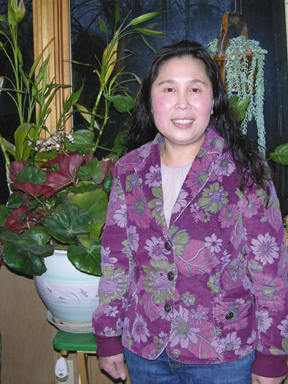
| Pone Vanphravong now. |
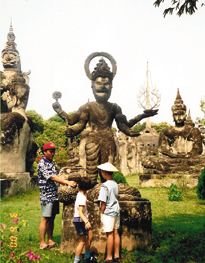
| The Vanphravong family in Laos |
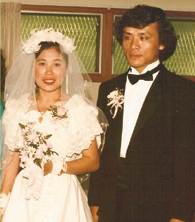
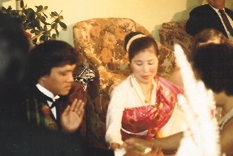
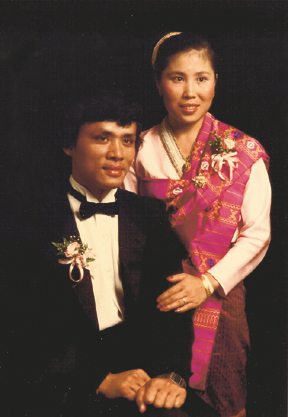
| Pone and Pan Vanphravong wed in both Buddhist and Christian traditions. |
 |