| By Ka Bao Lee |
| The first time Tria Vang's father saw a picture of Tria in their local newspaper, his father expecting the worst, asked, "What are you doing in the paper? What did you do wrong? Is that a gun you're holding?" Well, what was a father supposed to think? His son is involved in something called hip hop. You can't even understand anything coming out of their mouths. It's all gangster stuff anyways, right? Actually this "gangster stuff" has quite a powerful message. Tria is part of a group known as Free Inspiring Rising Elements or F.I.R.E. This Hmong/Lao spoken-word group in Minnesota consists of writers, poets, storytellers, and hip hop artists who have all come together to address issues from racism and lost traditions to the genocide in Laos. |
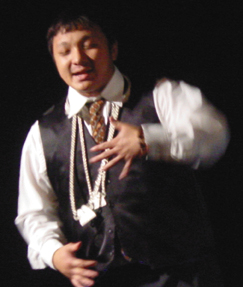
| The founder of F.I.R.E., Tou Saiko Lee (above left) explains that he had always been interested in writing. Although there were times when he was discouraged, after high school he found his passion again and began going to open mic nights. Through these, Tou Saiko created his own network of Asian artists. But more importantly, Tou Saiko created a way to talk about social issues that affected his community. Like a true artist, Tou Saiko said he saw hope in spoken word, for it "ricochets off the senses, to light up your heart, when love catches on fire, you can see through the dark." |
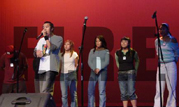
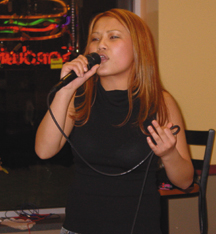
| What started as a project for "one lonely person," as Tou Saiko would put it, now has 11 members. Each member has their own unique style. Although they are all talented, the criteria to be a part of F.I.R.E are not solely based on talent. "We're giving a voice to the people," Tou Saiko explained; therefore, activism and dedication to one's community are the most important qualities in a member. Tou Saiko, along with three other members, Talee Vang (right), Tria Vang, and Doua Vang, performed in Madison on March 31 and April 1 during the Hmong American Student Association Conference. The two-day event was held at the University of Wisconsin-Madison campus and brought together over 300 college students from the Wisconsin area. Rooted in their Hmong culture and speaking up for those who don't have a voice, F.I.R.E. is often asked to perform at these events, where young people come together to learn about their past, their culture, and their future. |
| Doua, the newest member of F.I.R.E, said that members are not just complaining on stage -- that there is meaning behind their messages and they want people to see that social change is happening. Tou Saiko added, "It is a creative art form to pass on positive messages and be positive influences in our community and hopefully to inspire people through our culture." For all four members, this art form has been a driving force in their lives and have given them an outlet through tough times, whether it was breakups, depression, racism, or loss of self-identity. Tria, a sophomore at Century College, said that writing "keeps my sanity confined." To that, Doua added, "In a sense, the arts is all I have. I live off of it." |
| One of the most important things that these artists rely on is their culture. Twenty-year-old Talee explained that growing up, she just wanted to fit in and hated speaking Hmong, wearing Hmong clothes, having traditional Hmong celebrations, or being Hmong. "But then you get older and mature to the point where you realize you need to preserve your culture. You come to a point where you almost lose it and then you desperately try to fight back to get it," she said. "With this realization comes the responsibility to tell your own story rather than allowing someone else to tell stereotypical stories about you and your culture." |
| One of the projects that some members in F.I.R.E are involved in is the H Project. It is a compilation CD with music and poetry put together by artists from all over the country who were inspired by the genocide of Hmong people in Laos. For more information about this CD and to listen to a sample of this CD, visit http://www.myspace.com/hproject. Money from this CD will help different organizations such as Hmoob Hlub Hmoob (Hmong Love Hmong), the Fact Finding Commission, and others. These artists are creating change and bringing attention to those who can't. With this new movement of incorporating tradition with new art, it can be hard for any parent to understand. Just like Tria's father, many older generations will probably not understand what young people are doing today. Nevertheless, young people are understanding each other and inspiring each other to do something, to stand up for themselves, their culture and their traditions. With passion and determination, eventually people will see that it is not because people like Tria have done something wrong that has landed them in the papers rather they are holding a microphone and speaking out. |
| Excerpts from pieces written by the four members |
| "Father" by Tria Vang |
| 1970, NorthEast Hillside in the mountains of Laos. I laid restless, and if my mind could speak it would blame the war for my heavy heart and the bags under my eyes. The village below remains at a calm because the men have joined the army and the monkey boys had turned guerillas. The Shamans remained because favors would be asked. No one was promised liberty and we fought just to live. A ghost in the chambers of our enemies, a bullet away from becoming one. Morale was motives that often ran out. No doubt, the courage and bravery was always there. Children's was no longer the future, rather carbine soldiers. I can sense the ease this mountain gives and the souls of soldiers that call this place home. At 15, I carry a gun that's older than me, an M-16 to be exact, and the last time I used it was to dig a grave for my friend. The countryside is steep and the hills soon turned to mountains. The missions were guaranteed death, but promised gold. The American pilots were our responsibilities and worth more than the prettiest wife. 10 for the price of 1, we were promised gold. I've had recurring dreams of having kwv txiaj battles with each of the village daughters and always winning, the prize being her hand in marriage. If I've counted the amount of this recurring dream, I'd probably be married to the whole village. Everybody's dead, the only living thing here are the plants and trees that help pump our lungs, our only allies. There were no predators; everybody was bullet food. And the American planes overhead, help was not a concern because our lives were not their mission. |
| "Kwv Txiaj" |
| by Tou Saiko Lee |
| The melodic symbolic words |
| vibrate through us internally, |
| Verbally crushing our emotional |
| senses |
| bursting to multiple tears, |
| felt from our own life years. |
| We call it: kwv txiaj. |
| I'll admit that my second tongue has been eclipsing my |
| first since birth or since first grade, |
| And I've been slowly struggling to |
| replenish it. |
| Look closely into your own mental |
| reflections |
| and maybe you'll find cracks |
| of lost pride and identity, |
| but this broken mirror can extend beyond seven years, |
| these cracks could eliminate our culture forever. |
| xav kom lub hnub ci tuaj |
| Rau peb kom peb lub |
| neej loj hlob mus txog saum ntuj |
| thiab tag nro peb sawv daws los |
| koom ua ib lub siab |
| Kuv sawv ntawm no tau rau kuv cov neeg |
| "Little Yellow Girl" |
| by Talee Vang |
| I opened my mouth |
| and nothing came out |
| nothing |
| what happened to the strong |
| outspoken yellow Asian girl |
| what happened to the poet who gives a voice to those who have none? |
| what happened to my voice? |
| what happened? |
| I became |
| the stereotype that I |
| often write about... |
| just another little-yellow-girl |
| Flea Market Woman |
| by Doua Vang |
| By chance, you'll take a quick glance at her |
| a feelin' like you've seen her a thousand times before |
| Perhaps, she reminds you of your grand mother at home |
| maybe she may even share some of the same stories |
| Prolly, the best thing you will say is |
| Damn, Hmong people work hard |
| and then you'll simply turn and walk away |
| Just as I have |
| Because after all, |
| She is just another Flea Market Woman |
| isn't She? |
| Free Inspiring Rising Elements (F.I.R.E.) |
 |
 |
 |
 |