| by Heidi M Pascual |
| When viewing a Chinese brush painting, one may be intrigued by its beautiful lines, or its monochrome yet rich tones, or its simple yet powerful visuals mostly inspired by nature. It is amazing to feel how it expresses a culture through the romantic movement of Chinese brush on rice paper. Most importantly, it has evolved into an expression of an artist's emotions or deepest passions that sometimes take the artist to a place uniquely his or her own. |
| The Madison Chinese Fine Art Association (CFAA) started in 1998 as a group of "students" who merely wanted something new to do, or to satisfy their curiosity about a cultural tradition that seemed lost in new generations of Chinese Americans. Many of them are engaged in scientific work for a living that when they paint, they actually "feel they are in another world." |
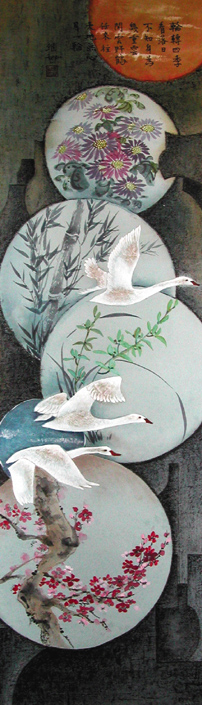
| In an interview with some CFAA members (Chinese and Americans) in Peking Palace recently, this author took note of the incredible collections of award-winning CFAA art work on display at the restaurant for sale that have one singular motif -- life and its many forms. Vina Yang, microbiologist in the U.S.D.A. Forest Products Laboratory, describes her art as an attempt to capture the sense of harmony and peace within images of nature. A serious artist, Yang says it's not easy to work on a piece of art. "There are two different schools of Chinese brush paintings," she explained. "One is spontaneous and the other, elaborate style. We're doing more work with the elaborate style. That means, very detailed and you have to put in a lot of time to finish your painting." The spontaneous style is good for short presentations, she continued, but the members of CFAA were not trained for it. |
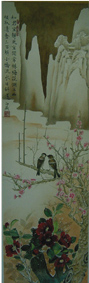
| Pai-Yien Chou (left) is a nature-lover, too, for she enjoys gardening among other things. A stay-at-home mom by profession, Pai-Yien said she finds Chinese brush painting as a means to "get away" once in a while from household cares. Without intending to, her painting has reached an extraordinary level of quality which didn't escape the notice of international brush painting jurors abroad. Pai-Yien's art submissions have received awards from the Sumi-E Contest in Japan for three years. As she continues to hone her skills, Pai-Yien finds herself "happiest when painting," and it takes her away from the conflict and confusion of daily living. |
| Kerry Kresse, library director at UW Physics Library, and June Buchanan, retired Dane County purchaser, are non-Chinese Americans who fell in love with Chinese brush painting. In the process, they have developed lasting friendships that kept the group going even in the absence of their former mentor and teacher who had left the state. "What we do is a much more informal process, so we gather at some place. We used to meet at Memorial High School for a while, where we got together and helped each other," Kresse recalled. They would compare notes especially when any one of them had consulted with their former teacher and there were suggestions made to improve an art work. |
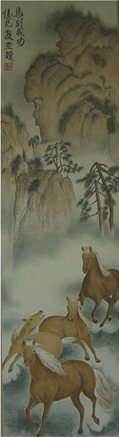
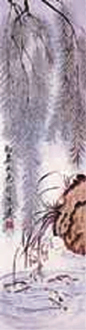
| While Kresse would prefer not to get out of the traditional brush painting motifs, Buchanan is creating her own blend of East and West in her art. Both, however, are conscious of the details needed to create a polished Chinese brush painting worthy of world-class recognition. In 2003, Kresse's "Fish and Willow" won the Worldwide NPO Co. Hobby World Children's Foundation Award, while Buchanan's "Palominos on the Mountain" won the International Cultural Exchange Center Award, at the International Asian Sumi-E brush painting contest and exhibition in Japan. |
| According to Yang, many CFAA members participate in this contest every year and receive awards. As a group, CFAA has held shows and exhibits at DeRicci Gallery in Edgewood College; the Arboretum Gallery; the UW Hospital Skylight Gallery; Promega Gallery. It also provides volunteer services during community events such as Celebrate Madison, and most recently in the 150th birthday of Madison, by conducting paper-cutting workshops at Monona Terrace Community and Convention Center. CFAA has an ongoing exhibit at Peking Palace (Hilldale Mall) and East Imperial Garden Restaurant. |
| The Chinese Fine Art Association?s goal is to bring the Eastern and Western art styles together to create unique images of nature. Visit its website at www.cfaamadison.org to learn more about the organization and its members, or to inquire about how you can become a member. [Note:Chinese brush painting may be traced back from the invention of the Chinese brush by Meng Kuo (Qin Dynasty, ca. 200 B.C.) and the rice paper by Cai Lun (Han Dynasty, A.D. 105). It makes extensive use of black ink to delineate the forms, with great emphasis on the rich tone in the ink, many shades of gray, and onto the form, will be applied the color. The brush stroke is important because through its skillful use the aesthetic effects can be achieved. Just like calligraphy, the quality of the flow is paramount.] |
| Chinese Fine Art Association brush painters Enjoying camaraderie, world recognition |
 |
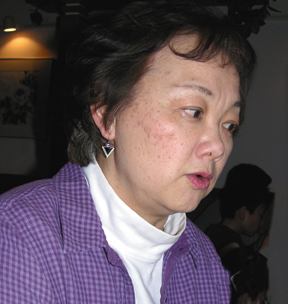 |
| Vina Yang and her work (right) "Travel with Time" |
 |
 |
 |
 |
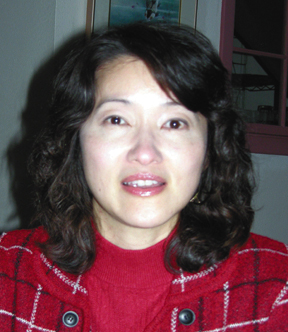
| Pai-Yien Chou and her work, "Love Endures." |
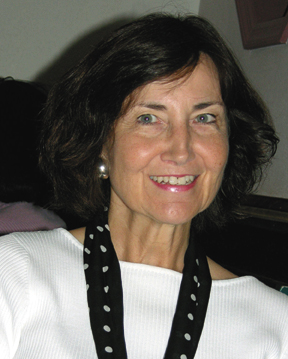
| June Buchanan and her work, "Palominos on the Mountain" |
 |
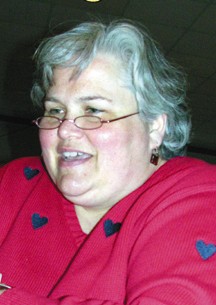 |
| Kerry Kresse and her work "Fish and Willow" |
 |