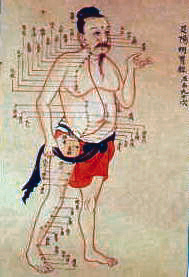
| Everybody is familiar with acupuncture, the arcane healing art from the east which seeks to alleviate ills by stabbing patients with pointy sticks. It is one of the best known examples of traditional Chinese medicine, although many of the principles are used in the Korean medical tradition kimsul and Japanese kampo. Despite the contempt and ridicule the procedure has earned from practitioners of Western medicine, recent studies are changing the opinions of patients and doctors alike. Acupuncture is becoming an unexceptional part of American healthcare and has earned a place alongside chiropractic care as a scientifically suspect, yet remarkably effective treatment for a variety of body pains. Acupuncture has existed for more than 2,000 years and it is only in the last hundred that the rise to prominence of western medicine has challenged its practice -- not just here in America, but in China as well, when the rise of the Chinese Communist Party and its dedication to science as the way to progress. Almost all elements of traditional medicine were declared irrational and even dangerous, and for a time acupuncture risked being lost as a cultural and medical tradition. But when Chairman Mao began his Cultural Revolution, he sought to preserve many of the unique elements of Chinese culture and declared, "Chinese medicine and pharmacology are a great treasure house and efforts should be made to explore them and raise them to a higher level." As Mao's word was law, acupuncture transitioned immediately from ridiculed, backward superstition to a standard course of treatment available for study at prestigious medical universities. Rising from the obscurity of traditional healers to sanctioned practice by classically trained doctors, acupuncture began receiving respect from foreigners, in particular New York Times correspondent James Reston. In 1971, Reston required an emergency appendectomy during a stay in China and wrote an account of how acupuncture successfully reduced his pain as he recovered, claiming "I've seen the past, and it works!" The exotic new treatment sparked interest and a steady growth in stateside acupuncture. According to traditonal Chinese medicine, illness results from an imbalance of body energy or chi, which flows along the body in paths similar to blood veins. Significant points and intersections along these paths can be stimulated with acupuncture needles to alter the movement of chi and by so doing "reduce what is excessive, increase what is deficient, warm what is cold, cool what is hot, circulate what is stagnant, move what is congealed, stabilize what is reckless, raise what is falling and lower what is rising." More specifically, an interregional seminar sponsored by the World Health Organization in 1979 drew up a list of specific diseases that clinical experience suggested could be treated to some extent by acupuncture. These included forty maladies from the common cold to tennis elbow to gingivitis to a gastro-intestinal disorder simply identified as "hiccough." Despite such impressive claims, it was not so easy to integrate acupuncture into the medical establishment in America as it was in China where two thousand years of precedent backed up the practice. In the years since acupuncture became prevalent in America, a great deal of scientific research has been conducted. Most studies support, but do not prove its efficacy. One prominent specialist suggests that this may be because acupuncture would benefit from assistance rather than scrutiny by scientific biomedicine. Dr. Felix Mann began studying acupuncture in 1958 after studying at Cambridge and spent ten years learning to read medical Chinese to study both ancient and modern texts. Mann believes traditional acupuncture is "fundamentally incorrect -- somewhat like the 'flat earth' theory of the Middle Ages -- good enough for building houses but not for navigation." Mann published "Reinventing Acupuncture" as the culmination of his research in 1992 and is both the founder and former head of the Medical Acupuncture Society. His research suggests that acupuncture has valid neurophysiological medical science behind much of the less-concrete philosophical concepts that govern its practice, and has essentially 'westernized' acupuncture into a medical procedure less daunting to modern practitioners. Due in large part to his work, even such lofty organizations as the National Institutes of Health have acknowledged that "the data in support of acupuncture are as strong as those for many accepted Western medical therapies." Tens of millions of Americans have undergone acupuncture therapy and in 2005, a survey of American doctors found that 60% consider acupuncture an effective form of treatment -- a stark difference from the 'quack medicine' reputation the procedure once had. So with ancient eastern medicine slowly proving itself more trustworthy than leery western physicians might once have suspected, what's next? Perhaps moxibustion, a variant of acupuncture which uses heated needles treated with herbs. When you can be burned, stabbed, and poisoned all in one convenient treatment, why even bother with a hospital visit? |
| By Ben Freund |
| AsiaPop: A look at cultures across the sea Acupuncture |
 |
 |