| Seema Kapani: In search of an authentic all-inclusive learning environment |
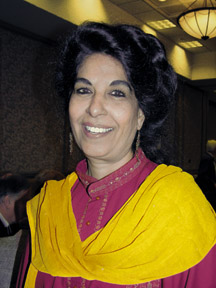 |
| By Laura Salinger Dr. Seema Kapani knows what it feels like to be an outsider. After moving to the United States from her native India, Kapani found herself in a place that spoke of diversity and acceptance but fell short of expectations. Perhaps that is why Kapani has dedicated herself to transforming the University of Wisconsin-Madison into a place that is not only multiculturally diverse in appearance, but authentically inclusive for all students, as well. Kapani is currently the diversity education coordinator for the Equity and Diversity Resource Center (EDRC) at UW-Madison, where she directs the Leadership Institute, the SEED (Seeking Educational Equity and Diversity) and SEEDED seminars, and other diversity education and training programs for faculty, staff, students, and the general community. In this capacity, Kapani hopes to create a college setting and community that truly is for all people. Kapani's perspective began taking shape when she was young and under the guidance of her "best educator," her mother. "My mother had no formal education, but is the most excellent educator I have known," she said. Kapani's parents were forced to leave Pakistan, their homeland, and move to India. Although Kapani is from India, she and her family faced discrimination in a country where they didn't totally fit in. "My parents were refugees," Kapani said. "The fact that they were not Muslims was why they were asked to leave what is now Pakistan." Kapani's mother tended the family and her father did odd jobs during most of her childhood, although later he did find a steady job. "We were mostly just surviving," Kapani said. Yet as Kapani's parents and their seven children struggled to make ends meets, Kapani's mother managed to inspire her children with her strength and her undying belief in humanity. Kapani credits her mother with teaching her very basic, yet profound, lessons on acceptance and humanity. "My own experiences have very much shaped my own [perspective],"she said. "Each and every human being is a sacred being, and any kind of oppression is simply not acceptable. That is always my starting principle." Kapani eventually moved to the United States and earned a doctoral degree in sociology from UW-Madison. She saw education as a way to break out of the cycle of poverty and put her mother's lessons to use. Kapani now has years of experience in a variety of settings, in which she has worked for social justice and human rights, and done diversity training. In her current position, Kapani is working to create a campus setting that doesn't simply look multicultural but one where the faculty, staff, and students have the skills and knowledge to really support diversity in a meaningful way. |
| The Asian Women in America A salute to Women's History Month by Asian Wisconzine |
 |
 |
| Li Chiao-Ping |
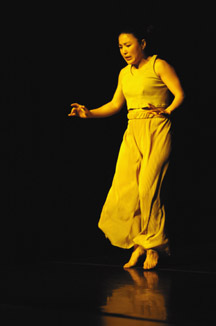
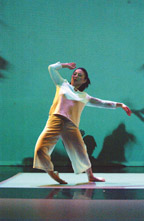
| By A. David Dahmer "I love that dance can communicate in a visceral way. In many ways, it speaks beyond words," said Li Chiao-Ping, an associate professor in dance at the University of Wisconsin-Madison. "Dance is something that is basic to all human beings. It's our birthright. It's something that everybody can do and should do." Li Chiao-Ping is well-known in Madison and throughout the United States for her dancing -- her work has been presented and screened throughout North and South America, including New York, Chicago, San Francisco, Washington, and Toronto, as well as at festivals such as Jacob's Pillow, Bates Dance Festival, The Yard, the International Festival of Video and Dance in Argentina, and the American Dance Festival. "I didn't formally begin dance training as a child, but I count the many hours I spent watching musicals on television as part of that training," Li said. "Although I didn't take classes, I learned a great deal from watching Fred Astaire, Gene Kelly, and even Shirley Temple." Noticing that she was a very physical child, Li's mother put her in a tap-dance class when she was 9, and in a creative movement class when she was 10. Li would soon join gymnastics -- which in many aspects is very dance-like -- and would discover dance along the way. A first-generation Chinese, Li grew up in San Francisco and went to college at the University of California-Santa Cruz. She earned her graduate degree in dance from UCLA. Li made the move to Madison about 11 years ago, when she accepted an assistant professor's position in the dance program of UW. In 1990, she founded a professional modern dance company, Li Chiao-Ping Dance, in which she serves as artistic director. Her company offers powerful programs packed with highly physical, elegant, and inventive works. "I felt like I needed an identity; an organized body to help me present the work I was interested in and the work I created," Li said. " We're a group of professional dance artists ... We measure well next to our peers across the country." Besides doing biannual conferences in Madison, Li's dance company also tours and performs in places across the United States. Li has created, produced and performed over 60 works for stage and screen and toured extensively as a solo artist with her acclaimed works, like "Yellow River" and "Entombed Warrior." |
| Li was seriously injured in a car accident in 1999, and it took a year-and-a-half before she performed again. "The first time I went out, I was nervous because I was sensitive to my new body and my new and different abilities," she said. "There were things I couldn't do, so I was limited. But it made me dig deeper into what I could do. Of Li's current projects, the one she is most excited about is "Laughing Bodies, Dancing Minds," which will be staged at the Overture Center for the Arts March 3-5, 2005. This presentation is an intergenerational modern dance workshop and performance collaboration. The "laughing body" refers to our physical expression, which gives voice to emotion via gesture and pure movement, and the "dancing mind" is the human ability to face the many and varied challenges of our lives and in our world with creativity, love, and humor. One of Li's goals, she said is to make dance more popular. "It's unfortunate that our culture doesn't embrace dance like other cultures do. [People] should question what is making them self-conscious about dancing ... Life is too short to not be somewhat brave." |
| -PHOTO BY DEL BROWN Li Chiao-Ping in "Painkillers" |
| PHOTO BY JOHN MANIACI Li Chiao-Ping in "Yellow River" |