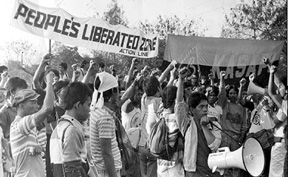
There is now little to say about this first EDSA Revolution known around the world and the subsequent EDSA revolution attempts, except the failure of their promise. Who could forget the four days in February 1986 when Filipinos joined together and turned EDSA, a major roadway in the Philippines, into a sea of people creating a gigantic wave to wash away 20 years of the Marcos dictatorship.
At EDSA, Filipinos showed the world that the masses could defy leaders who had robbed them and betrayed them. Many people were wiretapped, cheated, bribed, jailed, tortured, or killed, particularly leaders who refused to be corrupted by the Marcos regime.
Perhaps you remember the masses of people armed with nothing but their faith and cries for freedom. We used our bodies to shield those in the military establishment in EDSA. At the corner of EDSA and Santolan Road, where I was, women, men, children, the elderly, disabled, rich, poor, and people of diverse faiths gathered together and held hands, without fear of death. We barricaded to protect the two top Marcos cronies, the Defense Minister and the Vice Chief of the Armed Forces, who were defecting against their former master to support the political opposition call for civil disobedience led by Cory Aquino.
It felt like 20 years of suffering under Marcos was coming to an end at EDSA. Filipinos saw the promise that they could now install truly elected leaders of their choice into government. We believed that vote buying would end and that we all could speak out without fear once again. We could begin rebuilding our lives from whatever was left after the Marcos excesses and tyranny, and earn the global community's respect for Filipino freedom, democracy, and sovereignty.
At the first EDSA in 1986, we Filipinos learned to use our voices. But 20 years later, we are still unheard or ignored by many of those in power. Many returned for EDSA 2 in January 2001and another EDSA attempt last summer, demanding the same basic constitutional freedoms and a government for the people free of corruption. Each time, the masses of protesters were dispelled with empty promises from succeeding politicians who seized the opportunity to support the masses for their own purposes rather than to advance the EDSA movement's ideals. The Filipino people are still stuck in the same mud -- ailing economy, poverty, rampant political corruption, and constitutional crisis, or should I say circus. While the EDSA movements may not have been successful back home, they did send tremors around the world, inspiring social and political change in many places.
Despite the failures of the first EDSA and the last 20 years of desecration of Filipino bravery and sacrifice, the EDSA spirit is not dead. For those of us here in America, our journey away from our beloved country for economic survival may separate us from the fight back home, but the EDSA spirit should also remind us of our Filipino sense of social responsibility here. Those of us who now live in Wisconsin face the challenges of this year's midterm election in November, a number of decisions whose outcomes will affect us all. We should all remember the EDSA spirit. Let's re-light the flame of our first EDSA. Our numbers may seem like a drop in the bucket, but as the first EDSA taught us, all of us together, friends, neighbors, co-workers, fellow Asians, and other minorities, can create the wave to again wash away the confusion and fears that are currently looming over us. |