| Raising biracial and bicultural children is a unique experience for any family; it was for the Cowells. The modern Hawaiians have a name for my children: They call them "Hapas," half-Asian and half-something else. In fact, among their ancestors are representatives from China, England, French-Canada, Germany, India, Ireland, Malaysia, Portugal, Scotland, Spain, and, according to one great-grandmother, Sioux, but I think that is just wishful thinking. During our kids' childhoods, our family lived in three countries -- the Philippines, Taiwan, and Sri Lanka -- and we adopted a few choice expressions along the way. When Li and Jon were toddlers, the most important words were banyo and tubig (bathroom and water, Tagalog). We all still use bu hau (not good, Chinese), and ayaw ko (I don't want to, Tagalog), di ba? (isn' it? Tagalog), mali (younger brother, Sinhala), and salamat (thank you, Tagalog.). The wordless side-to-side shake of the head meaning "yes, I agree with you" in Sri Lanka is sometimes part of our body language, so is the quick raise of one's eyebrows to indicate agreement, a common expression in the Philippines. Our daughter's glossary was slightly different from her younger brother's. Pusod (belly-button) and kili-kili (underarm) were favorites because it delighted everyone when she showed hers. Being two in Taiwan, she was shiao mei mei and shiao pengyou (little sister and little friend, Chinese). She said Xie, xie (thank you, Chinese) and all of us still say it, probably with the incorrect inflection and tone. Tagalog and English creeped in during meal times, "Do you want to eat a butiki?" (small gecko, Tagalog). She called her grandfather "Lolo Pappy" because he was her grandfather (Lolo) and it only made sense to call him what everyone else called him (Pappy). Goodbye to her father as he left for work was a moralistic reminder: "Don't fall down." Her first word was "book." It was at this time that her younger brother was born, and she introduced herself to him by saying, "Hello Jonathan, I am your Ate (elder sister) Li." She is still called Ate by us and many friends. Her younger brother's glossary was slightly different. We were in the Philippines then, and his first word was "cat"; because at 10 months, he tamed a homeless cat by slowly approaching him with a smile and wonder. Then came the Tagalog words baho, chichas, utot, matigas ang ulo, bukol, sarap, gutom ka na? and sige na (smells bad, smelly feet, fart, stubborn, bump, delicious, are you hungry? And let's go!). It's no wonder that he would mix words up, such as: "I have matigas ang ulo," meaning he has a headache. In Sri Lanka, he became Jon Baba (child, Sinhala), and in the Philippines, in the midst of younger cousins, he was Kuya (elder brother) Jon. I still call him pogi (handsome, Tagalog slang derived from Spanish guapo). When in Manila and in need of service in a restaurant or store, both he and his sister follow the local practice and call the men "boss" and the women "miss." Thus, in the midst of many cultures and languages, it isn't any wonder that a three-year old would remark: "Mommy, we're Japanese because we speak Spanish, no?" Their creative use of the English language at a young age broadened their parents' vision of the world. We taught them to pray before going to bed. "Other Father who art in heben ... and lead us not into plantations but deliver us from eagles." I wondered if the prayer gave them bad dreams of jungles with raptors flying in to swoop them up for dinner. A trip to India gave them time to reflect on life, as well as to explore the labyrinths of ancient and mighty palaces. The Amber Palace, sitting like a jewel near a small lake in Rajasthan, India, held promises of wonder and discovery. They rushed through rooms within rooms; saw glass-decorated walls with semi-precious stones, intricately carved marble windows, fountains that once held water with reverence, dark prisons underneath beautiful gardens. Jon climbed every wall and investigated every room. We had our lunch at a quiet place and monkeys, being as smart as monkeys are, visited our table. Jon fed a few of them, and thoughtfully observed, "I was encarnated before as a monkey." Li rolled up her eyes, "He means reincarnated." Ah, maybe this is one way future Buddhists come to be. |
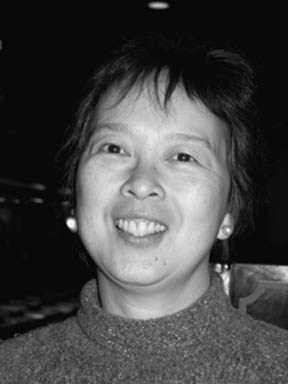
| "We're Japanese that's why we speak Spanish." by Regina Cowell |
 |
 |