| Every Philippine president since Ferdinand Marcos has embarked on several diplomatic initiatives, first through the Tripoli Agreement in 1996, and later, through the Organization of Islamic Conference of Foreign Ministers (OIC) and other international leaders from the Muslim world. Today, President Gloria Macapagal-Arroyo is pursuing another peace initiative through the same route. A number of local initiatives with foreign partners, such as the U.S. Institute of Peace, are actively engaged to make peace work among civilian Muslims and Christians. ACCESS Philippines Program is at the top of the list. "During the last quarter of the 13th century, if not earlier, there existed already a Muslim community in Sulu," wrote Dr. Nagasura T. Madale in his article "A Look at Philippine Mosques." A Filipino Muslim scholar, Madale has written countless books and essays on peace and development, especially on the delicate issue of the Moro/Muslim minority';s quest for self-governance in southern Philippines. At present, he is the first vice president for research and extension at the Capitol University in Cagayan de Oro City, Mindanao. Madale is in the United States briefly to supervise a project called ACCESS Philippines Program, which hopes to engage youth from southern Philippines in "interethnic dialogue and conflict resolution." "I'm the in-country co-coordinator of this program which is funded by the U.S. State Department," began Madale in a recent interview with Asian Wisconzine in Milwaukee. "We are on our third year, and we bring (about 30) students from all over Mindanao "15-17 years old and adults not more than 40 years old to be trained on peace, mediation, and conflict resolution." ACCESS Philippines Project is a joint endeavor of the Center for Southeast Asian Studies (CSEAS), the International Training Office (ITO) of Northern Illinois University (NIU), and Capitol University. It hosts Muslims and non-Muslims from Mindanao to learn from the example of civic relationships and cultural diversity in American society. After a month, these "trainees" would go back to their respective communities in Mindanao. "They would do grass-roots projects to build, promote, and nourish the so-called "cultural peace," Madale explained. "The idea is to train young people interested in changing the environment from a conflict-ridden community to one where there is love, peace, tolerance, and respect for everyone." , The participants are screened by a committee composed of Americans and Filipinos, and they should belong to these three groups: Muslims, Christians, and Lomads (tribe members). They should also be good in terms of academic performance," said Madale. "And they must have initiated grass-roots projects that promote peace and interfaith dialogue." Other requirements in the application form include submission of an essay about the applicant and his/her assessment of the peace and order situation in his/her locality as well as specific involvement in peace-related activities in school and community. As to the areas in Mindanao where participants are recruited, Madale said that they "divided" Mindanao into three parts: eastern Mindanao (Cotabato, Gen. Santos, Surigao), Central Mindanao (Cagayan de Oro, Lanao, Maguindanao); and southwestern Mindanao (Basilan, Zamboanga, Sulu, and Tawi-Tawi), and assigned regional coordinators to recruit potential participants to the program. The project hopes to produce youth and adult leaders who would make a real difference in creating peace and understanding in Mindanao, if not today, tomorrow. "To my mind, the most important thing for us to do is to change ourselves initially before reaching out to others," Madale said. "Unless we do that, we may not be able to change another person. Perhaps if we establish a kind of a Mindanao network of young people and adults who will work for peace, I think peace may be achieved. It may not be possible in our generation, but it may be in the next generations yet to come." |
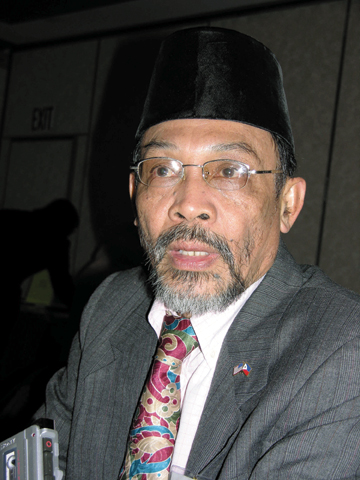
| Dr. Nagasura T. Madale Filipino Muslim scholar works for peace by Heidi M. Pascual |
 |
 |
| Filipino Muslims make up 5 percent, or around 4 million, out of the total Philippine population of 82 million. They are largely concentrated in the island of Mindanao, the second largest island of the Philippines. For hundreds of years, they had repeatedly resisted successfully the incursions of Spanish colonizers, until the American colonizers came with sophisticated weapons; allotting considerable administrative powers to locals; and implementing the demographic model of colonization where entire landless Christian populations from Luzon and the Visayas were encouraged to migrate to Mindanao on lands the Muslims had claimed as theirs. When Christians became the majority in Mindanao, the Muslims found themselves dislocated and confined in largely impoverished regions. In the late '60s, politically active Muslim students' groups waged several campaigns for the Philippine government to recognize the Muslims' right to self-determination. Movements such as these led to the establishment of the Moro National Liberation Front (MNLF) and later, the Moro Islamic Liberation Front (MILF), many of whose members underwent paramilitary training in Malaysia. By early '70s, violent incidents involving Christian and Muslim paramilitary groups escalated, resulting in hundreds of thousands of military and civilian deaths. |
| Dr. Nagasura T. Madale |