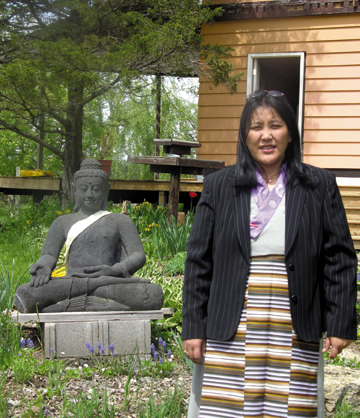
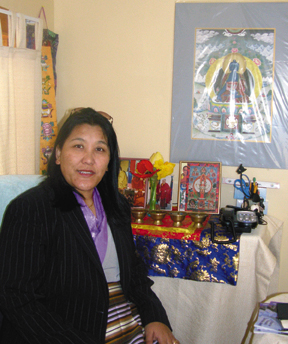
| The place is a regular Western house nestled in a peaceful rural mountainside of Spring Green, Wisconsin. A big Buddha sculpture graces the stairs to the front door of the house, and a smaller one "guards" the big yard to the right. I was greeted warmly by Amchi Karma Dolma La, dressed in Tibetan attire topped with a Western-style blazer. The inside of the house is decorated with everything Tibetan, from carpets to wall hangings, and several photographs of the Dalai Lama are placed on special spots throughout the house. Amchi Dolma led me to her office on the second floor of the house. It was a cozy room with windows that showed nature's art work: a view of rural Wisconsin: green fields punctuated with newly leafed trees of spring. It's no wonder a practitioner of Tibetan medicine will be found in such a natural setting. The place is called Medicine Buddha Healing Center. Tibetan medicine is "as old as civilization itself," Amchi Karma Dolma La began. "It is an integral part of the Tibetan culture, which evolved through time." Amchi Karma Dolma La is the third Tibetan medical practitioner sent by Men-Tsee-Khang (The Tibetan Medical and Astro. Institute of H.H. The Dalai Lama) to Spring Green, Wis., in partnership with the University of Wisconsin and a local Spring Green resident, Marion Nelson, owner of Global View, a museo-shop of Asian ethnographic art and textiles. "Mrs. Nelson travels in India a lot because of her business, and because she suffered from a neurological disorder that was cured by Tibetan medicine, she wanted to share with others her healing experience," Amchi Dolma explained. "She helped arrange with the UW, Men-Tsee-Khang's presence in Wisconsin." What is Tibetan medicine? Amchi Dolma opened her laptop and showed this author the basics of her field of expertise. "Tibetan medicine has depended on nature, and based on accumulated knowledge and years of practice, remedies from nature have been discovered to cure common ailments." Amchi Dolma recalled the early years before she went to the Men-Tsee-Khang Institute. "I wanted to be in the medical field even when I was a child because my mother used to be sick and I wanted to be able to treat her," Amchi Dolma recalled. "We lived in a village so far from the town that no treatment was available to her." As the eldest in the family of four, Amchi Dolma did household chores and took care of her younger siblings in between her school hours. "I was also in charge of milking the cow and making cheese," she said. "So when I told my mother that I wanted to go to the medical school, she refused, saying, 'Who will take care of me? Who will help me in the house?'" Fortunately, Amchi Dolma's father and grandfather pushed her to pursue her dream. When Men-Tsee-Khang advertised for students who are interested in the medical profession, Amchi Dolma saw the opportunity and took the exams in 1980. Two years later, she was enrolled as a freshman in the Tibetan Medical and Astrological Institute. When she graduated in 1987, her mother reportedly apologized to her, and said, "'Im sorry I tried to stop you; if you didn't go maybe you'd still be in the farm, and you got nothing. Now I realize you were right.'" We had to study the Four Tantras (rgud-bzhi), Amchi Dolma said about her years in the medical school. "It still remains the fundamental medical text today, although now the books are bound, unlike in the past when we had to read texts on loose leaves." Tantra (which means "lineage") is composed of four books, believed taught by Buddha himself, which explains all diseases; the anatomy and physiology of the body; the cause, nature and treatment of diseases; and methods of diagnosis, pharmacology and support. "The four tantras have 156 chapters, with 5,900 verses describing [above]," Amchi Dolma said. "And we have to remember everything in it." But that is not all. There is an internship stage, as well. "There are 40 branches or clinics of Men-Tsee-Khang all over India," Amchi Dolma continued. "We students go to a clinic with a senior doctor who visits patients, and we learn how to check or diagnose patients." Diagnosis is done via three methods: visual examination, pulse reading, and interrogation. "From visual examination of a patient's urine, for example, we can tell whether something is wrong," Amchi Dolma said, pointing to samples on her laptop. "There are differences between when a urine sample is newly taken from one that is lukewarm or one that is cold." She said this is like a mirror that shows a person's ailment inside the body. Visual observation also involves checking the patient's skin, color and texture of the blood, nails, sputum, and feces. Going deeper into her work, Amchi Dolma patiently guided me into understanding the root cause of all illnesses. "It's ego,"she said flatly. "And it leads to attachment, anger, and delusion; too much attachment results in stress; anger leads to bile disease; and delusion leads to phlegm disease. " These diseases may be avoided, Amchi Dolma continued, if we avoid those mental states in the first place. And when they can't be avoided, Amchi Dolma showed me a roomful of Tibetan medicine, herbs mostly, which she calls "supplements." "We don't do surgery," she said. "We can diagnose what's wrong with a patient and we start with analyzing one's diet and lifestyle. Sometimes, the treatment is simply a change in either or both." [Tibetan medicine is a science, art, and philosophy that provides a holistic approach to health care. It is a science because its principles are enumerated in a systematic and logical framework based on an understanding of the body and its relationship to the environment. It is an art because it uses diagnostic techniques based on the creativity, insight, subtlety and compassion of the medical practitioner. And it is a philosophy because it embraces the key Buddhist principles of altruism, karma, and ethics. -- Men-Tsee-Khang] Amchi Karma Dolma La was born in Dharamsala, India in 1963, four years after her parents arrived from Tibet. She graduated from the Central School for Tibetan Studies in Bylakuppe in 1981. In 1982, she entered the College of the Tibetan Medical and Astrological Institute (Men-Tsee-Khang), graduating therefrom in 1986 with a degree of Mencha Karchupa, and a year of practicum under the guidance of the late Dr. Lobsang Wangyal (personal physician of H.H. the Dalai Lama) and Dr. Dawa Dolma. In 1999, Amchi Dolma completed her degree of Menrampa Chungwa. From 1988 to 2004, Amchi Dolma was assigned to various clinics/branches of Men-Tsee-Khang. She has also traveled in several parts of the world to give lectures and medical consultations. It is the high level committee of Men-Tsee-Khang that selected her to serve as the resident health advisor at the Medicine Buddha Healing Center in Spring Green for two years. |
| Tibetan medicine according to Amchi K. Dolma La: A holistic approach to health by Heidi M. Pascual |
 |
 |
 |
 |
| Namo Maha Beshajeya "Honor to the Great Medicinal Buddha! Whoever due to wrong ideas and attitudes Is bound to fall into states of suffering If he even hears the sound of your sacred name, He will not be reborn in sorrow And will reach the state of immaculate Purity." Medicine Buddha Mantra "...Om Namo Bhagavate Beshajeya Guru Bedurya Prabha Rajaya Tathagataya Arahate Samayak Sam Buddhaya Tadyataya Arahate Samayak Sam Buddhaya Tadyatha Om Beshajey Beshajeya Maha Beshajeya Beshajeya Rajaya Samungate Savaha" |
| Amchi K. Dolma in front of Medicine Buddha Healing Center |
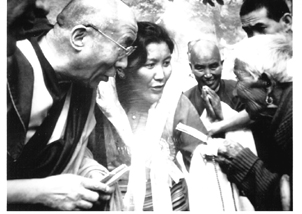
| (Above) With the Dalai Lama as Amchi Dolma attends to patients in India. |
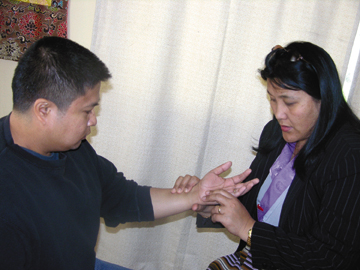
| Checking the pulse of Dennis Alfred Pascual in her consultation room. |
 |