The Khmer population of Wisconsin, many of whom are refugees and survivors of the Khmer Rouge terror in mid '70s, celebrated New Year (chol chnam) on April 15 in the tradition of Theravada Buddhism, at the Theravada Buddhist Temple (wat) in Oregon. Buddhist monks presided over the offerings and the rituals before the festivity started. As always, this special day was a way to celebrate the new life in America and to recall the hardships many of the older population experienced under the Khmer Rouge regime, their daring escape to avoid the "killing fields," and their survival in a foreign land.
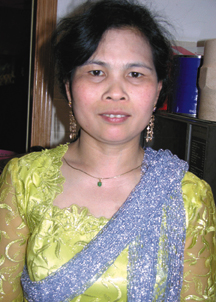
Song Chan of Janesville was 14 when she left Cambodia and escaped through a jungle route that took her to Thailand. "It was a difficult escape," she recalled, that kept her almost awake for three days and three nights. "There were millions of Cambodians killed by the Khmer Rouge, and I didn't want to be one of them." Song Chan's story was typical of the thousands of Cambodian refugees admitted to the U.S. since 1975. The common denominator was that the Khmer Rouge forced people';s total allegiance to the Angka -- the government, banned all institutions, and killed the educated, the sympathizers to the past regime, and those "disloyal" to them.
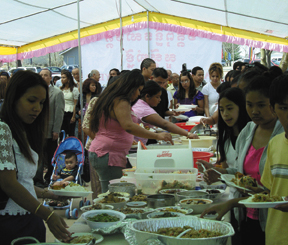
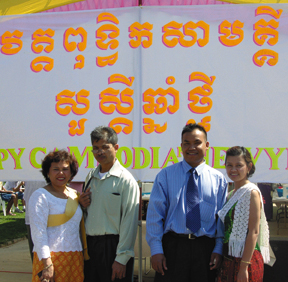
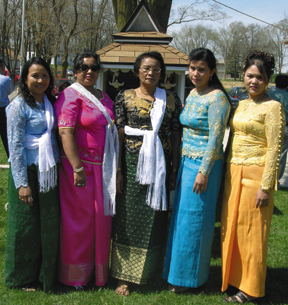
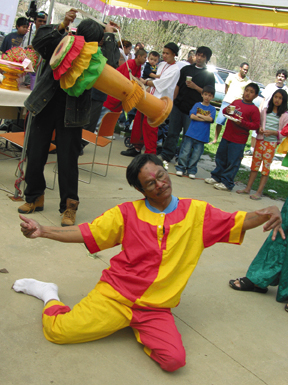
As I indicated in the first part of this article, the prelude of the celebration was the April 1 event honoring the Cambodian elderly. This second gathering had a more festive flavor to it, starting with the colorful native attire worn by women, elaborate traditional decorations, a continuous musical entertainment numbers, public dancing, and lots and lots of food for everyone present.
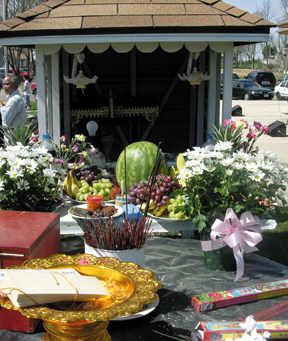
;According to my friend Rong Roun, the Cambodian New Year lasts three days. They clean and decorate their homes on the first day, and often a small hut or shelf called sakarak-bouchea, a place of worship, is built in front of the house in which a ceremonial ornament called slathor and a tiered ceremonial ornament called baisey are placed. It is a day to welcome the new angels and bless the New Year. "When the time comes, people light the candles and the incense on the hut, scriptures are read, and prayers are said for blessing, peace, health, and other requests," Rong said. &"After that, people prepare food, bring it to the pagoda (temple), offer it to the monks, then listen to prayers. Then paper lanterns are lit in the homes, some fly the lanterns aloft until the candles burn out. Traditional games are also played."
The third and final day is for the community to gather together to worship and celebrate their life and faith. The Cambodians in Wisconsin hope to carry on this tradition every year.
|