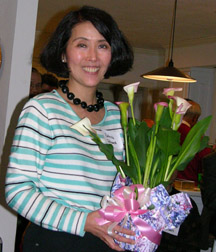
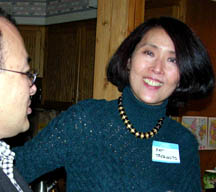
"Hawaii is such a melting pot," Takemoto said. "It's Polynesian, it's Asian, it's Caucasian. In Hawaii, you don't view people on an ethnicity basis. To me, that really frees people."
Takemoto grew up with her parents and two siblings in what some have dubbed paradise. Her father was a chemist and her mother a homemaker. She describes her childhood as happy and filled with community. In Hawaii, she was never ostracized or ridiculed for who she was or how she looked.
"I think you see people more for who they are in Hawaii." she said. ";I would love for everyone in Madison to spend a month in Hawaii. They could see how wonderful it is not to see things along ethnic lines. To me, Hawaii is the best example in the United States of how races can really work together."
Takemoto's parents, however, lived through a time that demonstrated extreme racial prejudice in the United States. Both her parents and grandparents survived the internment camps of World War II.
The internment of Japanese Americans began after President Franklin D. Roosevelt signed Executive Order 9066 on Feb. 19, 1942. Roughly 120,000 Japanese Americans were rounded up and placed in one of 10 internment camps in the U.S., where they were forced to live in extremely poor conditions. Many lost their homes and businesses.
"My grandparents had to sell their house and their business," Takemoto said. "My father also had to sell his business, which was a laundry, and his house."
Takemoto's parents met while imprisoned at an internment camp in Arizona. When they were released, they worked hard to build back what was taken from them. For a long time, they did not talk about their experience.
"They were ashamed of the episode," Takemoto said. "So for many years after, very few people talked about it. It wasn't until the late 1970s that people started to talk about it." Takemoto's mother still feels somewhat bitter about having to endure such an experience.
"She feels it was three or four years lost from her life," Takemoto said. "My mother still doesn't understand why as an American citizen she lost her rights."
Takemoto's family moved back to the mainland while she was in high school to live in the Chicago area. Takemoto attended high school in Chicago and then went on to the University of Chicago, where she majored in English literature. She received her Ph.D. in adult education from Northern Illinois University.
Takemoto first came to the Madison area for a graduate internship with Wisconsin Public Television (WPT). She worked with WPT until 1989, when she took a job with the University of Wisconsin-Madison's Outreach and Continuing Education program. She then worked with the UW System until she took a position with UW Extension. Now the assistant vice chancellor for UW Extension in Madison, Takemoto is charged with creating opportunities for UW Extension to work with higher education communities throughout the state.
"UW Extension is like the nontraditional arm of the university," Takemoto said. "We serve lifelong learners of all ages. [Our work] impacts over a million people a year."
UW Extension has been dubbed the "doorway to public education"; for individuals, families, and organizations across the state. Its programs include a number of lifelong learning opportunities, outreach and e-learning, as well as Wisconsin Public Radio and WPT.
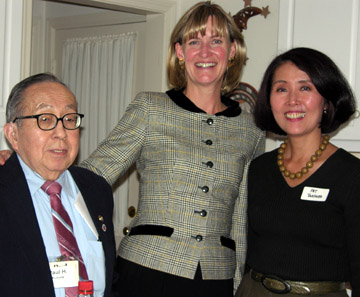
Aside from her high-profile job, Takemoto has become a notable voice for Asian Americans in the Madison community. She hosts meetings for the Wisconsin Organization of Asian Americans (WOAA), one of the largest organizations in Wisconsin that brings together Asian Americans of all ethnicities. The group has hosted talks by notable community leaders, including Sen. Russ Feingold (D-Wis.), Lt. Gov. Barbara Lawton, and Centro Hispano Executive Director Peter Muņoz.
Takemoto is also an active member of PAWA (Pacific and Asian?s Women Alliance), an organization that helped establish the Asian American Studies Program at UW-Madison.
"PAWA came together about 20 years ago," Takemoto said. "That group was really the impetus behind the development of the Asian American Studies Program."
Takemoto is not only an influential voice for Asian Americans in the Madison community; she is also an active advocate for the arts in Madison. She has been involved with the Madison Repertory Theater, the Dane County Cultural Affairs Commission, and the Madison Symphony.
"Arts and culture are so important for children and everybody in society," Takemoto said. "They contribute greatly to keeping a strong community."
Through her work and commitment to community organizations, Takemoto has positively impacted the Madison community. While she still thinks fondly of Hawaii and its people, she has done her share to make Madison a better place to live.