
By Anna Maria Manalo
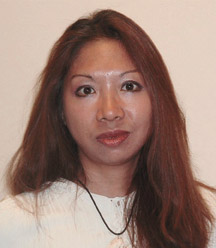
RP: I came to Madison in the summer of 1989.
AW: Where have you lived before?
RP: I was born and raised in the Philippines, growing up in the mountain city of Baguio and later in Manila. As an adult I have lived in the U.S., specifically Ann Arbor, MI; Washington, D.C., New Haven, CT; I also lived for a while in Suva, Fiji; and Sydney, Australia which is where I lived before I moved to Madison. Fiji and Australia were really major cultural learning experiences. I learned so much being of the perceived "majority" in Fiji, because everyone thought I must be part-Tongan or part-Samoan, or somehow a Pacific Islander because of my physical appearance. And I learned so much living in Australia because people thought (with my accent) that I must be from the U.S. or Canada, but because I am Asian-looking, they could not work out who and what I was! It was actually funny sometimes watching the White Australians try to figure out how to relate to me. I did make a lot of very good friends there --so many nice people with whom I continue to be in touch.
AW: Where did you do your undergrad? Master's? PhD?
RP: Undergrad: the University of the Philippines; Master's and PhD (modern history of the Philippines) at the University of Michigan in Ann Arbor.
AW: What do you find most satisfying about your work?
AW: What do you think about the UW's current efforts towards increasing diversity?
RP: We do have a long way to go, particularly in achieving a critical mass of students, faculty and staff of color. A look at trend data of student of color enrollment at all levels --undergraduate, graduate and professional -- will show the very slow rate of increase in numbers. The same is true for faculty of color and staff of color. That is discouraging. In addition, there are urgent issues of campus and classroom climate that tend to inhibit the success of not just people of color but also those who are not of the majority or predominant culture, religion, or lifestyle. To be fair, the university leadership does try to deal with these issues. For example, there are training programs for department chairs and people in leadership positions to increase awareness and suggest strategies for increasing diversity in hiring. And we do have departments that model the way social change can be brought to this campus. But those are the exceptions. What needs to happen is that these "model" departments have to become the norm. Their way of doing things has to become THE way of doing things. There are too many in the faculty, student, and staff sectors of this university who do not see a problem. Fortunately, there is a group of faculty, staff, and students who are NOT people of color who see the need for social justice and social change. Their number has to become the majority and their way of thinking has to bring about systemic change.
AW: Do you see any patterns to issues specifically concerning Asian students?
RP: Asian American students are often seen as the "model minority," students who do well in the sciences and present no problems in recruitment, retention, and graduation. But this stereotype, as do all stereotypes, do not do justice to the issues that confront the Asian American students. The university does identify the "targeted" Asian American students, i.e., the Southeast Asian American students of Lao, Vietnamese, Cambodian and Hmong backgrounds. Are there issues that other (non-Southeast Asian) Asian-American students face? Yes, there are. For example, one of the issues raised by the students is that there is a dearth of academic advisors and staff of Asian-American ethnic background with whom these students might feel comfortable. Because they are not considered "targeted," there is no specific effort to address this need. Because their retention and graduation rates are high, there is not much of a sense of urgency. But there are special needs that Asian American students confront. Student organizations like APAC (Asian Pacific American Council) and smaller groups like HASA (Hmong American Student Association) step into the breach. But as you can see, these are pretty much self-help efforts. Where is the institutional or community commitment?
AW: Can you summarize the main initiatives of Plan 2008?
RP: There are seven goals for Plan 2008. For me, the most critical of these goals is the college pipeline, to ensure that students at pre-college levels -- elementary, middle school and high school -- get onto the college track and (with their parents) see higher education as a career choice that they have the right to consider. So, I feel that the work that I have done with the PEOPLE program, through Student Affairs, as one of the most important contributions to implementing Plan 2008. PEOPLE is the sort of visionary program we need to do something about getting our gifted students of color into the best universities, include this one, in this country. Its leaders had the vision and the commitment to see PEOPLE through, and that's why this program exists. AW: What do you consider your greatest achievement?
RP: As a single mother, I raised my four children. Seeing them all through college as strong, bright, and principled young adults is what I consider my greatest achievement. But I cannot claim full credit. I have to recognize that my kids did a lot of growing up on their own. That is their achievement. Seeing them now as young adults is one of the best and brightest things for me.
AW: Do you have a life-guiding principle(s) to share?
RP: When anyone provides help or encouragement or does anything to help lighten your burden, remember what has been done for you, and do the same for someone else. Pass it on.
Anna Maria Manalo is currently back in Madison and is spending her time by performing solo piano programs for local communities, volunteering as a Big Sister of Dane County and for her Dad's medical mission PAGASA, working as a Tagalog consultant for the National Language Institute, and teaching piano and violin privately.

