A Report to Filipinos in America
by Heidi M. Pascual
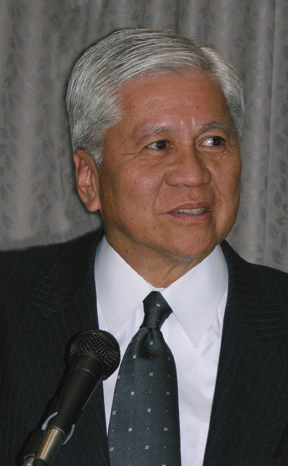
"I'd like to start by saying that with the leadership of President [Gloria] Arroyo, the bilateral relationship with the United States has been significantly enhanced," Amb. Del Rosario said. "The relationship is broader, deeper, and more diverse, and I believe that we've reached a level of maturity in some measure."
Amb. Del Rosario discussed at length the principal disagreement that transpired between the United States and the Philippines very recently, when President Arroyo decided to pull out the 51-man Filipino contingent in Iraq. "President Bush expressed a very bitter disappointment, and I'd like to explain to you the circumstances surrounding that decision of the president," he said. "When Angelo dela Cruz [an overseas worker in Iraq] was taken as hostage, the United States expected that there will be no negotiation, no ransom. This, of course, was the expectation of all allies as part of the coalition of the willing."
The action of the Philippine president, according to the ambassador, was very difficult but had to be made to avert the government's downfall. "Angelo dela Cruz was representative and symbolic of the eight million overseas Filipino workers, 1.6 million of whom are deployed in the Middle East, and 6,000 in Iraq. "If President Arroyo did not come to his rescue, we would have scores of families out in the streets; they would have been joined by the left , by the right, by the opposition, considering that we just had concluded a bitterly-contested election; ... and by the Church [which] was very much opposed to this war on Iraq."
National interest dictated such action which was seen negatively by the U.S. "It was very difficult for us to take that position -- to honor an international commitment at the risk of foregoing the national interest," Amb. Del Rosario continued. "What this has done for us is effectively unite the Filipino people so that we could be stronger as an ally for the United States in the future."
The Philippine Consulate in Washington, D.C. has arranged three state visits so far: President Arroyo has visited the United States in 2001 and 2003, and a reciprocal visit by President Bush in 2003.
In addition, a first-ever Philippine friendship caucus, consisting of 75 congressmen, has been established in the U.S. House of Representatives to promote Philippine interest. Amb. Del Rosario said he hopes to raise that number to a hundred legislators.
Defense and Security
The Foreign Military Finance (FMF) is the measure of assistance in terms of grants given to the Philippines by the U.S. It has improved quantitatively between 2001 to 2003 to more than 2,500 percent. The ambassador enumerated the items donated to the Philippines, such as helicopters, patrol boats, M16s, C130s, hundreds of trucks, and joint training exercises, and hailed the reform program for the Philippine military that improves its capability and modernization. A multi-year cooperation to the tune of $400 million -- the program's cost would be shared by the two governments.
On the Muslim extremists and Al Qaida cells in Mindanao, Amb. Del Rosario assured his audience that "We're closing down their cells as quickly as we can find them." And on the Muslim separatist movement, he said that the U.S. is providing diplomatic and financial assistance to pursue to closure a peace agreement with the MILF (Mindanao Islamic Liberation Front).
Economic Diplomacy
A new thrust in the Philippine Consulate in Washington, economic diplomacy focuses on three basic areas: generating investments; expanding trade; and boosting tourism.
Outsourcing has become the major component of investment generation. "We are promoting four or five major investment areas: information and communication technology, back office operations, medical and legal transcriptions, mining, and medical retirement facilities," Amb. Del Rosario proudly announced. He emphasized that the Philippines has its competitive advantage -- its people -- who are a quality resource in terms of education, English proficiency, and their attributes to learn quickly and be managed easily. "We're talking of a buildup of about 85 companies, most of which are American."
Trade and Commerce
Expanding Philippine markets is a major concern. "We're trying to get the U.S. to open access for our products,?"Amb. Del Rosario reported. "While we enjoy the GSP-Duty-Free exports to the U.S., we have to push for more products."
If the Philippine Consulate didn't lobby the U.S. Congress, the tuna canning industry in Mindanao would have died, according to the ambassador. "The U.S. Congress was trying to provide a preferential treatment for the Andean countries to wean them away from illegal trade; but in doing so, they were going to prejudice the Philippines." The effort to save the Philippine tuna industry utilized 128 visits in 6 weeks to the U.S. Capitol.
Tourism
For the first time in the Philippine tourism history, a Philippine ambassador initiated a tour for Filipinos abroad who have not gone back to the Philippines for many years. Called the Ambassador's Tour, its first trip this year boasted almost 600 participants, the largest tour group ever from North America.
Other areas of cooperation
Amb. Del Rosario acknowledged the presence of Filipino nurses in the audience, as he segued to the topic on other areas of cooperation. Because of the shortage of health professionals in the U.S., the Philippines sends thousands of health care professionals every year. "By 2010, the shortage would be close to 275,000. By 2020, the shortage will be as many as 800,000," he said. "What we're trying to do is create opportunities for our people to improve themselves because these opportunities are not available in the same quality and compensation levels as they have here."
Philippine political and economic situation
Jumping on the situation back home, Amb. Del Rosario informed the audience about the possibility of a charter change by converting the Congress into a Constituent Assembly. He said the direction is to move toward a parliamentary system of government to be able to do away with the gridlock between the legislative and the executive, and between the Senate and the House.
As to reforms on the horizon, the ambassador admitted that corruption has to be eradicated. "I think the problem as perceived is not only deeply rooted, but that it has also exacerbated," he said. "To that, we're saying that there should be three major corruption programs: to be able to put away the known tax evaders; the known smugglers in customs; and government officials who live beyond their means."
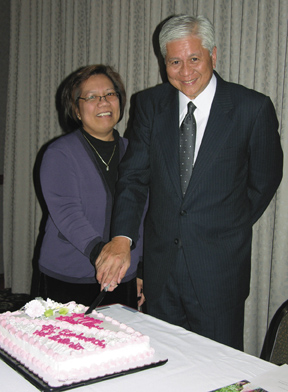
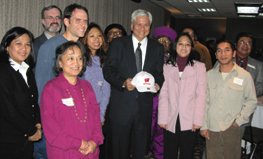
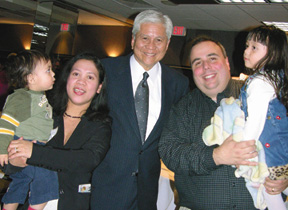
The ambassador then answered questions from his audience and afterward exchanged pleasantries with them, cut a birthday cake, and received special gifts from PAMANA (Philippine American Association for Madison and Neighboring Areas). Ambassador del Rosario received his bachelor's degree in economics from New York University. Prior to joining the Philippine government, he served on the Board of Directors of over 50 firms. His business career for over four decades has spanned the insurance, banking, real estate, shipping, telecommunications, consumer products, retail, pharmaceutical and food industries. In Sepember. 2004, Amb. Del Rosario was conferred the highest civilian award, the Order of Sikatuna, Rank of Datu, by H.E. President Gloria Arroyo, for his outstanding efforts in promoting foreign relations.