
Natasha Pierce: Teaching Chinese language beyond instruction
by Laura Salinger
Chicago's public school system is considered an innovative leader when it comes to Chinese language instruction. Their Chinese World Language Program, which started with 3 schools in 1999, is now offered in 20 schools and reaches 3,000 students. The program is offered during the school day and primarily serves non-Chinese speaking students. The
In Wisconsin, Chinese language instruction hasn't quite boomed like it has in Chicago. In Madison, only one high school- Memorial High School on Madison's west side- offers Chinese as an alternative to commonly taught languages like Spanish and French. Although, Chinese language classes aren't numerous in Madison, the course at Memorial High School is certainly innovative.
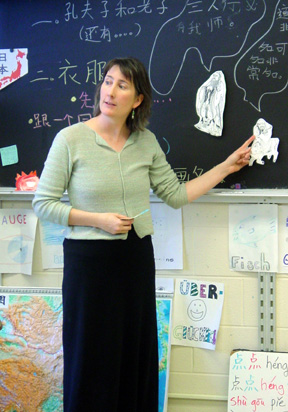
Natasha Pierce is the current Chinese teacher at Memorial and she has been lauded by colleagues as a teacher who goes above and beyond simple language instruction. Memorial's former Chinese language teacher Claire Kotenbeutel calls her "dedicated and innovative."
"I believe Ms. Pierce's innovative teaching of Chinese is far-reaching and has great impact on today's young people," Kotenbeutel said."Her goal is to not just teach the language, but give her students incentive to use Chinese in their future careers.
Pierce grew up in Wausau, Wis. And became a lover of languages at an early age. She studied German and French growing up, but wasn't introduced to Chinese until college. "I really liked [studying] language," she said. "But it didn't occur to me to study Chinese at this point in my life."
After college, she studied in Tawain for year while teaching English to elementary school students. She then spent a year as a translator for the National Palace Museum where she translated brochures for exhibits and a book about Bronze Age weapons. At the time, she said, she had no idea she would eventually be teaching Chinese to students in Wisconsin.
She first moved to Madison in 1994 to get her teacher's certification with the intention of teaching ESL (English as a Second Language.) With such limited Chinese language classrooms in Wisconsin at the time, she never really considered it an option to teach Chinese. She taught ESL for several years and eventually met the Chinese language teacher at Memorial. She began student teaching at Memorial in the 1996-97 school year and went on to teach Chinese at Toki Middle School. In the fall of 1998, she became Memorial?s full-time Chinese language instructor.
Pierce has taken the Chinese language program at Memorial to new heights. She brings not only her knowledge of the language to the classroom, but her experiences. "When I talk to my students about my experiences, it brings the culture alive for them," Pierce said. "I think it makes China that much more alive for them."
But Pierce doesn't just tell them about her experiences in China, she encourages them to visit the country as well. "Her students, both high school and college, have studied and lived with families in China," Kotenbeutel said. "They correspond with their sister-school in Harbin, China. They have done a study tour with Ms. Pierce in China. In short, the students feel connected with the language and country because their teacher gives them the world as their classroom."
To Pierce, this is a crucial part of learning a language. "I am always emphasizing to my students to use their Chinese in the country," Pierce said. "When you live the language, you learn all aspects of the culture and the language. In the last few years, I've really been trying to teach the kids beyond the classroom."
Pierce also incorporates ecology and environmental instruction into her lessons. She works closely with the International Crane Foundation and other organizations that bring China's environmental issues to the forefront. Her students have tracked the migration of Black-necked cranes, a globally threatened species indigenous to China, to learn about their ecology and habitat. Last year, they created children's books about Siberian cranes. This summer, Pierce will take up to 20 students to China to study "Cranes and Change."
Pierce and her students will spend 3 weeks traveling from major cities like Beijing to industrial cities like Lanzthou and to remote areas like Zoige in northern Sichuan, which is home to the breeding grounds of the Black-necked cranes. Students will stay with local families in Chengdu and visit one of Tibetan Buddhism's most important training centers; the Lagrang Monastery in Gansu Province.
According to organizers, the program "will explore both the challenges and opportunities China faces as it rapidly develops, along with the impact its modernization could have on the world and our future." Students will travel from "the construction cranes of economically vibrant eastern cities to the breeding grounds of living cranes on a remote plateau of culturally Tibetan western China."
Pierce's hands-on teaching style engages her students and brings Chinese out of the textbook and into the real world. At a time when the Chinese language is becoming increasingly popular in schools, Pierce is taking Chinese language instruction to new levels.
