
By Jonathan Gramling
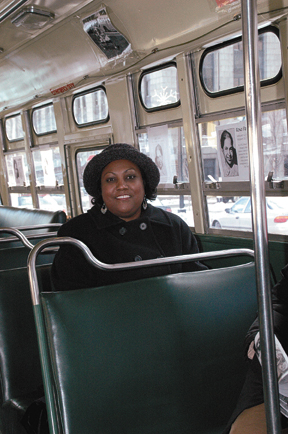
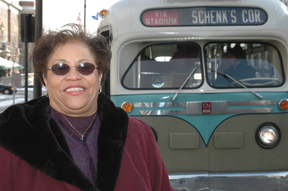
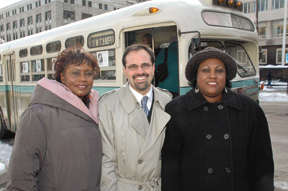
On December 5, the King Coalition reenacted Parks' historical act of civil disobedience and commemorated her in word and song at the Madison Municipal Building. A diverse crowd of over 75 people braved the cold and was warmed by the words of inspiration spoken at the event.
Rev. Gregory Armstrong, pastor of S.S. Morris AME Church, remembered the moment for its high ideals. "In a struggle for freedom and equality, we both celebrate and commemorate that moment in our country's history," he said. "We are transformed and invigorated to learn from this lesson while taking on our fight for freedom and justice for all."
Economic self-sufficiency, according to Scott Gray, president/CEO of the Urban League of Greater Madison, is the civil rights movement of the present. "The parity I speak of is folks of color having home ownership rates that are comparable to our White counterparts, jobs that are family sustaining, and opportunities for folks of color to create business opportunities," Gray said. "It will take all of our efforts to bring the American Dream to all Americans."
Ariel Ford, interim director of the Madison Equal Opportunities Commission, emphasized that Parks' act was the culmination of efforts and symbolic of many acts that African Americans took toward freedom. "Yes, on that historic December day, seamstress Rosa Parks did refuse to give up her seat on the bus," she said. "But others had tried before her. In 1949, a professor at Alabama State College had brought this issue to the forefront. Mrs. Parks and others from Montgomery had attended a session on civil rights at the Highlander Folk School in Monteagle, Tenn. There they met with people from other races and nationalities. This was part of the strength that Mrs. Parks gained to make her go and sit on that day."
Ford recalled her own small acts of disobedience that doubtlessly thousands of others had undertaken throughout the South. "For fun, I would just go and drink out of the White fountains and go drink out of the Colored fountain just to see what was going on," Ford said. "When I went to a camp in Boston and came back on the train, from Boston to Washington, D.C., there were a lot of other campers on the train. But from Washington to Birmingham, we didn't have a lot of campers. I got off the train in Birmingham with my little train case and walked into the White waiting room. Meanwhile, my mother and grandmother were frantic. The train had pulled out of the station. They looked in the Colored waiting room and there was no me. I'm sitting in the White waiting room with my feet on my train case. They came and got me out and explained why I wasn't supposed to be there."
And, in the end, it was this system of American apartheid that brought Ford to Wisconsin. "The University of Alabama would not let her go to school there to get her doctorate because it was segregated," Ford said. "But they would give her a stipend to go somewhere else. It was at that point she came to Madison and we moved here so she could get her doctorate."
Annie Weatherby, one of the organizers of the event, urged the audience to learn from Parks' example. "As a person who works for the Equal Opportunities Commission, I know that racism and discrimination are still active," Weatherby proclaimed. "Speak out! Ms. Rosa did and we all are the better for that." Change does happen one small act at a time.

