| Americans stood up and took notice. Policies and laws affecting African Americans were changed. The Civil Rights movement would go down in history for mobilizing a nation; its story and images still prevalent over 50 years later. While the Civil Rights movement in the U.S. was unique in many ways, the techniques used by protestors were not. The movement was deeply inspired by a man who had worked for social change for decades: Mahatma Gandhi. While people like Martin Luther King, Jr. and Rosa Parks became the faces associated with the American Civil Rights movement, it was leaders like Gandhi who pioneered the use of non-violence in political protest and set the tone for the historical movement. Martin Luther King, Jr. first became familiar with Gandhi while attending the Crozer Theological Seminary in Pennsylvania. He would later use Gandhian philosophies and practices to lead a nation on the quest for equality. "From my background, I gained my regulating Christian ideals," King once said. "From Gandhi, I learned my operational technique. The Gandhian philosophy of nonviolence is the only logical and moral approach to the solution of the race problem in the United States." Born Mohandas Karmachand Gandhi in 1869, Gandhi became one of the most respected spiritual and political leaders of the 1900s. He is perhaps best known for leading India and its people to freedom from British rule. The technique he used to do so is nonviolent resistance. Gandhi was married at age 13 to Kasturba, age 12, in a union arranged by their parents. The couple would have four sons. Gandhi studied law in London and returned to India in 1891. In 1893, he received a one-year contract to do legal work in South Africa. Like India at the time, South Africa was controlled by Great Britain. Gandhi witnessed discrimination and numerous abuses towards Indians in South Africa during his 21 years living there. Ruled by Apartheid, South Africa's government consistently denied civil liberties and political rights to Indians and other "non-Whites." Gandhi set out to change this. He developed a system of direct, non-violent social action to fight discrimination against Indians. He called it Satyagraha. Satyagraha promoted nonviolence and civil disobedience as tools to achieve political and social goals. Gandhi described Satyagraha as a "relentless search for Truth and a determination to search for Truth. Satyagraha is an attribute of the spirit within. Satyagraha can be described as an effective substitute for violence." After years of struggle, an agreement with South Africa's Natal government was reached in 1914 to alleviate anti-Indian discrimination. While the problem was not totally resolved, Gandhi and others had achieved a major milestone towards creating justice and equality for Indians in South Africa. It was now time for Gandhi to return home. In 1915, Gandhi returned to his native India in the hopes of improving the living conditions and rights of native Indians. Governed by the philosophies of Satyagraha, Gandhi led his followers on a campaign for Indian independence from Britain. By the 1930s, Gandhi had risen to become the leader of the Indian Nationalist Movement. The title of Mahatma (great soul) was bestowed upon him. By 1934, Gandhi left the political arena, yet continued his relentless pursuit for Indian?s freedom. In 1947, India finally gained independence from Britain. Tension and rioting between Hindus and Muslims, however, soon followed. On Jan. 13, 1948, Gandhi began a fast to promote the end of rioting and bloodshed. He believed in the possibility of a united India where both religious groups could live in peace. At the age of 78, Gandhi fasted for 5 days until opposing leaders agreed to stop fighting. Despite his efforts, a separate Muslim state (Pakistan) was created in 1948. On Jan. 30, 1948, Gandhi was assassinated by Hindu fanatic Nathuram Godse. His violent death shocked his followers and leaders worldwide. But it soon became obvious that his memory and philosophies would live on. Civil disobedience and non-violent resistance became a governing technique used by Civil Rights protestors in the United States in the years following Gandhi's death. Like Gandhi, American Civil Rights leaders would challenge their government and its policies through peaceful resistance. Gandhi spent a total of nearly seven years in prison in South African and India for his political activities. He considered imprisonment a powerful statement in the battle for justice and equality. Similarly, Martin Luther King, Jr. was arrested over 24 times for his political activities in the United States. He was assaulted at least four times. Like Gandhi, he did not waiver from his determination to create change. Inspired by a man halfway across the world, King and other Civil Rights leaders created sweeping changes using the philosophies and techniques of Satyagraha. Like Gandhi, King was assassinated while fighting for justice and peace. His death would also shock his followers and sadden a nation, but his message would also live on. |
| Mahatma Gandhi: Teacher of nonviolent uprising By Laura Salinger |
 |
| Throughout history, leaders have often threatened or used violence to create change. Whether they seek to conquer a country or create change within their own country, leaders and their armies have used swords, guns, and bombs to transform governments. Then there are the men and women who have used a different approach, an approach that some would argue takes more perseverance, wisdom, and courage than violence. Images from the Civil Rights era in the U.S. during the '50s and '60s are filled with nonviolent protesters being doused with fire hoses, dragged from sit-ins at restaurants, and sitting behind bars in jails throughout the south. The fighters involved in the Civil Rights movement created a different kind of army; one that used nonviolent civil resistance to create change. And it worked. |
 |
 |
| to go to January 2006 preview |
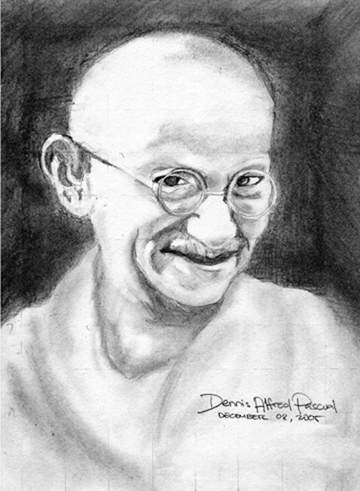
| Sketch by Dennis Alfred Pascual |