| On the road to Shangri-La by Lorin Robinson |
| February 2005 Cover Story |
 |
 |
 |
 |
 |
| The word "Shangri-La" is a recent addition to the English language. It first appeared in James Hilton's 1933 novel, "Lost Horizon," as a name of a virtually inaccessible mythical kingdom deep in the mountains of Tibet. The word came into even wider usage after the 1937 debut of Frank Capra's film "Lost Horizon," starring Ronald Coleman and Jane Wyatt. "Shangri-La" has come to signify a remote, beautiful, imaginary place where life approaches perfection. In other words, "utopia." It's no surprise that "Shangri-La" has been appropriated to name countless hotels, spas, massage parlors, and bars. Today, however, the Chinese government is spinning a whole new chapter in the history of Shangri-La. It's an effort to turn fiction into fact -- a practice not unknown to governments the world over. In 2002, tourism officials in China's far southwestern Yunnan Province declared an area centered on the city of Zhongdian in northwestern Yunnan to be "Shangri-La." The region, bordering Tibet, had been known as the Diqing |
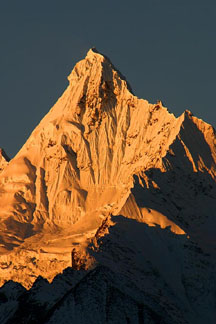
| Tibet Autonomous Prefecture. It has now been officially renamed. Stepping off the plane in Zhongdian's shiny new airport, the first thing you see, splashed in chromium script across the face of the terminal, is "Welcome to Shangri-La." The government says it pinpointed Shangri-La through a long process of research and considered several possible locations. The most telling clues, we are told, were both linguistic and geologic. Ancient stone tablets found in a village in the Diqing region named the village "Xiang Ge Li La," which locals pronounce "Shangri-Li-La." Tibetan linguists also maintain that "Shangri-Li-La" is a Tibetan word that translates, "to have the sun and the moon in your heart." For more solid evidence, tourism officials point to Mt. Kagebo, a 23,000-foot peak in the Meili Range west of Zhongdian sitting astride the Yunnan-Tibet border. The mountain's unusually shaped apex bears an uncanny resemblance to that of the Mt. Karacol described as looming over Shangri-La in Hilton's novel. Cynics label the naming exercise ploy to increase tourism in an area that was out of bounds to foreigners just a decade ago. Once-weekly flights were launched only in 1999. Today, a daily flight arrives from Kunming, the provincial capital, less than an hour away by air. The dubious maintain that it is doubtful author Hilton had firsthand knowledge of this area. Ben Hillman, author of "Minorities, Myths and Modernity in Northwest Unnan," surmises that Hilton's name for his mythical kingdom was a misreading of "Shambala," a Tibetan word referring to a mythical northern paradise. As for the resemblance of Kagebo to Karacol, some suspect that Hilton was familiar with the work of ethnologist and biologist Joseph Rock who lived in the area and wrote and took photographs for numerous National Geographic articles in the 1920s. The debate, of course, is moot. "Lost Horizon" was a work of fiction. And Shangri-La doesn't exist -- except as an inspiration to those who hope to achieve some semblance of beauty, peace, and perfection in their lives. And how does this "Shangri-La" stack up against those criteria? Pretty well. (Part 1 of 2) |
| (Clockwise from top right) Sunrise at Mt. Kagebo; Chorten and prayer flags at Temple of Heaven; Two Tibetan Buddhist nuns at Dong Julin Nunnery; A Tibetan woman carrying a child in Zhongdian. |
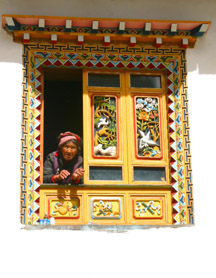 |
| An old woman by a window decorated in Tibetan fashion |
| About the author: Lorin Robinson is a communications manager with 3M Company and lives in Minnesota in the Twin Cities. Prior to joining 3M, Robinson was a professor of journalism and department chair at the University of Wisconsin-River Falls. His passion is photography and "adventure" travel. |
 |
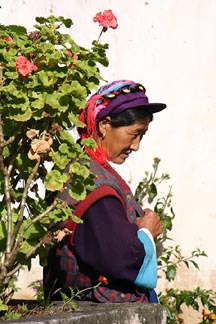 |
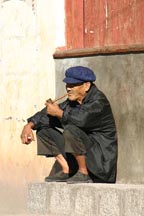
| Street Scenes (below) An old man in Deqen; (left) A woman amid geraniums |