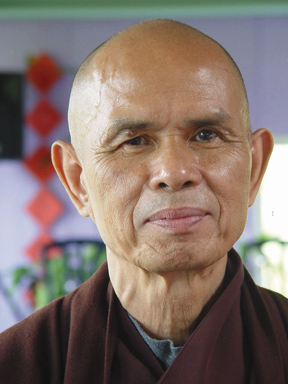
organization for accomplishing a wide variety of humanitarian efforts from rebuilding villages to organizing local agricultural cooperatives. More than 10,000 monks, students and other volunteers worked to restore their country, rallied around the Buddhist causes of nonviolence and compassionate action.
Despite his many contributions, Nhat Hanh was considered an enemy of the Vietnamese government. His popularity as an activist for peace threatened their military ambitions, and so when he concluded a peace mission to the U.S. and Europe in 1966 to raise awareness of the suffering of Vietnamese civilians, he found that he was not welcome home. He took the opportunity to continue spreading his message. He spoke with administration officials, gave speeches on college campuses, and was often invited to present the Buddhist viewpoint at many social and political gatherings. Traveling in such circles, it was inevitable that Nhat Hanh would meet America's own foremost leader in nonviolent agitation for human rights.
Martin Luther King, Jr. and Nhat Hanh became fast friends and allies, and Nhat Hanh convinced King to speak out publicly against the Vietnam War. Between the two of them, they represented the hopes and dreams of two nations of people torn apart by war, and their unified message was certainly one of the most powerful catalysts for the powerful peace movement that characterized America as the quagmire of a war dragged on. After working closely with Nhat Hanh for a year, King was moved to nominate him for the honor he himself had become the youngest recipient of two years previous: the Nobel Peace Prize.
It was such respect from his peers that made Nhat Hanh a natural choice to lead the Buddhist delegation to the Paris peace talks, where he is credited with much of the work necessary to achieve accords between North Vietnam and the United States. As recognition for such achievements on behalf of his homeland, he was invited to return to Vietnam, but he declined in order to continue spreading the word of peace.
In fact, spreading the word seems to come naturally to Nhat Hanh, who has written over 100 books in a variety of languages, mostly addressing methods of personal meditation and improvement as the first step to producing a peaceful society. But even a man of such dedication as Nhat Hanh can't traipse the globe forever, and so in 1982 he established Plum Village, a Buddhist community based in France. Much of his time is spent there, running workshops to train others to understand and spread his movement of engaged Buddhism, but establishing a new home has not prevented him from making his presence felt around the world.
Nhat Hanh's Plum Village retreat has only about 30 permanent residents, but each year thousands come there to learn from and be inspired by the great man. His guests range from destitute refugees to U.S. Senators, spanning all races, religions, and nationalities. These students go on to spread Nhat Hanh's philosophy of generosity and respect for life around the world. Nhat Hanh himself continues to visit America every other year, where his speeches draw crowds and his words are listened to carefully by leaders who have learned the strength of his vision. But Nat Hanh remains sublimely humble. As he declares in the last of his "fourteen precepts" for engaged Buddhism, 'Do not believe that I feel that I follow each and every of these precepts perfectly. I know I fail in many ways. None of us can fully fulfill any of these. However, I must work toward a goal. These are my goal. No words can replace practice, only practice can make the words." |