| Orphan Boy the Farmer - Tub Ntsuag Tub ua Teb, by Cha Yang From the University of Minnesota |
| ST. PAUL, MINN. -- A unique illustrated storybook designed to teach farm safety to Hmong children in a culturally appropriate manner is the end result of research conducted by the University of Minnesota Department of Biosystems and Agricultural Engineering. After comparing differences between Hmong and American farming practices, University researchers Michele Schermann and John Shutske concluded the best way to provide safety and health information to Hmong farming families is to use traditional storytelling methods. "Introducing safety information to Hmong farmers is a challenge," Schermann said. "In addition to the language barrier, Hmong farming practices are vastly different from other U.S. farmers. Many Hmong farmers use sharp knives and rototillers instead of combines and tractors, for instance." So Schermann and Shutske formed a team of researchers -- half of which were Hmong -- to explore the need and offer a solution. The team confirmed that Hmong use |
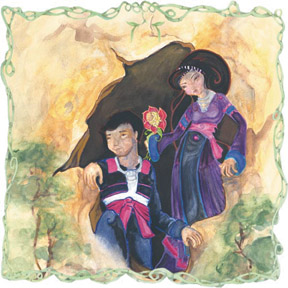
| Orphan Boy the Farmer - Tub Ntsuag Tub ua Teb, by Cha Yang Copyright © 2005 Regents of the University of Minnesota. All rights reserved. Hmong people believe that at the beginning of the world, Lou Tou and his wife, Ntsee Tyee, came out to the world through a crack in the mountains. When they came out, there were no plants or animals on the earth. They brought with them a magical flower that gave them seeds for food. As they explored this new world, they ate some of the seeds from the flower when they were hungry, while planting most of them all over the place. In a short time, the seeds that they spread throughout the world sprouted and grew into all kinds of plants. Among the plants that came from the seeds were rice and corn. |
 |
| stories to instruct their children, so a similar approach would be the most effective teaching method. The result of this effort is a part-folktale, part-safety storybook titled "Orphan Boy the Farmer (Tub Ntsuag, Tub Ua Teb)." Hmong playwright Cha Yang authored the book, with Hmong artist Kao Lee Thao serving as illustrator. It is written in English and the most common dialect of the Hmong language. University research also revealed that colors and graphics commonly used to highlight farm safety topics in the United States represent different tasks and potential hazards to the Hmong. Thao carefully illustrated the book using colors that would be more appropriate to the Hmong farm families.// Initial reaction to the book, which was piloted via live dramatic presentations, has been highly favorable among Hmong audiences in Minnesota and Wisconsin. "We couldn't be more pleased with the outcome of this book. It already has had a positive impact on the Hmong children of this region," Schermann said. The 90-page soft-cover book makes effective use of familiar Hmong characters, such as Orphan Boy the Farmer and Yer Shao the King of the Sky. In addition to teaching knife and rototiller safety, the book also addresses safety issues for children selling at markets. Each chapter ends with a concise overview of the farm safety messages embedded in the tale. The book is likely to be read-aloud by Hmong families in a group setting. "Orphan Boy the Farmer (Tub Ntsuag, Tub Ua Teb)" was funded by the National Institute for Occupational Safety and Health and by the Minnesota Rapid Agricultural Response Fund. It is available for $18 plus tax and shipping from: Hmong ABC, 298 University Avenue, St. Paul, MN 651-293-0019; JT Travel and Tours, 651-489-5339; University of Minnesota Extension Service Distribution Center, 800-876-8636 or 612-624-4900 ? Order Item #08311. Contact the University of Minnesota Agricultural Safety and Health Program at 612-624-7444 or safety@umn.edu for more information. Contact: John Byrnes, Director of Communications, University of Minnesota College of Agriculture, Food and Environmental Science, 612-625-4743; Michele Schermann, Research Fellow, Agricultural Safety and Health, University of Minnesota, 612-624-7444; John Shutske, Professor, University of Minnesota Department of Biosystems and Agricultural Engineering, 612-626-1250. Editor's Note: A link to view PDF page samples of "Orphan Boy the Farmer" is found at http://www.extension.umn.edu/distribution/cropsystems/DC8311.html. |
| Orphan Boy the Farmer - Tub Ntsuag Tub ua Teb, by Cha Yang Copyright © 2005 Regents of the University of Minnesota. All rights reserved. Moob ntseeg tias puag thaum ub, Luj Tub thiab Ntxhee Ci tawm hauv roob pob tsuas los rau ntiaj teb no. Thaum nkawv tawm los txog, ntiaj teb qhuav qhawv tsis muaj tsiaj txhu li. Nkawv nqa au ib lub paj nrog nkawv xwb. Nkawv txawm los ncig saib xyuas ntiaj teb. Thaum nkawv tshaib plab, nkawv noj cov noob paj. Nkawv ncig txog qhov twg, nkawv kuj muab cov noob paj w rau qhov ntawd. Tsis ntev tom qab, cov noob paj txawm loj tuaj ua txhua tsav txhua yam tsiaj txhu. Cov noob paj ntawd kuj loj tuaj ua tau pob kws, dib, thiab txhua yam qoob loo. Vim cov qoob loo no los ntawm lub paj los, lawv txawj tuaj. |
 |
| to home page |
 |
| to February 2006 preview |