| A traveler's journal/ by Heidi M. Pascual After Hurricane Wilma at the Yucatan |
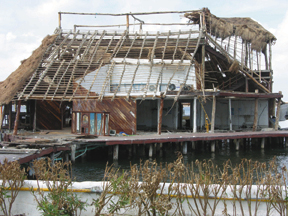
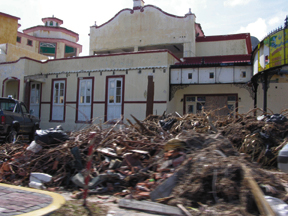
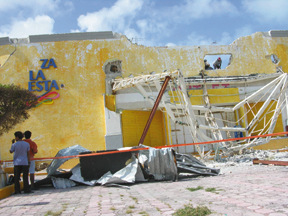
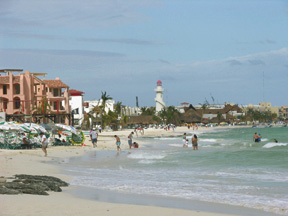
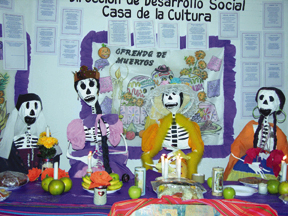
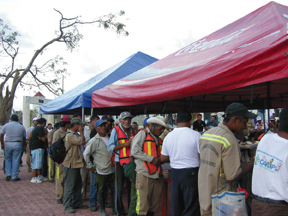
| My life is a journey, and part of that journey is the experience I get from travelling to distant places, meeting people from diverse backgrounds, and enjoying while sharing their cultures. I'd like to share this wonderful experience with you. Last November, I travelled to Mexico's Riviera Maya, a planned trip long ago that didn't expect the coming of Hurricane Wilma which, as you know, devastated Cancun and the island of Cozumel in October. The photos on the left show a minute sampling of Wilma's destruction along Cancun's roads, which brought all businesses and all other activities at a standstill for days on end. But the devastation did not destroy the spirit of the people. The recovery was amazingly swift, with the united efforts of all sectors of the community in the Yucatan peninsula. I stayed in Playa del Carmen (top right photo), a beachside village with uninterrupted stretches of white sand and an Avenida #5 which is famous for the longest shopping district in Riviera Maya. The most memorable moments in Playa, though, aside from the warmth of the people, were the commemoration of the dead at the town plaza on Dia de los Muertos (right) and the gathering hosted by the business sector (right below Dia) to thank every member of the community, especially the law enforcers, who worked so hard to rehabilitate Playa's destroyed areas. |
 |
 |
 |
 |
 |
 |
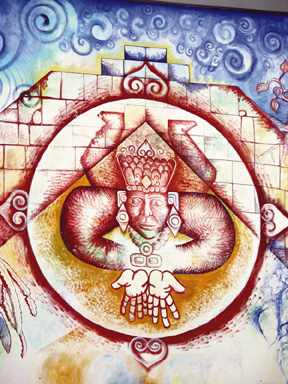 |
| Mural at Playa del Carmen's city hall speaks of the rich Mayan culture |
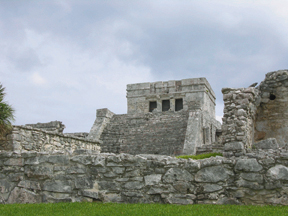
| At Tulum (tulum means fence, trench, or wall), the most important Mayan archaelogical site on the coast of Quintana Roo stands on a cliff overlooking the Caribbean. The Castle (left) is closest to the cliff, decorated with stucco masks on the corners, with opened mouths and large eyes. Its facade has three niches, and the middle one features a Descending God, a deity venerated in the peninsula. The buildings inside the wall were said to be the dwellings of the rich and the middle class. |
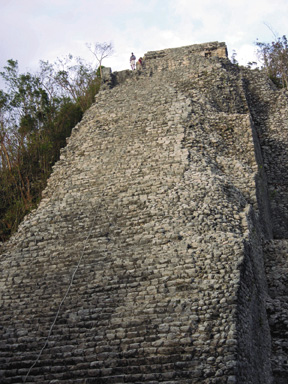
| Coba, 29 miles from Tulum, has 40 roads called sacbés (white roads), which are the most impressive network of roads in the pre-Hispanic period. Coba's buildings consist of patios, staircases, rooms, temples, and platforms. The Great Mound -- Nohoch Mul (left) -- is the highest pyramid in the Yucatan Peninsula. |
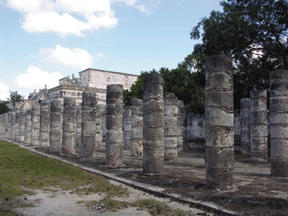
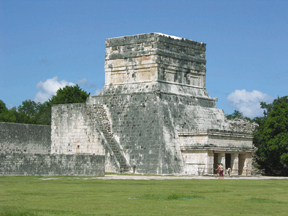
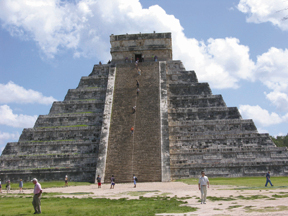
| Chichen Itza (which means mouth of the Itzas, the name of the Mayas who settled there) boasts of monuments and temples that spoke well about a magnificent ancient civilization. The Castle or the Pyramid of Kukulcan (right) is 24 meters high, with a square base, and a small temple on top. On each side of the Castle is a steep staircase (which I was so scared to climb); at the foot of the ramps are huge heads of serpents with open jaws and scary fangs. The worship of poisonous snakes was common during ancient times in Mesoamerica, and said to be introduced by Toltec invaders in the peninsula toward the end of the Classic Period. |
| In Valladolid, I visited a Catholic Church, representing the Hispanic period, the beginning of Christianity, and the spread of the Spanish language. There I felt a deep connection with the place and the people. After all, my original country, the Philippines, was also colonized by Spain for hundreds of years. It's always a wonderful experience to know about people and places other than ourselves and our countries of birth. Personally, it helps me understand how diverse our world truly is, and how we can help understand others and live harmoniously with them. |
| Common wealth: culture and people I had always dreamed of visiting the Great Mayan ruins which I had read about with fascination and awe. The Mayas, my readings said, created one of the great cultures of Mesoamerica during the pre-Hispanic era. Their buldings consisted of ceremonial temples where they also developed mathematics, astronomy and the calendar, hieroglyphic writing, architecture, and arts. The Mayas had a clearly defined social strata (very much like our societies today) where the elite focused on war, religion, and trade. |
 |
 |
 |
 |
 |
 |
| Photos at Chichen Itza |
 |
| to home page |
 |
| February 2006 Preview |