are probably THE most important social occasion for Indian families. December is wedding season. In Surat, there were literally dozens of weddings taking place each and every day for weeks. Families will typically rent out a big hall or open space specially designed for weddings. Professional planners handle all the details -- lighting, food, decorations, food, seating, and, of course, the food. The wedding ceremonies are usually daylong rituals that the bride and groom and their parents have to endure and nearly everyone else ignores. But that's the fun part. Since everyone in the extended family usually come to these events from every nook and cranny, weddings are occasions for family reunion as much as they are to celebrate matrimony. So while the bride and groom are reciting Sanskrit shlokas, getting incense smoke in their eyes, and trying to stay focused on the next part of the seemingly endless rituals, the rest of us are eating, laughing, gossiping, taking pictures, and generally goofing off. At one point during the day, two strangers paid us a visit. They were dressed in saris, fancy shoes, and gold jewelry -- typical wedding attire that any woman might wear. But there was something a bit odd about the way the two strangers walked and talked. These were transvestites -- hijras. They were at the wedding to collect a fee for bringing good luck to the newlyweds. All over India, hijras show up at various auspicious occasions -- weddings, the birth of children, birthdays -- to bring fortune to all in attendance. And for that service, they demand a fee. The two at our wedding got their fee and someone made them write their signatures on a pillar near the entrance so that other hijras wouldn't come to demand more good luck payments.
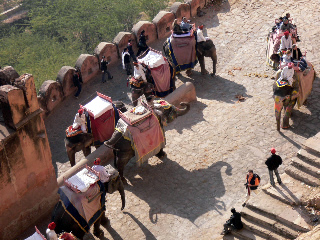
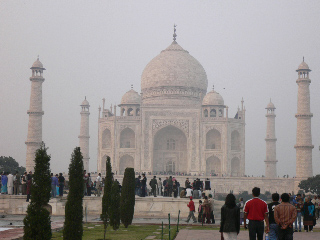
The next day we were off on our sightseeing tour. My brother's wife was visiting India for the first time so we had planned a route many first-time visitors take. We started in Delhi, the nation's capital, then went to the cities of Agra (to see the Taj Mahal), Jaipur, and Udaipur. In Udaipur, there is a very old palace that once belonged to the local maharajah. It's known as Amber Fort. It's perched on the side of a mountain overlooking the city and the valley beyond. The popular route up to the fort is along a winding cobblestone road. Local entrepreneurs have taken full advantage of this "exotic" attraction and have developed a decent business providing rides to the fort on the backs of lumbering elephants. As the number of tourists increased, the elephants were forced to take more trips up the hill per day and to carry more passengers per trip. Several years ago, reports surfaced that the drivers were trying to get elephants to move up the hill faster by prodding and beating the animals with sharp iron pokers. The animals were not happy. They seemed to be crying, in fact. Tourists began to complain. Animal rights activists filed protests with local government officials. One day, one of the elephants apparently had had enough and began to run amok. With passengers aboard, she began wildly swinging her head and trunk around and began running full tilt down the hill. The incident apparently scared everyone in the Amber Fort elephant ride industry because now, the number of times elephants can go up the hill is limited to six per day and they can carry only two passengers per ride. And we didn't see iron rods in the hands of the elephant handlers. Everyone -- people and animals -- seems a lot happier.
No trip to India can be called a success unless there is ample time for shopping. For most people, shopping in India means carpets, clothes, furniture, gold jewelry, and the like. I have a more esoteric interest. I am always on the look out for interesting renditions of Ganesh, the elephant-headed god of intellect, education, and wisdom, as well as the remover of obstacles. He is the son of Shiva and Parvati and, according to mythology, the scribe who wrote down the Mahabharata as narrated to him by the holy man Vyasa. At a small and dusty restaurant at the side of the road taking us from Delhi to Agra, a man was selling figurines -- mainly animals, but also a few gods and goddesses from the Hindu pantheon. Of course, I carefully looked through the collection looking for interesting statuettes of Ganesh. As the others waited impatiently, my persistence was rewarded when I found a tiny inch-high papier-mâché figure of Ganesh. He is sitting astride a bird in flight and playing a sarod, a type of musical instrument. His trunk is pointing upward rather than down and curving to the side as it usually does. It's the most unusual Ganesh figure I've ever seen. Of course, I bought it and added what has to be a one-of-kind rendition of Ganesh to my collection. Later, I found a wooden carving of a standing Ganesh with eleven heads, five extra ones on each side of his face. Jackpot.
The things I remember from the five short years I lived in India are fragments and traces. I was a child, of course, and I can never be certain if these are real memories or strands of stories narrated to me over the years that have become what I now think of as my memories. For instance, I'm not sure if I really did smack my pre-school teacher with a ruler before running out the door and across the street to my house, which was just across the lane from the school, or if the story is just family lore. I'm not sure if, on another occasion, an overly maternal monkey was about to swoop me up along with the cookie I was eating and run off into the woods. Luckily, the story goes, I dropped the cookie and the monkey ran off with this bit of food instead of with me! Added to these memories are recollections from the many trips I've taken back to India. Taken all together, they represent what India is to me: bits and pieces of biography revealed, family history retold, adventures experienced, and Ganesh statues found. It's hard to build a complete sense of belonging from bits and pieces. But it seems more than enough to keep me somehow connected to the place I was born -- even though I sill feel like a fish out of water there. |