Feng shui is one of many ancient eastern practices that has enjoyed new popularity in the West, but naturally the form of it we see here is a watered-down and nearly unrecognizable derivation of the original. The path of feng shui's history from its primitive origins to its modern architectural and domestic applications is nearly seven thousand years long and crosses boundaries between science, art, and religion. It begins with ancient Chinese architects seeking to harmonize their earthly dwellings with celestial influences.
"Feng shui" most directly translates as wind and water, the most basic physical representations of yin and yang, and the most primitive known forms of feng shui encouraged barriers to wind and proximity to moving water as ideal conditions for a village. Wind blew good influences away, and water attracted them. As early as 4800 B.C., relative positions of houses, graves, and other buildings were determined by relationships to compass directions and major landmarks. For example, you could expect some steep property taxes for a choice peasant hovel with a mountain behind it on the north side of a west-flowing river with your house facing south.
And, were you this imaginary hovel-dwelling peasant, you would be glad to pay them. An entire mountain guards you from the dire influence of the Black Tortoise of the North, leaving your home open to the auspicious Red Phoenix of the South. With good influences arriving on the carefully diverted river from the benign Blue Dragon of the East rather than the metallic White Tiger of autumn to the West, you would be positively swimming in good fortune.
But why stop there? With the grave of your family already oriented to the North Star and your house suitably tortoise-proofed, surely feng shui has more to offer you? Indeed it does, and generations of successive feng shui masters -- in reality the ancient, mystical counterpart to surveyors and urban planners -- devised increasingly complex and astrologically precise methods of feng shui. While ancient feng shui had its roots in utilitarian rules relating to wise medieval civic engineering, centuries of use and the rise of powerful emperors and dynasties in China revealed the need for far more delicate arrangements suitable for better classes of buildings. Methods of feng shui that could plan entire capital cities and arrange exquisite palaces for harmonious living were in demand.
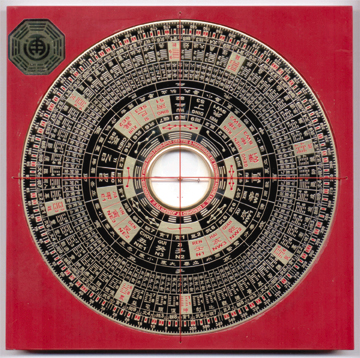
Thus, the most ancient form of feng shui concerned primarily with wind and water, known as xing fa, began to give way to the many schools collectively known as kanyu, which use various types of mystical astrological compasses known collectively as luopan to determine the effects of any number of elements on a given location. The most common of these was a rotating circular disc (the kan, representing yang) set in a square board (the yu, representing yin). Marks on the outer ring of the kan and the inner ring of the yu would be aligned according to the day and time and the current position of certain relevant constellations to determine prime sites that aligned with mathematical precision to the energies of heaven.
The nature of the forces and energies sought out changed throughout China's long history, and luopan has been based on any number of factors for any number of purposes. The 28 constellations of the zodiac were common guides, as were their correspending earthly "branches," but other boards incorporated the prophecy-telling art of the I Ching or classified areas according to the "five elements" of the universe. Regardless of the precise energies being queried, the amount of mathematical and astrological science involved was astonishing.
|