The Philippine-American Association of Madison and Neighboring Areas (PAMANA), based in Madison, Wis., is an association of more than 300 families dedicated to promoting understanding and goodwill among its members and the Greater Madison community through participation in social, cultural, and educational activities. The word pamana in Filipino means ?inheritance? or ?legacy? that embraces values, beliefs, and traditions of the Philippines that have evolved since the beginning of time and regardless of where the Filipino is at present.
Established by a small group in Madison in 1982, PAMANA first focused on building membership through social functions Filipinos loved to do: Christmas celebrations in winter, Flores de Mayo festivals in spring, picnics in summer, and Halloween parties in the fall. The year's biggest event, however, is the Independence Day celebration, held either June or July, depending on the availability of local space. This freedom day commemorates the June 12, 1898 flag-raising ceremony in Kawit, Cavite, when the Philippines got its independence from Spain after more than 300 years of colonization (although the country eventually became a U.S. commonwealth under the Treaty of Paris).
The main attractions in many of these events have been the musical performances of Rufino Licos and family, who have continuously shared their craft with the community for many years. At the same time, Agnes Cammer and Princess Emraida Kiram have formed a volunteer group of Filipino American medical practitioners to conduct biannual free medical services in remote areas of the Philippines, in collaboration with Fil-Am organizations in Milwaukee.
For more than 20 years, PAMANA's activities have expanded into community service, keeping in mind, however, the promotion of Philippine culture at the top of its agenda. Recent initiatives that caught the admiration of this writer included the awesome performance of Lahing Kayumanggi (a dance troupe from the province of Laguna) in 2002; the Balagtasan (Filipino debate on the issue "Could Filipinos be united or not?") in 2003; the publication of a Filipino cookbook titled PAMANANG Lasa in 2002; and the Pintig play (about the use of Igorot natives in the American Exposition of the early 1900s) in 2004.
The new elected president of PAMANA is Madison teacher Elizabeth Reyes. Using her skills in teaching children and her passion for keeping and spreading Philippine culture, Reyes recently initiated a cultural workshop for Fil-Am kids. In an interview with Asian Wisconzine, she explained the reasons for it and outlined her plans for future workshops.
"There are a lot of Filipino American kids who are strangers in their own cultural community," Reyes said matter of factly. "Whenever PAMANA has gatherings, these kids do not even understand what people around them talk about, why we gather, and how we observe certain traditions." Realizing that Fil-Am children, either born in the U.S. or the Philippines, end up being so "American" yet belonging to the Filipino community in America, Reyes and the new board members decided to do something about it before it?s'too late.
"You can immerse yourself in the American culture, do whatever is necessary to survive daily living ... but you don't relinquish your own culture," Reyes stressed. 'You represent who you are and where your parents and ancestors came from."
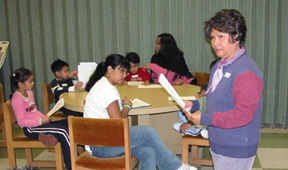
With this in mind, on Oct. 8, PAMANA conducted its first day-long workshop divided into four sessions: basic history and alphabet; traditional songs; traditional dances; and traditional games (including martial arts). The participants were children 4-13 years old, and they came with their biological or adoptive parents. "Parents in our generation ... we ... are the ones responsible for teaching our school-age kids about our culture," Reyes said. "If we don't do it now, our kids would totally lose it."
Being an ESL teacher, Reyes knows that language is the "major barrier" of other kids in the school system, such as the Hmong and the Latinos whose immigrant-parents don't speak English at all. The advantage of Filipino kids in school is that their parents are English speakers; hence, the language barrier is absent. However, the disadvantage is the fact that Fil-Am kids do not understand their parents' language and for the most part, Philippine culture. This is where PAMANA wants to make a mark in its history.
"We want our children to be exposed to our own language," Reyes emphasized. "And we need their parents' help in order to make this happen." She said she noticed that adoptive parents of Filipino kids were the ones very excited and enthusiastic about the workshop, but she's hopeful to get more participation from Filipino parents, as well.
PAMANA facilitators got feedback and observations from participants and their parents, and took note of revised strategies for a future undertaking. "Since this is an exploratory workshop, we have learned from it," Reyes said. "Next spring when we conduct the next one, we would be more organized and we would have more time to promote it so we could include everybody."
Judging from the photos of the workshop, Fil-Am kids who participated had fun and learned just enough to keep them asking for more. Parents who joined their kids in the workshop looked eager to speak their native tongue from then on and practice a lot more of their own traditions, including going back to saying "po" and "opo" (terms of respect) when they respond to their own parents at home.
Salamat sa PAMANA. Mabuhay kayo!