
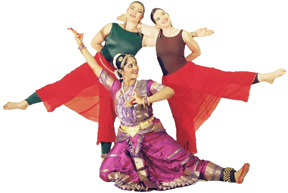


Upon hearing the news of such a forthcoming performance of Kalaanjali and Kanopy dance companies called "Fall for Dance" or "Fusion," as many called it, the initial reaction of some Bharatanatyam enthusiasts was generally lukewarm, while those who prefer the modern dance form took it as a novel and refreshing initiative. Only when the former watched the show did they develop a new appreciation of the effort.
For the first time in the history of Kanopy and Kalaanjali, their members joined hands in a collaborative work at the Overture Center for the Arts' Wisconsin Studio, Sept. 29-30, and Oct.1-2. The concert was divided into three "Balance of the Wheel" parts: Creation, Destruction, and Protection. Kalaanjali dancers took the first three numbers of part 1 on their own, all choreographed by Meenakshi Ganesan: the creation hymn, the Natyavedam, and Pushpanjali. Kanopy, choreographed by Lisa Thurrell, took the fourth item "In the Quiet," with music from Arvo Part, "De Profundis." Each dance company interpreted the theme of creation, destruction, and protection, in accordance with their own training. The joint dances were on the third and last part of the concert, where both choreographers tried to blend each art form in the smoothest way possible.
The new recipe worked for the audience who had never seen one like it before. It was indeed a "fusion" of cultures -- East and West -- and of opposites, in terms of time and space in history where each of them occupied man's interest and preference.
This novel project succeeded in bringing forth the idea of oneness, regardless of when and where an art form evolved. And speaking of evolution, the Fusion concept may well be the beginning of more beautiful unions of other art forms in Madison and other parts of Wisconsin.

