
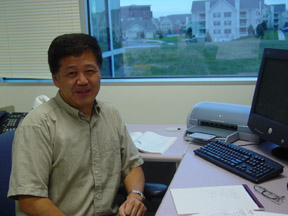
Rising tall from a "lost generation"
by Laura Salinger
Fang's success, however, wasn't easy to come by. He is part of what has been called the "lost generation" in China, a generation that grew up under Communist rule during a time when schools were shut down and youth were forced to work in the fields rather than receive an education.
"I grew up in the Anhui province near the Yangtze River about 300 kilometers from Shanghai," Fang said. "I grew up in a rural area in the country." Fang's parents were farmers in rural China and had three children -- all boys. Fang was just seven years old when famine struck the country. He remembers the constant gnawing of hunger that was reminiscent of the times.
"We were always starving," Fang said. "We had nothing to eat, so we would eat anything that we could find. We ate tree bark and grass."
It was several years later, with the country still reeling from the devastating famine, that the Chinese government shut down its schools. Led by Mao Zedong, the move was part of the Great Cultural Revolution launched in 1966. The goal of the revolution was to renew China's revolutionary spirit. Teenagers, teachers, and intellectuals were forced to live with farmers and toil alongside them. Mao's Red Guards took over schools and universities, substituting academics with political curricula.
"The revisionists in China viewed the artists and intellectuals as dangerous," Fang said. "The government closed the universities and sent the professors and students to farms and factories."
Fang, who was sent to school by his parents, was forced to return home and work on the farm. Like so many of his peers, he was denied the right to an education. From age 12 until he was 22, Fang was not allowed to attend school.
"People in my generation didn't have any education or job skills," Fang said. Hence, the group was dubbed the "lost generation." When China once again opened up to the world and adopted market reforms, many in this generation were left behind. But there were also some, like Fang, who fought to rise above this major setback.
Despite nearly a decade of lost time, Fang was determined to receive an education. He went to college in the mid '70s at the University of Science and Technology. "People like me were among the few lucky ones that were able to go back to school after the cultural revolution," he said.
After attending college in China, Fang took an exam to enroll in the Samuel Ching program at MIT, a program aimed at educating young physicists of Chinese heritage. He was accepted and went on to receive a master?s in physics from MIT. Fang then returned to China to help the country start a high-energy physics program of their own. The program was abandoned, however, due to lack of funding.
Fang once again returned to the United States and after receiving his Ph.D. and holding a six-year research position at Harvard, he found his way to Madison. He took a job with TomoTherapy Incorporated, a company seeking to provide "the best" radiation treatment for patients across the globe. Fang views his job as a way to contribute to society by improving health care for cancer patients.
Professionally, Fang has made his way from "lost" to successful. Yet, Fang is also determined to create a niche for himself and his family in Madison's social scene. In 2002, Fang and several others started MACCO.
"We have quite a sizable [Chinese] community here," Fang said. ";We wanted to start an organization where people could come together and share information."
Close to 100 active members gather regularly for events such as the Moon festival, Spring festival, and other Chinese festivals. The group also partakes in citywide events such as Celebrate Madison, a festival which celebrates the rich cultural diversity of Madison-area residents.
Between work and community, Fang has created a place for himself in the Madison community that is far from "lost." He is a successful professional and a devoted community member who has risen above the past and found himself.

