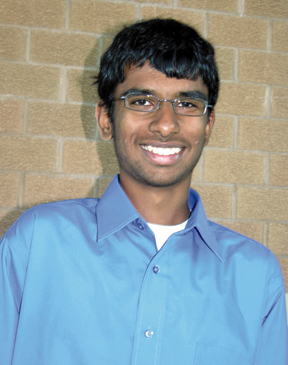
| Prasanth Prabakaran This youth wants to save the Earth |
| By Heidi M. Pascual |
| When many youth his age enjoyed summer vacation doing fun activities or none at all, Prasanth Prabakaran was busy experimenting to find a renewable source of energy. The ninth grader at Memorial High School was concerned about the price of gasoline reaching $3 a gallon and the alarming news of global warming and environmental degradation. With the help of a mentor (Prasanth's seventh-grade science teacher at Spring Harbor), Prasanth successfully came up with a project converting cooking oil to biodiesel fuel. The project was funded by a grant from Wisconsin Center for Academically Talented Youth (WCATY) under the Young Scholars program early last spring. Prasanth, together with other young scholars/awardees, was recognized for his project, which he presented at the 2006 Young Scholars Fair on September 23 at the American Family Insurance Headquarters. In a recent interview, Prasanth beamed with pride, hopeful that the result of his work can convince others that biodiesel is one of the best ways to save the earth. |
| "We can't expect that the world is going to be this way in (the next) eight years," he said. "With biodiesel, there would be reduced emissions. We have to start conserving now rather than later down the road for our kids and generations to come. We'll have a ruined earth. While we enjoy a nice earth, the future generations will have an earth where there's pollution, green house effect, no good water. So we have to start saving the earth because we can't get it back." It was a very thoughtful explanation and expression of concern that reflected an uncommon interest for a regular 14-year-old youth. Prasanth admitted that his work on biodiesel is not an original idea, but something that he wanted to know how to make. "The reason I thought about the biodiesel idea was because when I was in sixth grade, this bio-bus came to Madison at Memorial, and it was going across the country telling everyone about how these college students had a bus that ran on soybean oil," he recalled. "I thought it would be pretty cool if I try that out. So last April, I got the chance (through the WCATY Young Scholars program), and I tried it out." When asked how the experiment was conducted, Prasanth smiled and with confidence described the steps. "It's a pretty simple process," he said. "You take any kind of oil. I used canola oil, then lye, sodium hydroxide, and then you mix it with ethyl alcohol - the de-freezer that is used in cars - and then you mix them altogether, shake it up for a long time and then it separates into glycerin and biodiesel." The study also involved comparing costs of fuel versus biodiesel, and Prasanth was sure the cost would be much lower than gasoline. "If you use vegetable oil, my mentor and I estimated that the price would be around 88 cents per gallon of biodiesel," he said, and added, "but it will only run in diesel engines." He noted that about 80% of vehicles in Europe run on biodiesel fuel, so he said he wonders why the U.S. hasn't done that yet. Answering himself, Prasanth continued, "Maybe they're waiting for our fuel sources to run out; then they would say, 'We should have done biodiesel a long time ago." The six-week project this past summer was not only a learning experience for Prasanth, but a fun one too. "It was like doing hands-on chemistry," he said. "It kept me busy because I really didn't have anything to do in the summer. And I had fun as I spent time with my mentor, David Ropa. He's a good influence." Prasanth received $500 to do his biodiesel project, a small amount that provided a huge difference in a young man's self determination and confidence. "I'd like to be a doctor someday," he said. Saving the earth and its people is foremost in Prasanth's heart and mind -- a lofty dream that is not far-fetched considering his views on how to conserve the earth's resources. The Wisconsin Center for Academically Talented Youth (WCATY) is proud to offer many opportunities for talented students in Wisconsin. These include on-line programs during the school year, and enrichment and accelerated courses through our residential programs during the summer months. WCATY is an accredited organization through the NCA-CASI. In addition to these, WCATY is the Wisconsin affiliate for the Midwest Academic Talent Search (MATS). CONTACT: WCATY, 2909 Landmark Pl., Madison, WI 53713; (p): 608-271-1617 (e-mail): info@wcaty |
| Notes from MATC Profiles, Fall 2006: Excerpts from "From fryer to fuel tank" The Madison Area Technical College (MATC) recently dedicated its biodiesel reactor which was designed and built by UW-Madison engineering students at the request of MATC's Diesel Equipment Technology Program. It will be used to educate MATC students in the production, use and quality control of biodiesel fuels and the maintenance of biodiesel-fueled engines. The reactor removes glycerin from vegetable oil or animal fat to create fuel. Its goal is for students to synthesize and study various biodiesel fuel blends, according to Ken Walz, an MATC chemistry instructor. MATC diesel instructor Paul Morchauser noted that the lubricity of biodiesel is greater than that of conventional fuel and it has a very low sulfur content, so biodiesel will reduce the concentration of hydrocarbons, particulate matter and sulfur oxides in engine exhaust. UW graduate student Stephanie Britton added that biodiesel is an environmentally friendly fuel; and because the oils come from agricultural crops, combustion of the fuel has zero net carbon dioxide emissions, which reduces greenhouse gases and helps address global warming. |
 |
 |