| Creating a Disapora Flow |
| By Marlene A. Paez |
| Touring from their home in the Twin Cities, Diaspora Flow, a nonprofit arts organization, migrated to the Overture Center for the Arts, Rotunda Stage to perform a dynamic series at the 35th Annual Conference on South Asia on October 21. The event was sponsored by the University of Wisconsin-Madison Center for South Asia. |
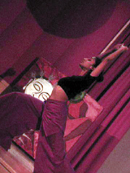
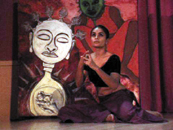
| Three Sri Lankan American women fluidly translated culture through streams of artistic movement. Their collective talent featured dance, video, and visual art in the performance The Space Between Thoughts. Setting a mythical backdrop, Chamindika Wanduragala's installation framed an imagination of dreams. Her work A Partially Digested Fire Takes Root, Sunbaby Leaves Markings So She Can Find Her Way, and Dreams Come Weeping in the Shape of Dark Poppies demonstrated her deep understanding of her Sri Lankan heritage, creating a visionary landscape of folklore. The choreography by Pradeepa Jeevamanoharan is pure innovation. Trained in classical South Asian dance since the age of three, her choreography fuses Bharatanatyam, a traditional Indian dance, and other genres such as modern dance, plus yoga. Adding the final component is Annelize Machado. Utilizing images of ancestors, her video expressed, "every woman before me danced their stories -- and now through our feet." Machado has shown the value of passing down tradition to the youth. Together, as Diaspora Flow, the women communicated a consciousness of preserving culture from one generation to the next. |
| Behind the Scenes |
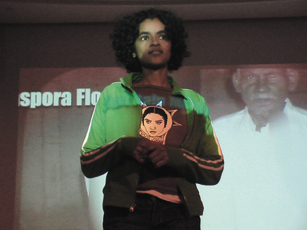
| As I walked into their rehearsal, I was immediately captivated by the music and lyrical dance. Pradeepa and Annelize were already on stage doing a run-through of their performance, stopping momentarily for sound checks. Their hard work proves that practice does make perfect. Sitting in the audience, Chamindika was delighted for an interview with Asian Wisconzine. |
| AW: Can you tell our readers about Diaspora Flow and how it was created? |
| CW: Pradeepa and I started Diaspora Flow in 2001, in Minneapolis-St. Paul. We started Diaspora because we felt what was missing in the Twin Cities arts community was being able to see high quality art that's affordable and accessible. We wanted to create a space where artists of color can perform their work in front of folks from all different communities including their own. Having access to art is a right, not just a luxury. |
| AW: How do you feel that the audience connects with Diaspora Flow? |
| CW: Instead of feeling just like a spectator, the audience is connecting to our experiences. It's the fact that we don't just draw from the traditional arts. We do multi-disciplinary shows representing spoken word, dance, theater, film, and video ? just about everything! It's kind of a cabaret style. In addition to an immigrant generation, we have an audience from the second and third generations. We present a full spectrum of experiences. |
| AW:How long does it take to actually produce work? |
| CW: It takes months! We first produced a workshop on this piece. Then, you need to rehearse. We haven't even incorporated the live music yet. So, that's going to take some coordination. We want to create a seamless interaction among the visuals, video, dance, and music. |
| AW:What are the future plans and goals for Diaspora Flow? |
| CW: We are going to continue presenting artists of color in a much bigger way in a sense that we want to compensate the artists more. Being a community-based art organization, we don't want them to just perform for a small amount of money. We really want to be able to support the artists so that they can continue to create their own work too. In terms of our own production, our vision for this piece is to have live musicians. Basically, the whole choreography will have more. Ultimately, we want to be able to commission art so that [artists] can have the opportunity and the time to create their ideas. |
| AW:If you could speak to aspiring or upcoming artists from the Sri Lankan American community and other Asian Americans, what would you say? |
| CW: Wherever they are, I would say to work with local community organizations that are there to help give them the opportunity to present their work, even reaching out to national organizations as well. We had a lot of people, not only Sri Lankan American, but also people of color in general, connecting to us saying, "This is great that you exist! Can we come out and perform?" Networking in the community helps foster creativity too. |
| If you would like to obtain more information about Diaspora Flow and upcoming events, please visit their website: www.Diasporaflow.org. |
 |
 |
 |
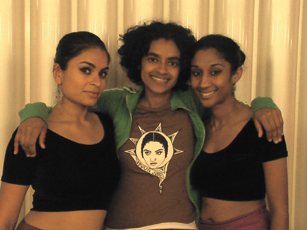 |
| Chamindika Wanduragala, Annelize Machado, and Pradeepa Jeevamanoharan |
 |