| Nirmala Rajasekar Veena artist presents melodious sounds of India |
| By Heidi M. Pascual |
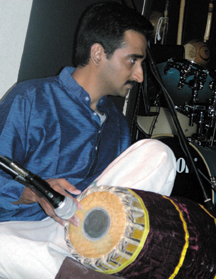
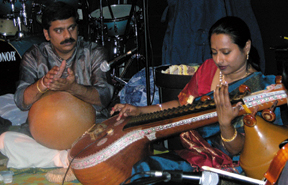
| Late last spring, Nirmala Rajasekar of Minnesota awed Madison with a two-hour Veena concert at the Madison Center for Creative and Cultural Arts. Music aficionados and friends were treated to a very fine traditional sound that was smooth and tender, slow and sweet -- andante con espressione -- then climbing into a crescendo, stirring various emotions and imaginations -- piu agitato -- from the audience. Many closed their eyes to experience the sensation within, the rhythm of the melody that struck deep into one's heart. In an interview with Asian Wisconzine, Nirmala explained how the veena instrument caught her interest that led into a lifelong "partnership." "As a six-year old, I was intrigued by the veena, and there was this unexplainable attachment to it that made me want to study its music." This "unexplainable attachment" provided the drive to pursue the study of veena and its music. "To me, my veena is like a family member or a dear friend," Nirmala continued. "And as with any art, it takes a good number of years of learning and dedication to play it well." In addition to the "personal attachment" with veena, Nirmala talked about its significance in relation to India's history and how it differs from other string instruments. "The veena, along with the bamboo flute and the two-headed drum, the Mridungam, is the oldest of Indian instruments; it is at least over 2000 years old," she explained. "Its shape and form today make it stand apart from all other string instruments. The frets are set in black wax which is a very unique feature of the instruments. This lends it its deep soulful 'Naadha' (tone). It is said to be closest to the human voice." Nirmala has been performing all over the world for over 25 years. She has performed to great acclaim in many world-renowned venues in including London, Berne, Zurich, Bombay, New Delhi, Chennai, New York, Cleveland, and Minneapolis. As a young teen, she was chosen by the Indian Council for Cultural Relations to present concerts in Festivals of India around the world. When asked if there are wide differences between and among varied audiences, she said every audience has a diverse "composition of people." "Even in the same city, audiences are different," she said. "In concerts where the veena itself is a new feature, the expectations are naturally quite different from that of an Indian audience in a famous Chennai (the heart of South Indian classical land) venue!" These different audiences, however, pose not only a challenge to entertain, but to continue to develop and improve her craft. Nirmala also knows how important it is to feature local musicians in her shows. "I've been very fortunate to have always had very supportive audiences and co-artists," she said. |
| She is committed to promote the veena by teaching how to play it and encouraging Indians and non-Indians to learn it. "One of my dreams is to take the music of the veena to the far flung corners of the globe and showcase this great instrument and system of Carnatic music," Nirmala said. "I enjoy teaching anyone interested in learning it; in fact, I am teaching non-Indians to play it ... this instrument and its music truly belong to the world." Aside from her numerous performances lined up this year, Nirmala is busy bringing her musical skills to the next level. "I'd like to learn and explore the length and breadth of Carnatic music more and understand its beauty more," Nirmala continued. "Learning about other art forms and traditions is also very high on my to-do list." At the close of the interview, Nirmala thanked God and the very special people who helped her become the leading artist that she has become. "It has been possible for me to to pursue music, that has given me so much joy and satisfaction, only because of the Grace of the Almighty and some very special people in my life," she said. "My parents who had the faith in me and made it possible for me to begin learning at the age of six and continue until now; my teachers who continue to give me a gift of music their love and care; my sister who always supports me across countries and continents; my children who have understood the importance of music as a way of our lives; and my husband, who has endured many tough times, including traveling across the globe in many modes of transport with one constant -- the veena. To them and my many other musician friends, I owe a huge debt of gratitude. Where I've come so far is not one person's effort but the labor of love of so many people!" In Minnesota, Nirmala has composed and performed for the Minnesota Orchestra, Walker Art Center, Schubert Club, Cedar Cultural Center, Minnesota Public Radio, Indian Music Society of Minnesota, WCCO TV, City of Minneapolis productions. She has performed in several places in the Midwest -- Rochester, Winona, Marshall, Stevens Point, Decorah, Iowa City to name a few. She has won numerous awards, including Best Concert award from KFAI Radio in Minneapolis, and has received many grants including Cultural Collaboration Grants from the Minnesota State Arts board, Composers' grants from the Jerome Foundation and the American Composer's Forum, among others. Nirmala has been selected as a BUSH fellow for the years 2006 -2007, and has become the first Indian Classical musician ever to have received this. Nirmala can be reached at 18625, 34th Ave. N, Plymouth, MN 55447; Phone: 763 258 1074 (Home); 763 245 6799 (Cell); Email: nirmalarajasekar@hotmail.com. Visit her website: www.nirmalarajasekar.com. |
 |
 |
 |
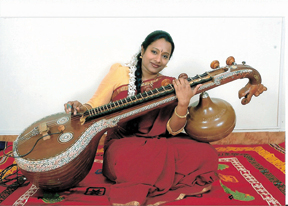
| The Saraswathi Veena The Veena is a (plucked) stringed instrument which consists of a large body hollowed out of a block of wood and a stem also made of wood. The veena has seven strings. Of them four are main strings that pass over the frets and are attached to the pegs of the neck. The other strings are used as side strings for rhythmic accompaniment. These strings pass over an arched bridge made of brass. They lie flat over the top of the body and are secured to the main bridge. All this is on the resonator side of the veena simply known as the large gourd. |
| A gourd (which is smaller than the resonator) is placed on the other end to support the veena .The veena is played by sitting cross-legged up on the floor. The small gourd rests on the left thigh while the left arm passes round the stem so that the fingers rest easily upon the frets. The main body of the instrument with the larger gourd (resonator) is placed on the ground. There are different varieties of veena. Some of them are Mahanatakaveena, Saraswativeena, Rudraveena, Vichitraveena etc. Saraswativeena is known as the queen of all veenas. -- NirmalaRajasekar |
| Nirmala Rajasekar is one of the country's acclaimed veena performers whose stage is the world's great performance halls. In Madison, she performed last spring with local and national artists at MCCA. |
 |