| Unclaimed rights to education |
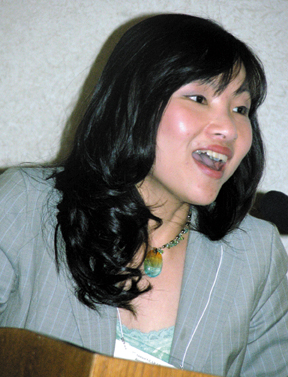
| By Dang Chonwerawong, Associate Director for the TRIO Student Support Services Program at UW-Madison (Abridged speech delivered at the GEAR UP-Early Identification Program (EIP)'s 7th annual recognition banquet on May 23 at the Lowell Center) |
| First, I would like to congratulate all of the students for finishing another school year and to the graduates for their success. I also I want to thank the Department of Public Instruction-Gear Up program for the honor of being one of their speakers today. Given the theme of today's reception, I decided to title my speech "Unclaimed rights to education." Let me tell you about educational opportunities in Thailand, my native country, where access to rights depends upon your wealth and status in society. Public education in Thailand only goes from 1st to 6th grade. In order to access higher education, parents have to pay for their children's high school tuition. It is common knowledge there that private schools are able to provide better college preparation than public schools. In order to enroll in our public university system, where the government subsidizes most of the cost, all high school graduates have to compete by taking national college entrance exams. Only a handful of students get selected and most of those students come from middle to upper class families whose parents can afford to send their children to competitive private high schools. To access some really good government schools often requires personal connections and bribery. It is common in Thailand for parents in the rural areas to leave their children behind while they go to the city to seek better job opportunities since this is the only way they can provide for their families. Last year when I returned home, I learned that one of the workers at my parents' house has not seen her two children for a year because she could not afford to pay for both her trip and her children's living expenses. I often heard about children from low-income families taking turns going to school because families could only afford to buy one uniform. I am sure that most of these people would like to have equal opportunities to obtain a good education in order to gain access to better paying jobs. However, democracy often only applies to those with money, power, and connections to the right people. As you can imagine, without those key ingredients, children from low-income backgrounds in Thailand have a little chance of bettering their lives. I gave you these examples to remind you of the privilege we all have here in America. Even though opportunities are far from equal, we are still in a better position than many other places in the world. We have free public education, and government aid to assist parents and students through programs such as Upward Bound, Head Start, Gear Up, and TRIO. While the system still does not provide equal access to the American dream, evidence of those who prevailed are more common here than possibly any other place in the world. In addition, there are people like Laurie, Gia, my colleagues at TRIO, and myself who work hard to challenge the system and to provide all of you with the necessary tools so that you can exercise your rights to an education. Have you done your best to exercise and protect those rights? Did you listen to your parents' words of advice? Are you attending classes regularly? Are you taking as many college preparation classes as possible? Do you sign up for workshops and events offered by the Gear Up programs? If you are already doing those things, I congratulate you. However, let me tell you why you and all of us need to do more. I want to share with you some local and national statistics to illustrate the larger picture of what is going on in American education. First, let's look at some local statistics. According to the UW System's report, the median family income of UW-Madison students in 2004 was $72,000. Less than 7% of students attending the university are from low-income families. The university only enrolls 20% first-generation college students. Even though there are 40% students of color in the Madison Metropolitan School District, the UW's students of color population has consistently been around 10%. The six-year graduation rate of targeted minority students at Madison is about 55%, while the graduation rate of other students is at 80% (UW-Madison Office of Academic Planning and Analysis). Now, the picture becomes clearer about who actively exercise their rights to be at this public university. Nationally, there are more minority students (36% compared to 25%) enrolled in 2-year institutions than 4-year institutions (U.S. Department of Education, fall 2002 survey). A National Education Longitudinal Study of 1992 high school graduates found that only 21% of first generation college students attended 4-year institutions compared to 65% of students of whom their parents received at least a bachelor's degree. Furthermore, according to the U.S. Department of Education National Center for Educational Statistics, the fall 2002 enrollment of all degree-granting institutions in the U.S. were comprised of 6% Asian, 12% Black, and 10% Hispanic. Nationally, while the college completion rate of White students of the 1997 freshman cohort was 60%, only 41% of Black and 47% of Hispanic students completed college (U.S. Department of Education National Center of Statistics). I could give you many examples of how students of color are missing out on higher education, but I am sure that you get the picture now. Why aren't we as first-generation college students, students of color, or low-income students pursuing our education? Why are we missing from the statistics? It is important that we, fortunate citizens of this country, actively exercise the rights that were given to us and participate in the making and changing of our society. As you can see from my examples, there are millions of children in the world who would do anything to be in your shoes. You can exercise your rights to your future by utilizing the resources available to you to the fullest; claim your place at a prestigious college or university such as the University of Wisconsin, and work together to change those statistics, and pave the way for others. I want to thank you for your time and attention. I look forward to working with you as freshmen in UW-Madison. Like Gear Up, TRIO is a federally funded program to assist students from low-income families, first generation college students, and students with disabilities. |
 |
 |