| Part 1 of 2 By Bophia So |
| to make them happy, even though they didn't have other luxuries found in America. They lived in a land where Americans dream of going for vacation. A land where you could relax under the sun, count stars at night. and drink fresh coconut milk in a hammock. In 1975, the year that I was born, this peaceful place became a nightmare when the Communists took over Cambodia. Their mission was to wipe out the intellectuals and rebuild the country, so that they could put a new government in place. The people in the city were forced to evacuate their homes and to work in the fields, later known as the "Killing Fields." Innocent, highly-educated, wealthy, and famous Cambodians were brutally killed. Most people in the capital city of Phnom Penh were labeled as second-class citizens, many of whom later died through starvation, disease, or execution. Those who were not executed fled the city and disguised themselves as peasants. My family members were not executed because they were classified as peasants. Eventually, we were separated. I stayed with my dad because I was the youngest. My older sisters stayed with my mom. My dad was assigned to work in the garden planting corn, yam, and other vegetables for the "community." My mom and older sisters were assigned to work in the rice fields. I could still remember everything that had happened, although I was only four. It is like a nightmare which continues to haunt me to this day. I remember the ringing of a bell; that's when the women (including myself), dressed in black, were served rice soup with a few kernels of corn. We were fortunate to have soup, fish paste, and rice. When an opportunity arose, my family ran toward the border of Thailand. I saw an abandoned broken-down white building with a huge clock. I asked my dad, "Why don't we stop and live here? I am tired." My dad responded, "We can't stay here. We have to keep moving fast." Out of nowhere, my mom and my older sisters united with us. I was puzzled. I did not know that I had older sisters and a mother. We fetched our belongings and continued our journey. Along the way, my dad fed me expired rice and grilled fish paste in a banana leave. We were lucky to have fish paste for meal, while other people had salt and rice for meal. |
| In the woods, close to Thai border, a group of armed Vietnamese soldiers commanded us to go back to Cambodia. They said it was safe to go back. A man in our group told the soldiers that we would turn back after we rested. The soldiers agreed, and left. After they vanished, we fled again. Later, we ran into Thai soldiers. A woman, carrying a newborn, cried out, "We have to find a place to hide. They are going to kill us. Please, don't kill me, I don't want to die." She ran to hide under a huge broken tree. The Thai soldiers said that they would not kill us, but that they just wanted us to return to our own country. After the soldiers left, we moved quickly and quietly past a railroad to the Thai boarder. We camped at Kao-I-Dang in 1980, waiting to be sponsored. In 1981, my grandmother's cousin sponsored my family, so that we could go to San Diego. San Diego Community My parents and their six daughters stepped out of a Boeing 747 at the Los Angeles International Airport barefoot and cold. We had only a few belongings with us. The most important things my dad brought were seeds from a mustard plant, water spinach, and bitter melon. Valuable items such as gold and wedding memorabilia had been buried in Cambodia, so as to prevent identification during escape). Other family members were more fortunate. They received warm clothes and a place to stay. In San Diego, my family had to share a two-bedroom apartment with two other families. About two months later, we obtained our own two bedrooms near a Cambodian neighborhood. Within a few months, the Cambodian neighborhood grew larger. Seemingly overnight, San Diego became a city of diversity -- a world condensed in a small land. People of different nationalities from all over the world were present. People seemed to be clinging to their own cultures, while also trying to adapt to American culture. My family never adapted to American culture because they never wanted to leave Cambodia. Part 2 will discuss "Discrimination against Asians" and "The Challenge of Adapting to the American way of life." |
| Escape to the new world |
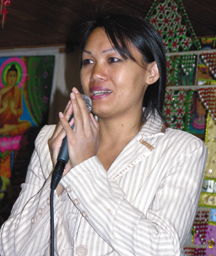 |
| I am a Cambodian American and I want to tell you about myself and bow I faced diversity in the new world. In Cambodia, my parents had their own land; their rice paddies provided enough food for immediate and extended family members for two years. They had farm animals, and they planted vegetables around their house. Most of their neighbors were relatives. They had everything |
 |